Change management is treated as the work that begins after the decision to change has been approved. That sequence is backwards. The discipline starts before rollout, when the organisation tests whether the decision to change was sound enough to deserve the resources it is about to consume.
Change management is how organisations move from how things work now to how they need to work next, without losing the people or the institutional knowledge that keep the operation running. The discipline exists because announcing a change and making it real are two different acts. People need to understand what is changing and why. They need the skills and support to work differently. And they need structures that hold the new way of working in place after the programme team has moved on.
Change management is the discipline of turning a chosen change into adopted action while keeping the assumptions behind that change visible, tested, and monitored from before rollout through implementation.
What is change management?
At its core, change management is a structured way to move an organisation from a current state to a desired future state. The "management" part is not project management. It is the work of preparing people, reshaping processes, and adjusting systems so that the change lands and holds. Without it, an organisation can announce a change and watch nothing happen, or watch adoption spike during the initiative and collapse the moment attention moves on.
The scope varies. It can mean moving a team to new software, restructuring a division, merging two companies, or shifting an operating model. What stays constant is the pattern: someone decides that something needs to change, and the organisation needs a method for making that change real in the behaviour and operations of the people who do the work.
Two questions define the practice. First: is the change itself sound enough to justify what it will demand from the people who carry it? Second: how do we support those people through the transition? Most of the discipline has focused on the second question. Roger Estall and I wrote Deciding because the first question matters just as much and gets asked far less often.
The change itself, before the programme wrapped around it, is worth defining on its own terms. I have set out what organizational change actually is and the three forms it takes, and the test that decides whether a given one has earned commitment.
How the change management process works
Most change management processes follow a recognisable sequence, even when the labels differ. The organisation assesses the change, prepares leadership, engages stakeholders, communicates, trains, manages resistance, and reinforces the new way of working.
Assessment comes first. What is changing, who is affected, how ready is the organisation, what are the risks of the transition itself? This stage produces the picture that every later stage draws on. For a digital transformation assessment, connect the first proposed investment to a service failure and its delivery dependencies before funding rollout.
Sponsorship follows. A change without an active sponsor, someone with enough authority to remove obstacles and enough credibility to hold attention, tends to stall once the initial energy fades. The sponsor does not need to do the work. The sponsor needs to be visibly committed to the outcome.
Communication and training overlap. Communication tells people what is changing, why, and what it means for them. Training gives them the knowledge and ability to work differently. Both are necessary. Neither is sufficient on its own. Telling people why a new system matters does not teach them how to use it. Teaching them how to use it does not answer why they should bother.
Reinforcement is what separates a change that lasts from a change that reverts. Recognition, measurement, accountability structures, feedback loops. Without reinforcement, the organisation defaults to the old way within months.
This is the standard process, and it works when the change being implemented is sound. The problem I describe below is that none of these steps tests whether it is.
A change communication plan gives managers a working record that carries the decision, tests whether its meaning survives the handover, and sends evidence back to the person who can pause the rollout.
Change management models worth knowing
Four models dominate the field. Each does something real. Understanding what each one actually does, rather than treating them as interchangeable labels, matters when deciding which to use and when.
ADKAR sequences individual adoption: awareness of the need for change, desire to participate, knowledge of how to change, ability to implement required skills and behaviours, reinforcement to sustain the change. It is useful because it diagnoses where an individual is stuck. If someone has awareness but no desire, more awareness will not help. If someone has desire but no knowledge, motivation is not the problem. ADKAR finds the bottleneck.
Kotter's eight steps build organisational momentum: create urgency, form a guiding coalition, develop a vision, communicate the vision, empower action, generate short-term wins, consolidate gains, anchor the change in culture. The model works because it addresses a real problem: organisations lose momentum. Urgency fades. Coalitions fracture. Short-term wins keep energy alive.
Lewin's three stages, unfreeze, change, refreeze, is the oldest and simplest. Unfreeze disrupts the current equilibrium. Change implements the new state. Refreeze stabilises it. The value is conceptual clarity: change cannot take hold until the existing equilibrium is disrupted, and disruption without restabilisation is chaos, not change.
Force field analysis, also from Lewin, maps the forces driving and restraining a change. Driving forces push toward the new state; restraining forces resist it. The tool is useful for identifying where energy is concentrated and where resistance is strongest.
I use all four of these in practice. They are genuine tools. But they share a common boundary: they help carry a change that has already been judged worth carrying. The question they leave unanswered is whether that judgment was sound. That boundary is where the most consequential failures occur.
A closer look at how change management frameworks fit after the diagnosis shows that the common ground matters more than the differences between models.
When the rollout is already fragile and the comparison itself has become the bottleneck, diagnosing the resistance pattern before selecting a model keeps the choice grounded in what the organisation is actually facing.
When resistance is already active, the cause determines the response. Mapping which change approach fits the resistance pattern before selecting a framework prevents the most common mismatch: applying an adoption model to a decision problem.
For the individual-adoption view, see ADKAR, but keep the boundary clear: it helps diagnose adoption bottlenecks after the upstream decision has earned the right to proceed.
A worked force field analysis example shows what happens when the strongest restraining force sits in governance rather than on the shop floor.
Once the map is drawn, the step most teams skip is deciding what to do with it. The guide to what to do after a force field analysis covers that conversion.
Write down the assumptions your change initiative rests on before the resistance names them for you. Start the Walk →
Why change efforts fail
A large proportion of change efforts do not deliver what they set out to deliver. Some failures are execution failures. Communication was unclear, training was inadequate, sponsorship dropped off, resistance was ignored or mishandled. These are real and common, and the models described above were built to address them.
But a second category of failure has nothing to do with execution quality. The change itself was not sound. The assumptions behind it were untested, invisible, or politically protected. The organisation executed the rollout competently and adopted a change that should not have been made, or that should have been made differently, or that rested on conditions that had already shifted by the time implementation began.
A governance structure that separates the decision from its implementation creates exactly this blind spot. The board decides; the programme delivers. Nobody owns the question in between: is the decision still sound enough to deserve what we are about to spend on making it real?
I have seen organisations adopt the visible architecture of a change programme while actual decision quality stays flat. Organisational alignment breaks down in exactly these cases. They invest in communications plans, sponsor networks, training calendars. They do everything the change management literature recommends. And the decisions underneath that architecture remain unexamined. The organisation looks like it is managing change. What it is actually doing is managing the appearance of change management while the decision that matters goes untested.
That is where organizational change management needs a hard boundary. It can prepare people, support managers, and read adoption signals, but it cannot rescue a decision whose readiness evidence has already broken.
The real question is whether the people who must act on the decision can demonstrate they understand the assumptions it rests on. That is what a genuine change readiness assessment ought to measure: not comfort levels or sentiment scores, but whether the team has tested the decision underneath the change.
A cultural assessment built on survey responses and declared values inherits the same gap. The profile looks like data, but it has not tested whether those values hold when budgets tighten or a merger forces two operating cultures into the same reporting line.
The question every framework skips
The conventional taxi industry shows what happens when no one asks it. Uber did not outcompete taxis on service quality or price alone. It arrived because smartphone ubiquity and mobile payments converged with accumulated passenger frustration. The taxi industry had every opportunity to read that convergence. It did not. By the time incumbents recognised they needed organisational change, the assumptions underneath their operating model had already collapsed. No amount of change management could rescue a decision that should have been made three years earlier.
The question the industry skipped was not "how do we manage the change?" It was "what is changing around us, and do we need to change before someone else changes things for us?"
Every framework described above begins after leadership has committed to a change. The programme office inherits that commitment as a given. Its job is to execute, not to question whether the change deserves execution. If the original decision was weak, the programme office will produce immaculate Gantt charts for a change that should never have left the boardroom.
Roger and I distinguish between primary elements and secondary elements of any decision. The primary element is the change itself: what will actually be different. Training, communication, and sponsorship are secondary elements. They support the primary change. They should never be mistaken for proof that the primary change is sound. The secondary elements are visible and measurable. You can track training completion rates, count communications sent, map stakeholder engagement scores. None of these metrics tell you whether the primary change is sound. They tell you the organisation is busy. Busy and sound are different things. Before an integration milestone removes an existing arrangement, the follow-up to integration planning tests whether responsibility can pass while the day-one service continues.
The test is simple: can you state the primary change in one sentence, and can you name the assumptions it rests on? If the programme team cannot do that without reaching for the plan document, the plan has become a substitute for judgment, not a product of it. Organisational governance should insist on that test before any secondary element receives budget.
That test is the subject of a separate piece on why change is usually mobilised before it is justified.
What to test before you mobilise people
Organisations preparing for change analyse stakeholder readiness and training needs, often scoring them in a change management risk assessment. They do not ask whether the change itself rests on assumptions that have been tested against the context it will land in. It is the Holmes and Watson problem: Watson analyses the astronomy and the theology while Holmes points out that somebody has stolen the tent. Elegant analysis of everything except the one fact that matters.
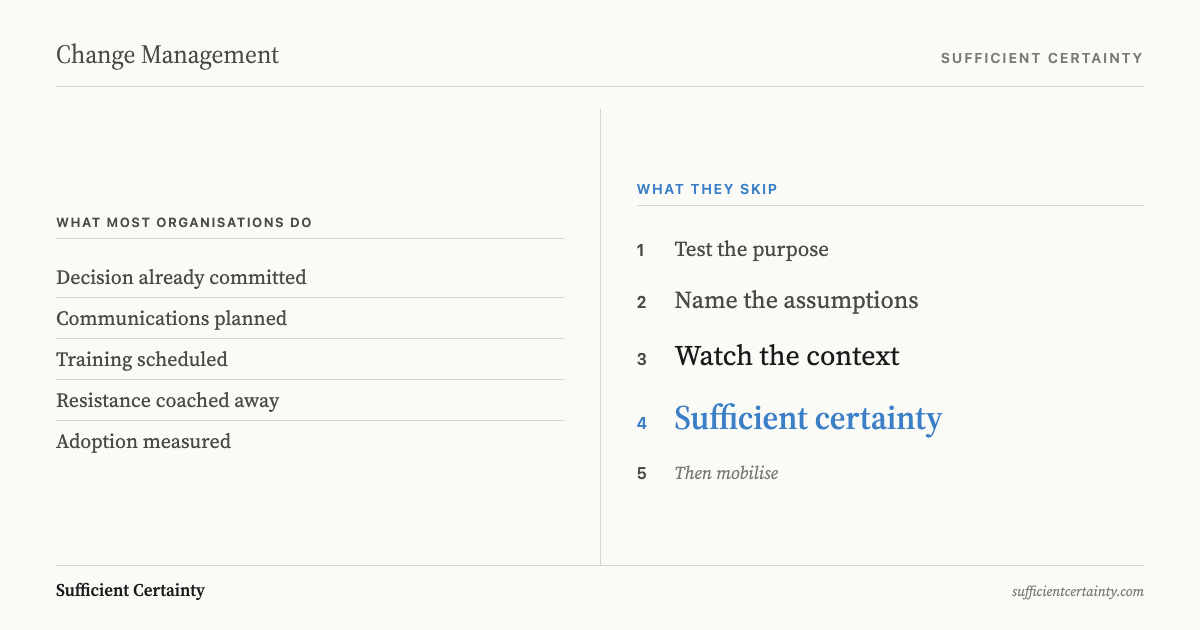
The method tests five things before anyone is mobilised. Purpose: does the change serve what the organisation exists to do? Opportunity: is the window real, and will it remain open for the duration of implementation? Desired outcome: can you state success in terms that are observable, not aspirational? Duration: how long will this change take to embed, and what could shift in that time? Context: what external and internal conditions is the change assuming will hold steady? The questions themselves are simple. What makes them powerful is that nobody asks them before committing budget.
The context question is the one I find most neglected. A simple template forces the decision-maker to name the conditions they are relying on. If you cannot list them, you cannot watch for their absence. And if you cannot watch for their absence, you will discover the change has failed only after it has become expensive to reverse. A design sprint verdict hides its conditions the same way, which is why the work after a design sprint starts by writing them down.
If the answers reveal that the change rests on assumptions you cannot defend, you have not failed at change management. You have succeeded at judgment. You have caught the problem before it became expensive. Stakeholder alignment and stakeholder buy-in become tractable when the people being asked to change can see that the decision was examined before it reached them. People navigating organisational change can disagree with a decision and still align behind it if they can see the reasoning was sound. Alignment is not agreement. It is the shared understanding that the decision was made with visible assumptions and sufficient certainty.
Resistance is signal, not sabotage
Resistance to change is often late-arriving evidence that a key assumption was weak, hidden, or politically protected. The standard change management framework treats it as a people problem: identify the resistors and bring them on board. That framing assumes the change is correct and the people are the obstacle.
Consider a plant manager who pushes back on a new production system. She is not afraid of change. She is the only person in the room who knows that the system assumes a supply chain reliability that does not exist on her floor. Her resistance is data. If the change programme treats it as a coaching opportunity rather than an assumption to be tested, the programme is actively suppressing the information it most needs.
The same pattern plays out at every level. Engineers who raise concerns about timeline assumptions get labelled as not bought in. Sales teams who question a new CRM rollout get sent to more training. Middle managers who flag that the reorganisation assumes a collaboration pattern that does not exist get told to be change agents. In each case, the organisation is treating knowledge as a behaviour problem and attempting to coach away evidence it should be collecting.
Step three of the method, Recognise assumptions, is designed to surface exactly the kind of knowledge that resistance to change often carries. If you do that work before mobilisation, the obvious objections have already been addressed. If resistance still appears after the assumptions have been tested, it tells you something new has entered the picture. Either way, it is signal. Managing disagreement in teams means building a structure where that signal reaches the people who can act on it, not a structure where it gets labelled as a readiness deficit and handed to HR.
The diagnostic value of that signal depends on separating it into dimensions. Resistance to change carries three independent dimensions, each pointing at a different weakness in the decision or its implementation.
How to monitor change after rollout
When a change fails after rollout, I want to know which of four things happened. Was the original decision defective: did the assumptions fail from the start? Did the implementation drift from what was decided? Did the supporting elements malfunction: training inadequate, communication garbled? Or did the wider context shift in a way that made a previously sound decision unsound?
Each of these demands a different response. Lumping them into "lessons learned" produces nothing actionable.
The fourth type is the one that catches organisations off guard. A building stands for years. Then a neighbouring site begins excavation, the water table shifts, and the foundations that were perfectly sound when the building was constructed become unstable. Nothing about the original decision was wrong. The context changed after implementation.
Post-implementation reviews rarely catch this because they look backwards at execution quality, not outwards at shifting context. A change management plan that does not include ongoing context monitoring is a plan that assumes the world will hold still while you implement. The world does not hold still, especially when the operation must keep running while the change is introduced.
Monitoring has no value unless its results reach someone competent and authorised to act. We cannot wait for the auditors to pick problems up once a year; we need to know within minutes, hours, or days.
Day-to-day monitoring belongs with line management, not with periodic auditors who arrive after the damage is done. The five steps end with Design monitoring because the assumptions you identified before the decision do not become facts after the decision is made. They remain assumptions. They need watching. The people doing the watching need to be the people closest to the work, not the people furthest from it.
The change management plan itself needs the same discipline. A plan anchored to untested assumptions will schedule training, assign sponsors, and track adoption without ever checking whether the decision behind the change was sound.
That is where transition management matters. The handover after approval still needs authority to reopen the decision when reality moves.
You can launch the change, or test whether the change itself deserves to go live.
Work through your decisionNo sign-up. Just pick your decision and start.
Grant Purdy is the co-author, with Roger Estall, of Deciding (2020), and the architect of the Universal Decision-Making Method.