
Stakeholder buy-in breaks down the moment the room discovers that nobody stated the assumption the decision depends on. Finance signed off, the readiness pack was clean, and the committee nodded. Then the first hard question arrived and nobody could explain the reasoning behind the commitment they had all approved.
I have seen programs approved by a steering committee. Finance had signed. The readiness pack was cheerful. Canada managed the same trick at national scale with Phoenix: the payroll system touched about 290,000 public servants, yet by July 2017 more than 80,000 were not paid correctly and the clean-up had already burned another CAD 228 million. That is stakeholder buy in from people who still could not tell you what payday would look like when the exceptions hit.
The dangerous part is polite assent from people who still cannot tell you what the decision assumes, or what change would drag the matter back onto the table. Once that happens, the organisation is performing confidence for itself.
Stakeholder buy-in is visible support for a decision from the people whose backing or work the decision requires.
Stakeholder buy in measures support, not understanding
Stakeholder buy in only earns its keep when the people backing the decision understand the work it creates. In the Phoenix report, Canada's Auditor General called the rollout an “incomprehensible failure of project management and oversight”. Sponsors were abundant, understanding was not, and nobody could say who was actually ready or how the exception traffic would be handled once pay broke. A lot of what passes for organizational alignment is this, a launch date protected by polite language.
I like the I-STEM paper because it says the quiet part aloud. People close to the work improve decisions by surfacing local constraints and ugly facts. They tell you which part of the plan is fantasy. In my experience, the earlier they do that, the cheaper the lesson.
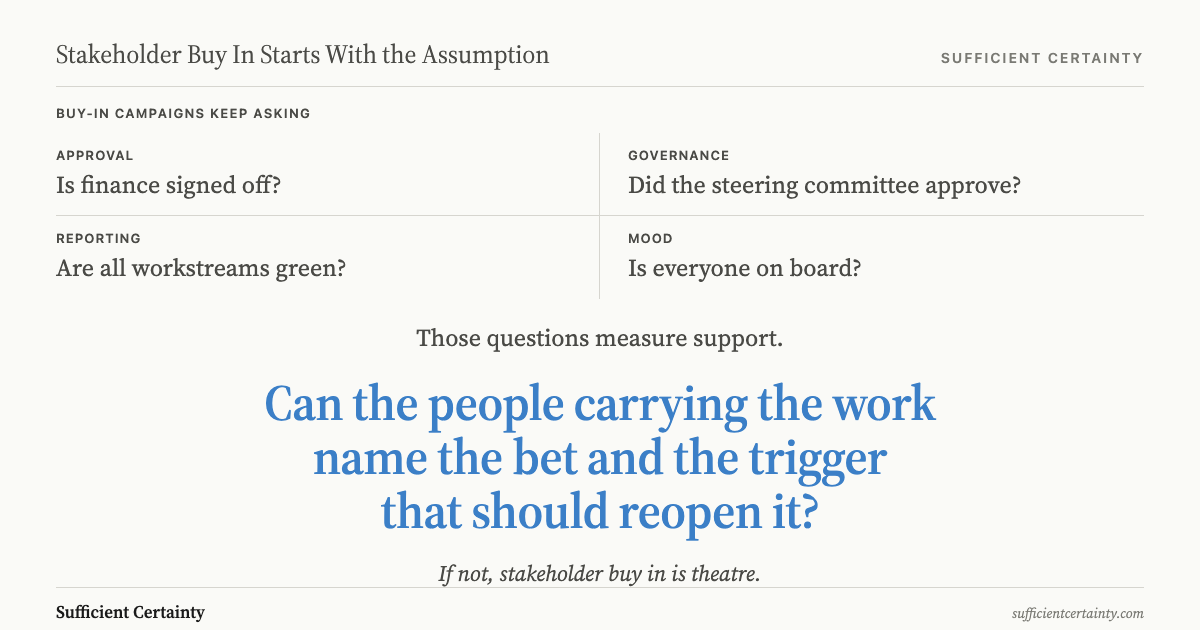
When buy-in becomes the goal, awkward questions get filed as obstruction. If the payroll team says the exception path is unclear, the decision just improved. If you train the room to nod instead, you have bought silence and called it consensus.
I have sat in too many meetings where every workstream was marked green because nobody wanted to be the person who moved the date. That arrangement has beneficiaries. The sponsor keeps the milestone and the people doing the work inherit the failure on Monday morning.
Take the approval you are chasing and test which hidden assumption would make stakeholder support collapse. Start the Walk →
Stakeholder buy in collapses when assumptions stay hidden
It collapses the moment the real operating assumption stays buried under the sales story. The House committee's 737 MAX report gives a brutal example. Two crashes killed 346 people. Pilots moving from the 737 NG to the MAX were expected to need 16 hours or less of computer-based training, and Southwest had negotiated a $1 million per-aircraft rebate if simulator training became necessary.
Boeing got the sales story, Southwest got the training bargain, pilots got the exposure. The bet was that minimal training would still be enough when the failure arrived at cockpit speed. That bet travelled downward as commercial convenience and upward as certification comfort. It did not travel as plain safety truth to the people who had seconds to deal with it.
In my experience, requests for more support usually mean the plan still cannot survive daylight. The way to get leadership behind a decision is to name what it assumes, not to polish the argument. When the room can rescue a proposal only by relabelling objections as attitude problems, the proposal was already rotten. That is usually where trouble in managing disagreement in teams really starts.
Formal approval cannot rescue a system people do not understand
Formal approval is useless once the people using the system cannot work safely with it. The GAO review of the VA's new electronic health record says the rollout had reached six medical centres at a cost of about $12.7 billion, while an Institute for Defense Analyses estimate put the life-cycle cost at $49.8 billion. In the user feedback GAO reviewed, 60 of 71 respondents disagreed that training was effective and 58 of 71 said patient-safety risks had increased.
This is why I have no patience for the buy-in industry. Sponsors can protect the date and consultants can invoice the workshop, but neither has to enter the medication order when the system behaves strangely. Clinicians needed a system they could understand, training that matched the work, and a fast route for safety concerns to reopen the decision. Without that, program approval is just expensive theatre.
Notice how the machinery keeps its dignity in these failures: the steering group still meets and the users still carry the danger. Buy-in language is popular because it lets the apparatus look healthy while the real understanding has already drained out of the room.
The same move appears in ordinary teams. The person treated as difficult is often the last person still describing the work honestly.
What I ask for instead of a buy-in campaign
I do not ask whether people are on board. Roger Estall and I wrote in Deciding because too many organisations mistake support for understanding. The Universal Decision-Making Method keeps me on two questions: what is this decision betting on, and what fact would make a sensible Decider pull it back before launch? If the people who must carry the work cannot answer both in plain English, I do not care how many approvals you have.
I usually test this with two people from different parts of the organisation. I ask each, separately, what the decision is relying on and what change would make them stop and reopen it. If I get two different answers, support is cosmetic. If I get shrugs, the room never understood the call.
I would rather send the decision back before launch than discover, after go-live, that everybody had merely backed the sales story. If the organisation is using ADKAR, the same question still sits at the heart of change management: did the people carrying the change understand the bet, or were they told to get on board? I cover the broader version in my guide to stakeholder alignment.
Stakeholder buy in is an after-effect of clear reasoning, not proof that the reasoning was good. Where people understand the bet and the trigger, support usually shows up without much theatre. Where they do not, the campaign for support becomes part of the damage.
You could run the next buy-in campaign and still leave the assumption untested.
Work through your decisionNo sign-up. Just pick your decision and start.
Grant Purdy is the co-author, with Roger Estall, of Deciding (2020), and the architect of the Universal Decision-Making Method.