
Data paralysis is not caused by too much data. It is caused by data that has no decision attached to it. When a team collects information without first stating what the decision requires, every new dataset feels relevant and none of it feels sufficient. Frame the decision before requesting the evidence.
Data paralysis is not caused by too much data. It is caused by data that has no decision attached to it. When a team collects information without first stating what the decision requires, every new dataset feels relevant and none of it feels sufficient. The fix is framing the decision before requesting the evidence.
In boardrooms I have watched the same little ceremony: a sales dashboard glowing on one screen, a forecast model on another, and a thick appendix nobody will read before the biscuits go stale. The executives are then told to be more data-driven, as if piety were a method. Salesforce's 2024 survey of 552 U.S. business decision-makers found that 76% felt pressure to back up arguments with data, yet confidence in data accuracy had fallen 27% in a year. That is data paralysis.
Roger Estall and I wrote Deciding because serious decisions need evidence, not decoration. My quarrel is with the small transfer of authority that happens when a table of numbers enters the room and every Decider suddenly becomes deferential. I have watched people quote a number as though it had walked into the meeting wearing a judge's wig. The number may be useful; the bowing is the problem. Data carries assumptions about what was measured and whether yesterday still resembles tomorrow. Leave those assumptions unspoken and the dashboard becomes theatre, usually theatre with a recurring licence fee. I described how that transfer plays out at board level in business decision analytics under uncertainty.
Data paralysis is a condition in which growing volumes of information make commitment harder because the evidence remains unframed or incomplete.
Why data paralysis is getting worse
The Salesforce numbers matter because they describe a condition I now see almost everywhere. People are being asked to produce more evidence while trusting the evidence less. I have heard boards use data-driven as a moral compliment. Once that phrase has status, the useful question feels impolite: does this data mean what we are pretending it means? Nobody is paid to ask that in minute eight of a dashboard review. That is why the machinery survives. The same survey found that 54% were not fully confident handling the data on their own. The shortage is judgment about which information can carry the decision. The same missing judgment drives choice overload, where criteria multiply faster than anyone can say which difference matters.
I have watched the same thing happen with the risk register. Once a document acquires status, people keep feeding it because not feeding it looks careless. The data industry has borrowed that machine. It sells apparatus that looks serious and still leaves the Decider asking the one question nobody answered: do we know enough to act?
Google Flu was data analysis paralysis in miniature
Google Flu Trends was hailed as a triumph of big data. It used search queries to estimate influenza prevalence in real time. Then reality interfered. In their 2014 paper in Science, David Lazer and his co-authors showed that at the peak of the 2012-2013 flu season Google Flu overestimated prevalence by more than 100%. From August 2011 to September 2013 it overestimated flu prevalence in 100 of 108 weeks. Simpler models using CDC data and ordinary seasonal patterns did better.
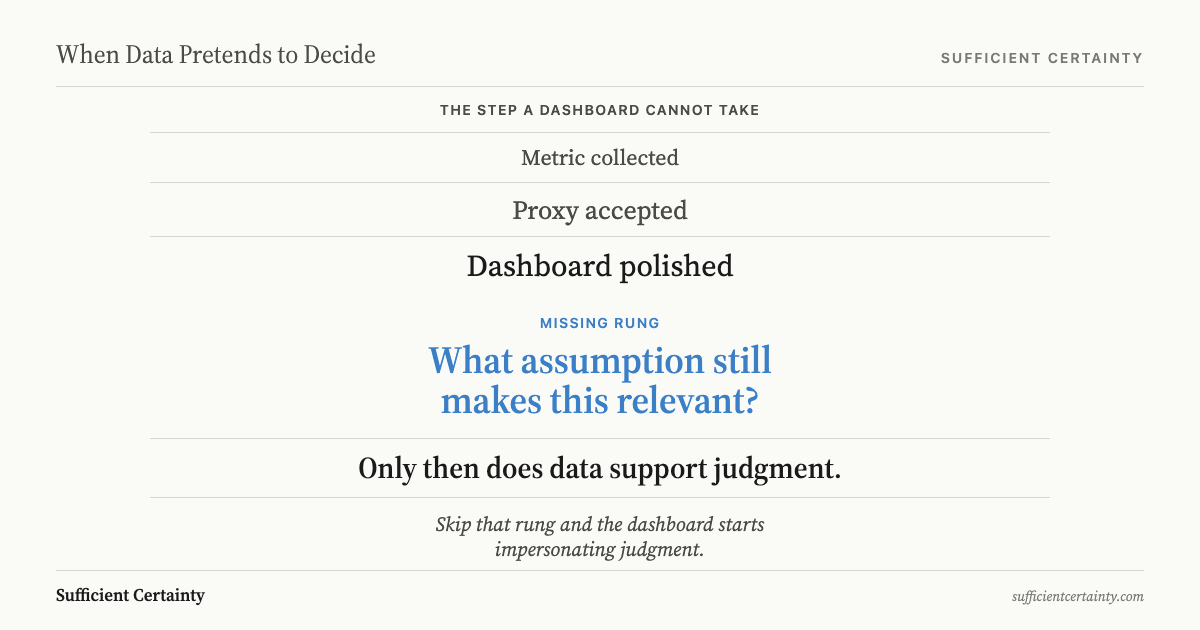
Google Flu failed because it treated search behaviour as a stable proxy for illness after media coverage had changed the behaviour being measured. The model's neat precision became decoration. In the Universal Decision-Making Method, Recognise assumptions would have forced one question to the surface early: what assumptions make this data relevant to this decision right now? If you cannot answer that, you do not have enough to act, however elegant the output looks.
Pin one dashboard-driven choice to the page and decide what the data still cannot settle for you. Start the Walk →
Zillow had the data and still did not know enough
Zillow is a useful case because nobody can claim it was short of transaction data. The company had years of price history and a model built to turn that into home-buying decisions at scale. Then the market refused to behave like the spreadsheet. In its third-quarter 2021 results, Zillow said that "the unpredictability in forecasting home prices far exceeds what we anticipated." It booked an inventory write-down of about $304 million. A model that loses that much money is short of a tested assumption.
This is what I mean when I say data can impersonate judgment. A pricing model can estimate a house value. It cannot decide whether the business's assumptions still hold. I have seen the same pattern in analysis paralysis in business, where committees demand fresh numbers because that is safer than admitting the question has changed. Once the assumption weakens, more output from the model will not rescue you. You chase the one fact that matters, or you change the decision before the market changes it for you.
Robodebt turned data into administrative theatre
Robodebt is the ugliest example here because the victims were ordinary citizens, not spreadsheet cells in a property model. The scheme used averaged Australian Taxation Office income data to infer fortnightly earnings and then raised debts against welfare recipients. The Australian government's 2023 response to the Royal Commission called it a "costly failure of public administration" that harmed more than 500,000 Australians. Services Australia's 2023-24 annual report says that, by 30 June 2024, more than $749.7 million had been repaid.
That mess began with one assumption: that annual income averages could stand in for the specific earnings needed to establish a lawful fortnightly debt. A serious decision process would have exposed that at once. Any data driven decision making framework that begins by asking what the decision actually needs would have forced that question before the first letter was printed. Are we sufficiently certain this method can support the claim we are about to make against a person? If the answer is no, you stop. You do not send the letters and call the process rigorous.
The exit from data paralysis is a stopping rule
Roger Estall and I built the Universal Decision-Making Method for the ugly point where a Decider has to say what would count as enough. At that point, a request for more data is too vague to be useful. I ask which assumption the data is meant to test and what evidence would actually change the decision; if it cannot do that, it is scenery, sometimes expensive scenery.
The same stopping rule applies when dashboards have become the hiding place; I described the general loop in how to overcome analysis paralysis, but data needs its own blunt question. Data paralysis survives where display is mistaken for decision support, because display protects everyone except the Decider whose name is on the choice. Ask what the data is assuming before you ask for more of it.
You could open another dashboard and still leave the room without a decision.
Work through your decisionNo sign-up. Just pick your decision and start.
Grant Purdy is the co-author, with Roger Estall, of Deciding (2020), and the architect of the Universal Decision-Making Method.