
Competing priorities are a decision you have not made yet. The conflict persists because nobody names the losing option. Once someone states which commitment gives way and on what assumption, the six urgent items sharing one budget become one decision with a visible trade-off.
An operations director I worked with opened her Monday to six escalation emails, each from a different division, each marked urgent, each attaching a business case she could not fault. Six competing priorities sharing one budget. She spent Monday afternoon in the project tracker, rearranging the priority sequence. By Wednesday the same six items sat in the same queue, still unresolved, and the rearrangement was not a decision.
I have watched this pattern in manufacturing plants, hospital boards, and programme offices across four decades. When two objectives need more resources than the organisation has, someone reorganises the queue. The queue changes, but the conflict does not, because the conflict is information the organisation is refusing to act on: you have more commitments than capacity, and at least one of them must lose.
Competing priorities are objectives that cannot all receive the resources they require because a choice between them has been deferred and nobody has named which one must yield.
Why competing priorities outlast every planning session
Michael Porter put it plainly in his most cited strategy paper: "The essence of strategy is choosing what not to do." He was writing about competitive strategy, but the observation applies with equal force inside an organisation trying to allocate a fixed budget across divisions that each have a legitimate claim. Trade-offs arise because activities are incompatible: more resources for one objective means fewer for another. When leadership refuses to make the trade-off, the priorities coexist on the strategic plan and compete for the same resources in practice.
The choice gets made anyway, by whoever controls the budget line or moves fastest, without reference to the organisation's stated purpose. I find this reliably comforting for the people involved, because nobody in that Monday meeting loses their job for failing to decide; somebody loses their job for being the one who said which project dies.
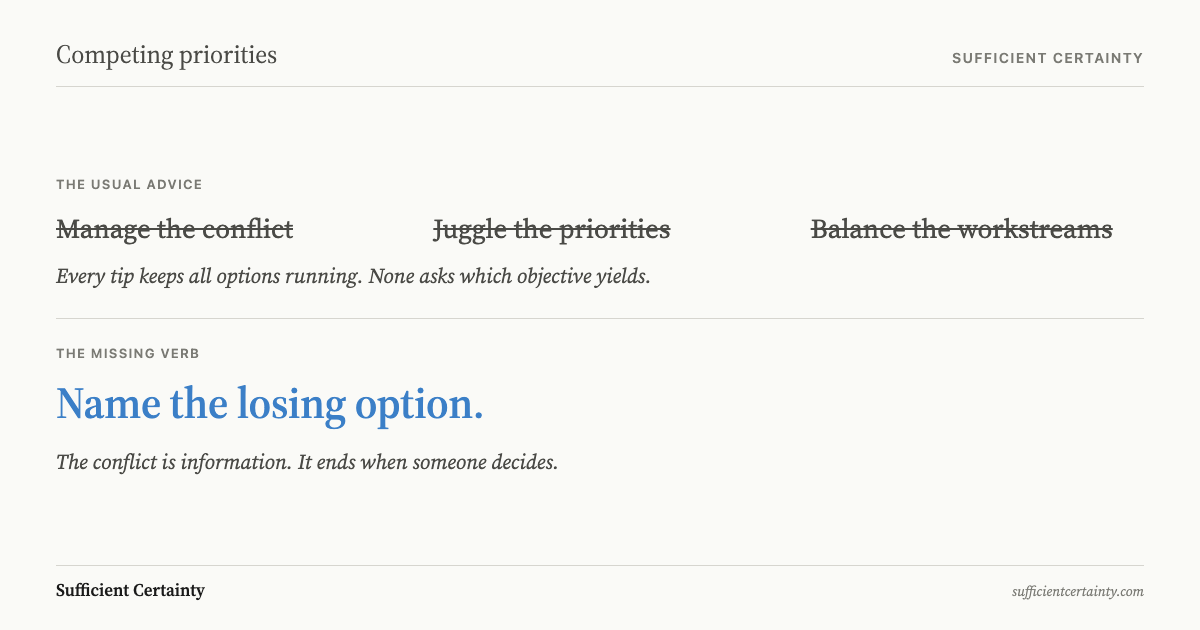
Porter identified the reason the refusal persists. Managers fear trade-offs because naming the losing option means accepting accountability for the loss. The preference is to maintain the appearance that all objectives can be pursued simultaneously. That preference is what the entire advice industry reinforces. Search "competing priorities" and every result on the first page promises tips for managing the conflict, strategies for juggling, frameworks for balancing. The assumption beneath every result is that all priorities remain valid and the answer is better organisation. The missing verb is "decide."
A hospital trust that treated every target as a priority
Between 2005 and 2009, Stafford Hospital in the English Midlands pursued foundation-trust status while patient safety deteriorated around it. The Trust treated access targets, financial balance, and regulatory accreditation as simultaneous priorities and allocated resources accordingly. Nobody stated which priority would yield if the others came under pressure. Patient care lost by default, because it was the only objective without a measurable target and an external body watching the numbers.
The Francis Report, published in February 2013, documented the consequences. The Hospital Standardised Mortality Ratio reached 127 to 145 against an expected baseline of 100. Robert Francis QC concluded that the failures were "in part a consequence of allowing a focus on reaching national access targets, achieving financial balance and seeking foundation trust status at the cost of delivering acceptable standards of care." I have never read a cleaner verdict on competing priorities: every target the Trust pursued was individually reasonable, and the combination was lethal because nobody said which one could wait.
Had the Trust begun with what the Universal Decision-Making Method calls Frame the decision, the question would have been stated before any target was set: what is our purpose, and what outcome do we need? The tension between access targets and care quality would have surfaced as a testable assumption: we assume we can meet waiting-time targets without additional clinical resources. That assumption was never articulated, never examined, and never monitored, and it failed silently over four years while hundreds of patients died.
Name the objective on your Monday list that cannot receive full funding this quarter and decide what happens to it. Start the Walk →
What a conglomerate's breakup reveals about the cost of not choosing
In 2000, General Electric was the most valuable company on Earth, with a market capitalisation exceeding $600 billion. Under Jeff Immelt, CEO from 2001 to 2017, GE tried to compete simultaneously in aviation, financial services, and healthcare while also investing heavily in digital platforms. Each division had a legitimate strategic case, and the conglomerate structure allowed leadership to avoid choosing between them because portfolio theory said diversification was the strategy. I distrust that word, "diversification," whenever it appears in a sentence that should contain the word "choose." It lets a leadership team keep its options open, which is a polite way of saying it lets them keep their jobs longer than a leader who commits to one bet and owns the downside.
The $10 billion acquisition of Alstom's power division produced a $22 billion write-off. GE lost more than 80 per cent of its value by 2018 and was removed from the Dow Jones Industrial Average. Larry Culp finally made the decision no predecessor would: break GE into three independent companies, completed in April 2024, after the company had reduced more than $100 billion in debt. For two decades, parallel commitments across unrelated industries were treated as a portfolio strategy. The breakup was the admission that the strategy had been a refusal to choose.
Continental Airlines ran the same pattern at a smaller scale. In 1993 it launched "Continental Lite" to compete with Southwest Airlines on short-haul, low-fare routes while maintaining its full-service hub-and-spoke operations. The two business models competed for the same fleet, the same gates, and the same management attention. Porter calls this straddling: attempting to match a competitor's position without giving up your own. Continental Lite lost more than $300 million in eighteen months and was shut down. The airline treated "compete with Southwest" and "maintain full-service operations" as coexisting priorities, but they were alternative decisions requiring incompatible operating systems, and the $300 million was the price tag on two years of not choosing.
I have watched the same vocabulary do the same job in smaller rooms: "portfolio strategy" at GE, "market expansion" at Continental, "we're pursuing both" in a Monday tracker meeting. Each phrase postpones the moment at which someone would have to say "this objective loses." The longer that moment was postponed, the more expensive the resolution became. Not a virtuous circle, certainly a lucrative one for everyone whose fee depends on keeping all the plates spinning.
How to end competing priorities instead of managing them
The operations director who rearranges her project tracker each Monday is not failing at scheduling, delegation, or stakeholder communication. She is applying scheduling solutions to a conflict that scheduling cannot touch: each of her six objectives needs more resources than the organisation can provide. To resolve the conflict, the starting point must change: treat the priorities not as parallel workstreams requiring better coordination but as alternative options in a single decision that has not yet been made.
The Universal Decision-Making Method provides the structure for that decision. The first step is to Frame the decision by stating the purpose and the desired outcome. "How do I manage six urgent items?" is not a framed decision. "Which three of these six objectives will receive full funding this quarter, and what happens to the others?" is.
The second step, Develop options, treats each objective as a distinct option rather than a parallel workstream, and forces in the staffing, monitoring, and contingency that a prioritisation matrix usually leaves out of the calculation.
The third step recognises the assumptions, and the critical assumption behind every such conflict is always the same: we can pursue all of them simultaneously without any of them failing. State that assumption plainly, and test whether it has ever survived contact with a budget already two-thirds committed.
The test is whether you have sufficient certainty that the chosen set of objectives will deliver the desired outcome given the resources available. If you do not, you can seek more information, modify the option, or choose a different set. What you cannot do is keep all options running and wait for circumstances to decide which one fails, because circumstances rarely choose the option you could most afford to lose.
Roger Estall and I wrote in Deciding that monitoring must be specified at the point of decision, because that is when the Decider has the greatest awareness of the assumptions the decision depends on. An organisation that selects three objectives out of six and monitors the assumptions behind each one has made a decision it can defend. An organisation that runs all six and waits has bought itself a write-off it cannot explain.
You could rearrange the tracker again and still leave all six items unfunded.
Work through your decisionNo sign-up. Just pick your decision and start.
Grant Purdy is the co-author, with Roger Estall, of Deciding (2020), and the architect of the Universal Decision-Making Method.