Decision making frameworks parade through search results as a list of names: RAPID, decision tree, weighted matrix, rational model. Most of them solve one part of the job and quietly pretend the rest has taken care of itself. A complete framework carries a Decider from purpose through assumptions to monitored action.
Search for decision-making frameworks and you get a parade of names: RAPID, decision tree, weighted matrix, WRAP, rational model. The list looks useful. It still leaves one live decision on your desk. A complete framework carries a Decider from Purpose through assumptions, sufficient certainty, and monitoring before action begins. Most of the frameworks people find online stop sooner.
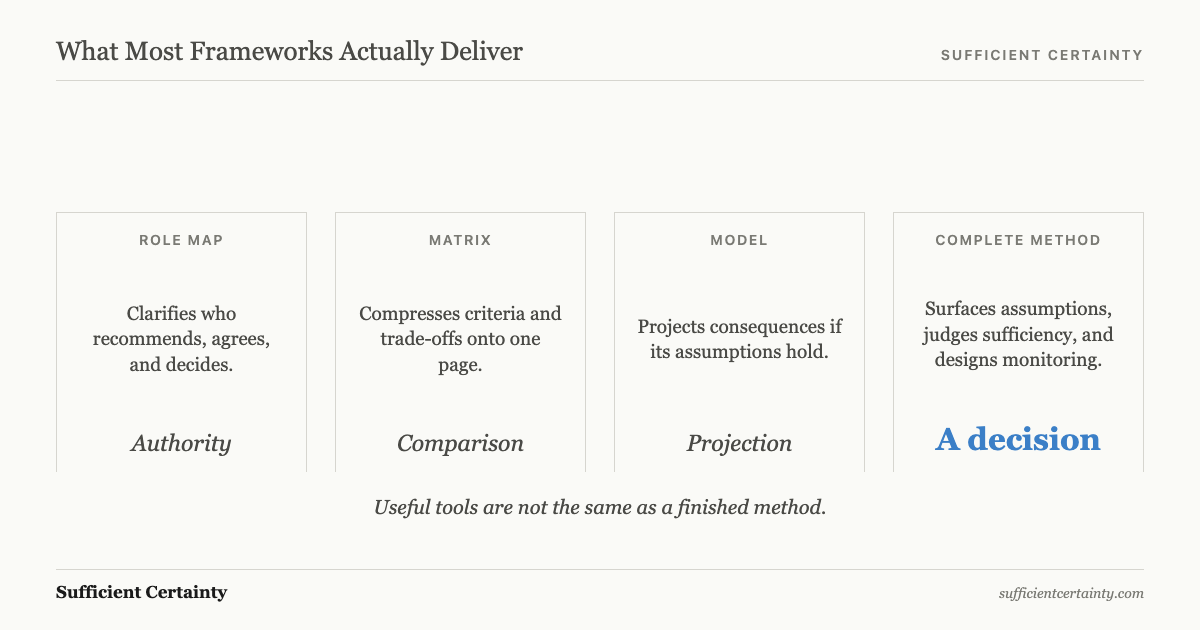
I have spent nearly fifty years watching organisations confuse help with completion. A framework that clarifies who decides can be useful. A framework that scores options can be useful. A framework that models outcomes can be useful. None of those, by themselves, tell a Decider whether the decision is ready to make.
That is the distinction most roundups miss. Not every framework is worthless. The problem is that most of them solve one part of the job and then quietly pretend the rest has taken care of itself.
A decision-making framework is the discipline of moving from a question to a choice with steps that test what each option depends on.
| Framework type | Solves | Does not solve |
|---|---|---|
| Role frameworks (RAPID, RACI) | Who recommends, who decides | Whether the decision is sound |
| Comparison tools (weighted matrix) | Which option scores highest on stated criteria | Whether the criteria rest on valid assumptions |
| Branching models (decision tree) | Consequences under stated conditions | Whether the stated conditions are the ones that matter |
| Complete method (Universal Decision-Making Method) | Purpose, assumptions, sufficient certainty, monitoring | N/A (carries through to verdict and review) |
What people usually mean by decision-making frameworks
When people ask for one, they are usually asking for structure. They want something more reliable than instinct and less cumbersome than another consultant's deck. A framework promises sequence, categories, and a way to stop the conversation collapsing into opinion.
The trouble starts when distinct tools are treated as if they were interchangeable. A decision matrix helps compare options against criteria. A decision tree helps map branches and consequences. RAPID helps clarify who recommends, who agrees, and who decides. Those are not the same thing. Each answers a different question.
That is why so many framework roundups leave the reader unsatisfied. They present a shelf of names without distinguishing what each one is actually for. A Decider with a live board paper, a plant decision, or an acquisition question does not need a taxonomy of labels. They need to know what work still remains once the labels have done what they can. The same problem infects the personality side: decision making styles describe comfort, not quality, and a room that knows everybody's type still cannot tell you what the recommendation is resting on. I compare the main families and where each stops in decision making models.
Why most decision-making frameworks do not help a Decider decide
Most of these approaches do not fail because they are illogical. They fail because they stop at organisation, not judgment. They tidy the discussion, then leave the decisive burden hidden.
The Sydney apartment failures made that painfully visible. Newly built towers had passed through approvals, certifications, and inspections, then residents were forced out when alarming cracks appeared. The compliance machinery had completed its task. The decision quality had not. The rule set produced paperwork and sign-off. It did not force anyone to surface the assumptions about competence, independence, construction quality, or what would be watched once the buildings were occupied.
The same thing happens in slower settings. A steering committee asks for another model. A board commissions another report. A project team refines criteria weights while the market window narrows. Paul Nutt's 1999 study of 400 strategic decisions found that roughly half failed, largely because decision-makers locked onto a preferred option too early and never worked through genuine alternatives. The process is still active, so everyone feels responsible. The decision is still absent, so nothing useful has happened. When that pattern drags on, it becomes analysis paralysis.
Rational decision making is the polite name for that ritual: gather every fact, rank every option, and produce a recommendation that looks rigorous but never asks what it is resting on.Decision matrices, decision trees, and role frameworks each solve only part of the problem
A weighted matrix is good at forcing trade-offs onto one page. That matters. It can stop a team pretending all criteria are equally important. What it cannot do is explain where the weights came from, whether the criteria themselves rest on bad assumptions, or whether the underlying context is about to shift.
A decision tree is good at mapping branches. It can clarify the consequences of a choice under stated conditions. It still depends on somebody deciding that the conditions being modelled are the ones that matter. If the tree rests on poor assumptions, it gives false confidence with admirable neatness.
Role frameworks such as RAPID deal with a different problem altogether. They answer the authority question of who recommends, who agrees, who performs, who inputs and who decides. That is useful, especially in organisations where Deciders have been buried under committees and blurred accountability. Useful is not the same as complete. A role map can tell you who owns the call. It cannot tell that person whether the reasoning under the call is sound.
The 2007 Global Financial Crisis showed what happens when a model becomes the decision. I wrote about the same pattern in decision analysis under uncertainty: the calculations were not the main problem. The hidden assumptions were. Ratings, probabilities, and reassuring outputs kept moving long after the underlying conditions had changed. Once a tool is mistaken for judgment, the neatness of the tool becomes part of the danger.
That is the first distinction to hold onto. Some frameworks clarify authority. A decision rights framework maps who recommends and who approves, and that clarity is real, but it cannot surface assumptions or test for sufficient certainty. Some compare options. Some model consequences. An ethical decision making model can flag which options cross a line, but it still cannot tell you whether the remaining options rest on sound assumptions. A complete method has to do the harder work that follows: expose what the preferred option is resting on, judge whether that is enough, and decide what will be watched after approval.
Run your current framework's output through the step it skipped: name the assumptions and test whether they hold. Start the Walk →
Assumptions are what most frameworks leave unstated
The most useful question in the whole subject is brutally plain: what are we assuming here? Once you ask that properly, frameworks that looked complete suddenly reveal the work they were postponing.
Take a weighted matrix comparing three expansion options. The rows look respectable, covering cost, speed, labour availability and regulatory ease. The scores look disciplined. The hidden work sits underneath them. What are you assuming about labour costs six months from now? What are you assuming about council approval timing? What are you assuming about customer demand holding up long enough for the capital spend to pay back? Those assumptions were always there. The matrix did not create them and did not test them. It simply concealed them under numbers.
This is where the broader question of decision-making under uncertainty enters the picture. Uncertainty is not a separate topic that arrives after the framework has done its work. It is the reason the framework is needed at all. If assumptions remain hidden, the framework is only theatre with cleaner typography.
That is also why the first real act in a complete method is to frame the decision around Purpose. If the Purpose is vague, every assumption that follows becomes harder to rank. Teams start discussing data, preferences, and politics before they have even agreed what outcome the decision exists to serve.
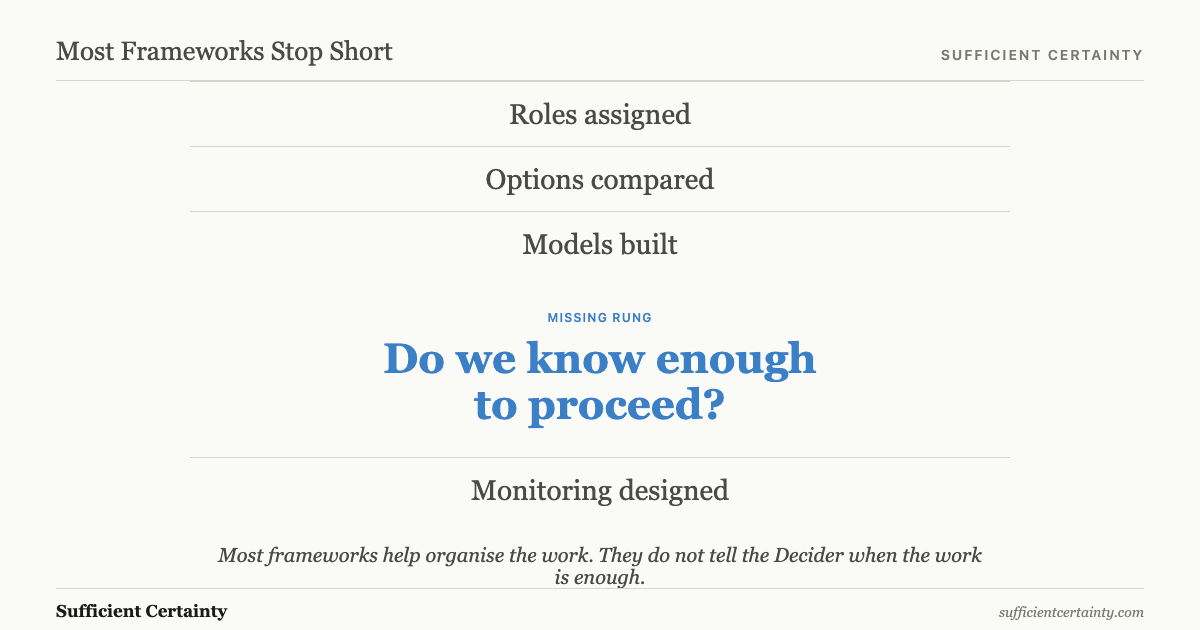
A decision model sits inside this gap. It can produce a useful estimate, but the moment the room treats the output as the decision, the model has taken over and the sufficiency question never gets asked.
Sufficient certainty is the missing stopping rule
Most frameworks tell you how to analyse. Very few tell you when the analysis has done enough. That missing stopping rule is why so many organisations drift into delay while feeling diligent. The root confusion is that problem solving and decision making are different jobs, and treating them as one lets analysis masquerade as commitment.
The phrase Roger Estall and I use is sufficient certainty, which is not maximum certainty and not perfect information, but enough to proceed while uncertainty remains, because uncertainty always remains.
One statutory public safety body I chaired had drifted so far from its legislative purpose that only 0.03% of the budget was reaching the function the statute called its prime consideration. Once the decision was reframed around Purpose and that share was lifted to 0.5%, loss of life fell by 60% within two years. The breakthrough was not another layer of analysis. It was deciding what mattered enough to back.
A complete framework therefore needs a judgment point. At a project checkpoint, what to do after a stage-gate review starts with the test results required before the next budget can be committed. Daniel Kahneman, Dan Lovallo, and Olivier Sibony made the same complaint in their 2011 decision-quality checklist: even strong analytical routines fail when assumptions go unexamined and the alternatives are only decorative. Do we know enough about the assumptions carrying this option to proceed? If not, there are only three sensible moves: get better information, modify the option so it depends less on the weak assumption, or choose a different option. Anything else is drift disguised as prudence.
Monitoring is what keeps a framework tied to reality
Most frameworks end at selection. The meeting concludes. The option is chosen. The slide deck says "next steps". Everyone behaves as if the framework has finished its duty. It has not. A decision keeps living through the assumptions on which it rests, and some of those assumptions will change.
That is why monitoring belongs inside the framework and not after it. The Decider should specify in advance what must remain true for the decision to keep making sense, how likely those conditions are to shift, how quickly that shift would matter, and what would trigger review. Without that, the framework produces a decision that cannot recognise when it has stopped being sound.
Monitoring is how an approach stays connected to reality after approval rather than fossilising into institutional wishful thinking. The practical question is simple: what would have to change for this decision to stop making sense, and who is responsible for noticing?
The same applies when reviewing outcomes later. A decision autopsy is not blame dressed up as governance. It is the discipline of asking what was assumed, what changed, and whether the framework gave the organisation a fair chance to see the change coming.
How the Universal Decision-Making Method differs
The Universal Decision-Making Method is different because it does not pretend the job ends at options, authority, or analysis. It carries the Decider through five stages that the other framework families usually split apart or ignore.
First, frame the decision around Purpose, the opportunity, and the intended outcome. Then develop real options rather than one preferred answer with decorative alternatives. Then recognise the assumptions each option depends on and rank their significance. Then judge whether there is sufficient certainty to proceed. Finally, design monitoring before the decision leaves the room.
That is why I do not treat the method as one more item in a roundup. It is the structure that tells you where the other tools fit. A decision tree may help inside option development. A matrix may help compare choices. RAPID may help settle who owns the call. None of them replaces the full sequence.
For a closer look at how those five stages fit together as a single sequence, and why most process diagrams stop at the midpoint, see the full decision making process model.
Which framework to use when you actually have a live decision
If your real problem is blurred accountability, use a role framework first. If your real problem is too many plausible options, a matrix may help compress them. If your problem is branching consequences, a tree may clarify the paths. If the question is whether the technology can work at all, a technical feasibility study will answer that and nothing more. If the question is which variable drives the model, sensitivity analysis will rank the inputs and nothing more. If the question is which option scores highest against weighted criteria, multi-criteria decision analysis will rank them and nothing more. If the question is which design best balances competing engineering requirements, a trade study will select one and nothing more. If the question is whether to build a capability in-house or buy it from a supplier, a make-or-buy analysis will compare the costs and nothing more. If the question is whether a project's benefits outweigh its costs, a cost-benefit analysis will return a ratio and nothing more. Then stop pretending that those tools finished the work.
Once a decision becomes live, once your name is the one on the recommendation and the consequences are real, you need a framework that reaches a verdict honestly. That means Purpose stated, assumptions surfaced, sufficiency judged, and monitoring designed. For a business case, the nearest worked translation on this site is making difficult business decisions. The same logic holds whether the subject is an acquisition, a closure, a market entry, or a public-sector policy call. For the broader question of what separates leaders who decide well from those who merely preside, see decision making for leaders. When the decision sits inside a larger strategic problem, strategic problem solving shows where most frameworks stop short. And when the question is less about solving and more about direction, strategic thinking explains why analysis without a commitment test is theatre.
That is the hard truth hidden by most frameworks. They are not wrong. They are incomplete. Useful pieces are not the same as a finished method.
You could pick a model, fill the boxes, and still not trust it.
Work through your decisionNo sign-up. Just pick your decision and start.
Grant Purdy is the co-author, with Roger Estall, of Deciding (2020), and the architect of the Universal Decision-Making Method.