
Crisis communication fails when the statement was cleared but the decision behind it was never recorded. Spokespeople rehearse the talking points. Nobody writes down the judgement those points defend. When the story shifts, the team has approved words and no traceable reasoning underneath them.
Crisis communication fails when the statement was cleared but the decision behind it was never recorded. Spokespeople rehearse the talking points. Nobody writes down the judgement those points are supposed to defend. When the story shifts, the team has approved words and no traceable reasoning.
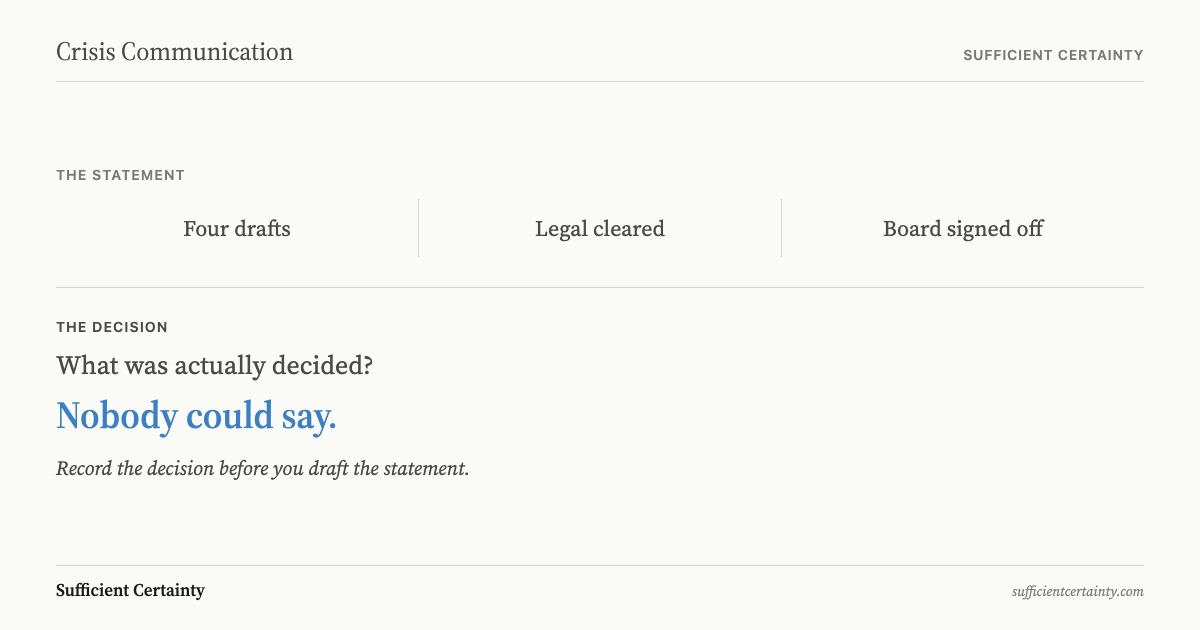
I once sat in a room where a crisis statement had been through four drafts. Legal had cleared it. The communications director had tightened every sentence. The board chair had signed off. The statement was, by any professional standard, flawless. Then I asked the room a simple question: what was actually decided? Silence. Nobody could tell me what the organisation had committed to or what that commitment assumed. They had spent two days polishing crisis communication about a decision that had never been recorded.
That is the problem most organisations discover when something goes wrong. The recorded decision is missing underneath the words, and without it every response is guesswork, regardless of how carefully the response is crafted.
Crisis communication is the practice of conveying information to stakeholders when an organisation faces a sudden threat to its operations or viability.
Why crisis communication keeps failing
The academic field has two dominant models, both built to tell you what to say after someone else has already decided what happened. Timothy Coombs's Situational Crisis Communication Theory sorts crises by how much responsibility the public assigns the organisation and prescribes a response posture for each level. William Benoit's Image Repair Theory offers a menu of rhetorical sub-strategies, all calibrated against reputation as the variable to optimise. Both are message-matching engines: given a crisis type, they output a posture.
Neither model asks how the organisation decided which type its crisis belongs to. Classifying a crisis as accidental rather than preventable is itself a decision, usually made by the people whose personal exposure depends on the answer, never surfacing the assumptions it rests on. The models hand you a response once that classification is settled, and they have nothing to say about whether the classification itself was made with sufficient certainty. In my experience, this is the feature that makes the theory attractive to the people who need it most: if the framework starts after the classification, nobody has to defend the classification.
The statement was perfect and it still failed
In April 2017 a paying, boarded passenger, Dr David Dao, was forcibly dragged off a United Airlines flight at Chicago O'Hare to make room for repositioning crew, and video of the removal went viral within hours. CEO Oscar Munoz's first public statement apologised only for having to "re-accommodate" customers. The same day, a leaked internal memo to staff called Dao "disruptive and belligerent" and praised the crew for following procedure. Under compounding backlash, the airline's share price dropped roughly four per cent intraday, briefly wiping out on the order of $1.4 billion in market value.
Munoz issued a second statement two days later, then a third, and United eventually reached a settlement with Dao and announced a ten-point overbooking policy change roughly two and a half weeks after the incident. Judged by Coombs's own framework, the first statement was a textbook mismatch: an evasion-of-responsibility strategy deployed in a scenario that SCCT itself classifies as preventable, which calls for rebuild or mortification rather than diminishment.
But even the correct rhetorical posture from the menu would not have changed the outcome, because the actual decision under scrutiny was the overbooking removal policy itself: that forcibly removing a boarded, paying passenger was an acceptable resolution to a scheduling problem. That policy had been in place for years. Nobody had tested the assumption it rested on, which was that the forced removal of a compliant passenger would never be filmed and shared. The ten-point policy change that followed was the organisation belatedly making the decision it should have made before the crisis. I have watched this pattern across dozens of organisations: the communications team works around the clock on the statement while the policy that caused the crisis sits undisturbed in a procedures manual, unrecorded as a decision anyone ever consciously made.
Write down what your organisation actually decided before the communications team drafts the statement that describes it. Start the Walk →
When "we fixed it" is itself an untested assumption
Chipotle's experience between 2015 and 2016 shows what happens when crisis communication runs ahead of the decision it claims to describe. The company experienced at least six distinct foodborne-illness outbreaks across different pathogens and states inside roughly a year. CEO Steve Ells responded with full-page apology advertisements in national newspapers and a company-wide restaurant closure for a staff safety meeting in February 2016.
Comparable restaurant sales fell 14.6 per cent in the fourth quarter of 2015 and continued falling through 2016, because new outbreaks kept surfacing even after the company had publicly declared the problem addressed. Each statement asserted that the underlying problem had been fixed. It had not, because "fixed" was never defined against a monitoring standard that could catch the next outbreak before it reached customers. The company kept restating confidence in a decision about new food-handling controls that had not yet earned sufficient certainty, and a press statement is not a monitoring system regardless of how sincere the person reading it.
In my work, I have seen this cycle so often it has its own rhythm: the board demands a statement that declares the problem solved, and nobody asks what evidence would prove the statement wrong before it is issued. That cycle benefits one party above all others: the firm billing hours on each successive round of "transparent communication." The Universal Decision-Making Method ends in implementation with monitoring built in: defined signals that would force the decision to be reopened. Had Chipotle's decision about its new food-safety controls included a reopen trigger, the trigger would have fired after the second outbreak and the company would have had something honest to say.
The six-week silence that was actually a decision
Equifax's 2017 data breach is the cleanest illustration. The company's systems were compromised from mid-May 2017 through an unpatched Apache Struts vulnerability that the Department of Homeland Security had specifically flagged on 8 March 2017, more than two months before exploitation began. Equifax's own internal patching policy required action within 48 hours. It was not followed. The company detected the intrusion around 29 July but did not publicly disclose it until 7 September, a gap of roughly six weeks during which three senior executives sold close to $1.8 million in company stock before the public announcement. All three were later cleared of wrongdoing. A separate Equifax employee, a software development manager who traded on his own knowledge of the breach, pleaded guilty to criminal insider trading months later.
Once Equifax finally spoke, the response was procedurally competent: a dedicated breach website and free credit monitoring for affected consumers. None of that changes when the real decisions were made. Whether and when to tell 143 million people their data was exposed, and whether internal stock trading should have been frozen the moment the breach was confirmed: those decisions were made, badly, in the six weeks before any statement was drafted. I have sat in boardrooms where the disclosure question is the one nobody wants to record, because recording it creates a timestamp, and a timestamp creates liability. That is a risk culture problem masquerading as a crisis communication one. The six-week silence was the visible trace of a decision nobody wanted to own.
What crisis communication actually depends on
In the book I wrote with Roger Estall, Deciding, communication is classified as a secondary element: a feature intended to make it more likely the primary elements of a decision deliver the desired outcomes. Communication sits alongside monitoring and contingency arrangements at that level, and both support a decision rather than replacing one. When I see the crisis communications industry growing in scope and profitability while the decisions behind the crises remain unmade, I am watching the same dynamic I describe in Appendix C: a practice whose advocates benefit from the dysfunction they claim to address.
Record the decision before you draft the statement. If that record exists, what you say will be true. If it does not, the audience will react to the missing decision regardless of what your spokesperson says. The apparatus of risk management cannot substitute for a decision record, because registers and matrices describe categories. A decision-based approach would have given each of these organisations what they lacked: a recorded commitment and the conditions under which it would be revisited. The pattern is sharper still in four cases where the communication was competent and the outcome was catastrophic.
You could polish the next crisis statement and still not know what was decided.
Work through your decisionNo sign-up. Just pick your decision and start.
Grant Purdy is the co-author, with Roger Estall, of Deciding (2020), and the architect of the Universal Decision-Making Method.