
Crisis communication examples fill every PR textbook. Most of them study what an organisation said, how it said it, and how fast. The implicit lesson is that better words, faster timing, and a more empathetic tone would have changed the outcome. That framing is wrong, and these four cases show why.
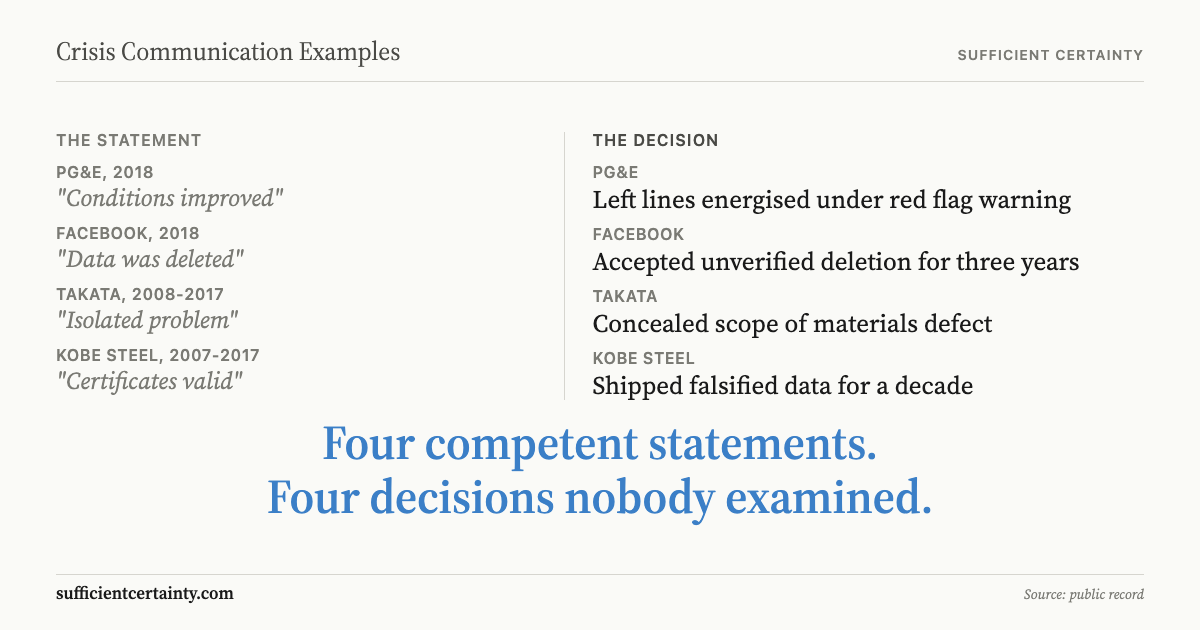
Each organisation below had the communication apparatus in place: media training, holding statements, crisis plans, designated spokespeople. The apparatus functioned. What failed was the decision the apparatus was supposed to serve. In every case, there was a single untested assumption that, if surfaced and examined before the crisis broke, would have forced a different call. The communication was never the failure point. The decision was.
Crisis communication is the practice of conveying information to stakeholders during an organisational emergency, where its effectiveness depends less on the message than on the decisions that preceded it.
PG&E and the Camp Fire: "Improved" Did Not Mean Safe
On the morning of 8 November 2018, PG&E decided not to de-energise power lines in the Sierra Nevada foothills despite an active National Weather Service red flag warning for extreme fire conditions. Wind gusts were forecast up to 55 mph through dry vegetation. PG&E's stated reason: conditions had "improved."
The context makes that word indefensible. PG&E had already developed a Public Safety Power Shutoff program precisely for conditions like these. The utility had conducted shutoffs in other parts of its service territory that same week. For the Caribou-Palermo transmission line in Butte County, the decision went the other way. The line ran through terrain where vegetation management had been deferred for years. The towers were decades old. The "improvement" meant that wind gusts had dropped from extreme to merely dangerous, while the red flag warning remained active.
Nobody in the decision chain forced a simple question: what does "improved but still under red flag warning" actually mean for ageing transmission equipment running through tinder-dry canyons? The assumption that improvement equalled safety went unchallenged. There was no mechanism in PG&E's process that required anyone to state the assumption explicitly and test it against the condition of the infrastructure. The gap was not information. PG&E had the weather data, the vegetation records, and the equipment age. The gap was a decision process that allowed "improved" to pass as "safe" without anyone being required to justify the equivalence.
Equipment on the Caribou-Palermo line failed shortly after 6:15 a.m. The Camp Fire killed 85 people, destroyed 18,804 structures, and erased the town of Paradise.
PG&E eventually pled guilty to 84 felony counts of involuntary manslaughter. The fine was $3.5 million against over $30 billion in total liabilities. No communication strategy was going to change that arithmetic. The accounts that cite PG&E typically focus on the utility's delayed public statements. The actual failure was not what PG&E said after 85 people died. It was the decision, made that morning, to leave the lines energised. Everything after it was paperwork.
Facebook and Cambridge Analytica: Deletion on Trust
In December 2015, a Guardian journalist contacted Facebook about a data-harvesting operation. Cambridge Analytica had used a personality quiz app to collect detailed profiles on roughly 50 million users, far beyond the quiz participants themselves. Facebook's internal review confirmed the breach. What followed was not a cover-up in the traditional sense. It was something more instructive: a decision to treat the problem as resolved without verifying that it was.
Facebook asked Cambridge Analytica to delete the data and accepted the assurance that deletion had occurred. For the next three years, nobody checked. The company did not audit Cambridge Analytica's servers. It did not commission an independent verification. It did not disclose the breach to the 50 million users whose data had been harvested. In 2016, while Cambridge Analytica was reportedly using that data to build voter-profiling models, Facebook treated the matter as a closed compliance item.
The untested assumption: that a political consultancy with strong commercial incentives to keep voter-profiling data would simply delete it because someone asked. That is not a communication failure. That is a risk culture problem dressed up as a resolved compliance matter. Facebook had signed a consent decree with the FTC in 2012, committing to protect user data. The 2015 decision to accept an unverified deletion claim was made in the shadow of that decree, which makes the absence of verification harder to explain as an oversight.
When the story broke in March 2018, $37 billion in market value vanished in a single day. The FTC imposed a $5 billion fine, the largest privacy penalty in US history at the time. Zuckerberg and Sandberg were silent for five days, and when they did speak, the response was polished but beside the point. The silence was not a media relations failure. It was the direct consequence of a decision, made three years earlier, to treat an unverified promise as a closed matter. By the time communication became relevant, the damage was structural.
Take the assumption underneath your next public statement and test it before the audience tests it for you. Start the Walk →
Takata Airbags: A Decade of Selective Disclosure
Takata's ammonium nitrate propellant in airbag inflators was chemically unstable. In heat and humidity, the propellant degraded, and when the inflator fired, it could rupture the metal housing and send shrapnel into the cabin. Internal testing identified the problem years before Takata acknowledged it publicly. Engineers knew. In 2004, Takata began secretly conducting tests on inflators returned from the field. In 2006, an engineer wrote "Happy Manipulating" on an email referencing altered test results.
By 2010, Takata was telling the National Highway Traffic Safety Administration that the problem was an "isolated manufacturing problem" affecting a small number of inflators. This was a deliberate characterisation choice, not a technical conclusion. Takata's own engineers could not identify which propellant lots were defective because the company's traceability records were incomplete. The degradation rate depended on cumulative exposure to heat and humidity, meaning inflators that passed testing when new could become lethal with age. The company commissioned researchers at Penn State to investigate the propellant link while simultaneously telling regulators there was no systemic issue.
The assumption nobody forced into the open: that you can manage a materials science failure with selective disclosure and partial recalls. Each recall expanded the scope of the previous one, because the previous scope had been set to minimise the apparent scale of the problem rather than to match the actual extent of the defect. If your traceability records are incomplete and you cannot identify which lots are defective, you cannot credibly claim that any recall scope is sufficient. Nobody asked that question internally. When regulators finally asked it, the answer was that every ammonium nitrate inflator was potentially affected.
The result was at least 19 deaths, over 400 injuries, and the largest safety recall in US automotive history: 67 million inflators across 19 automakers. Takata filed for bankruptcy in 2017. Three executives were indicted for wire fraud and conspiracy. The drip-fed partial recalls were not communication. They were the visible trace of a decision, renewed at every stage, to conceal rather than confront the scope of the problem.
Kobe Steel: Ten Years of Falsified Certificates
For at least ten years, Kobe Steel employees at multiple factories falsified quality certificates on aluminium and copper products. The certificates showed materials meeting customer specifications for tensile strength, yield strength, and dimensional tolerances when they did not. The practice extended to plants in Japan, China, Malaysia, and Thailand. This was not a rogue individual. An independent investigation later found that the falsification was systematic, spanning multiple product lines, and that senior executives knew.
The assumption that sustained a decade of fraud: that falsified certificates would never be tested against reality. The steel, aluminium, and copper went into products manufactured by more than 500 customers, including Boeing, Toyota, General Motors, Ford, and Mitsubishi Heavy Industries. Some of those products were safety-critical: aircraft fuselages, car body panels, nuclear reactor components. The question nobody asked was brutally simple: what happens when a customer puts an out-of-spec component into a safety-critical application and it fails?
The discovery forced an extraordinary downstream cascade. Each of the 500-plus customers had to determine whether the out-of-spec materials compromised the integrity of their own products. Boeing had to verify whether affected aluminium met the fatigue life requirements for airframe components. Toyota had to retest body panels. Nuclear operators had to assess whether reactor vessel components met regulatory specifications. The investigation required physical testing of materials already embedded in finished products, some of which had been in service for years.
When the scandal broke in October 2017, Kobe Steel's disclosure was almost confessional. The CEO resigned. The company lost its Japanese Industrial Standards certification, a government-sanctioned quality seal held since the program's inception. The US Department of Justice opened an investigation. An independent committee found over 70 cases of altered data across aluminium, copper, iron powder, and LCD materials. The communication was irrelevant. The decision that mattered was made years earlier, and renewed every day for a decade: ship the product, sign the certificate, and assume that nobody would ever check.
What These Crisis Communication Examples Share
These four crisis communication examples share a structure that PR case studies rarely name. Each organisation had the apparatus: de-energisation protocols, privacy compliance, quality testing, inspection certificates. The apparatus functioned. What failed was the decision the apparatus was supposed to serve. In every case, there was a single assumption that, if surfaced and examined, would have forced a different call. Nobody surfaced it.
I have seen this pattern across industries and decades. A utility assumes "improved" means safe. A technology company assumes a verbal assurance means compliance. A manufacturer assumes a materials defect can be managed through controlled disclosure. A steelmaker assumes falsified data will never be tested. The communicators in all four organisations were competent professionals. They were handed a problem that no amount of competent communication could fix, because the problem was not a message. It was a judgment call that nobody had examined.
If your crisis communication plan starts with "draft the holding statement," it starts too late. The useful question is not what to say. It is what was decided, and on what basis, before the situation became a crisis. Start there, and the communication writes itself. Start with the statement, and you are polishing a consequence.
These cases sit inside a broader pattern I have written about in what organisations get wrong about risk. The common thread is not incompetent communication. It is a system that files uncertainty in a register, scores it in a matrix, and never asks whether the underlying decision rests on an assumption that nobody has tested.
You could study every crisis communication example and still leave the decision underneath your next one unexamined.
Work through your decisionNo sign-up. Just pick your decision and start.
Grant Purdy is the co-author, with Roger Estall, of Deciding (2020), and the architect of the Universal Decision-Making Method.