
Data driven leadership means owning the recommendation, the assumption behind it, and the trigger that would reverse the call. Most leaders use data as cover: the model said so, the dashboard showed green, the committee reviewed the numbers. None of that is a decision. It is dispersed accountability.
A divisional head I worked with walked into a quarterly review carrying a 61-page board pack and a $14 million capital request nobody wanted to own. The BI team had already done its work. The dashboard was on the wall. The chief executive listened for twenty minutes, then asked the only question that mattered: what do you recommend? The room went quiet. That is why leaders avoid owning decisions: the evidence is easier to present than the judgement it still requires.
Most advice on leadership accountability pretends the leader's job is to produce better reporting. I have never seen that solve the real problem. The numbers rarely remove the uncertainty that matters most, which leaves someone to make a call and defend it later. If the leader points back at the dashboard when the board asks why, the dashboard has started wearing the leader's suit.
The wider argument in data-driven decision making is simple enough: evidence should sharpen a call, not save a leader from making one. In this room, the person at the table cannot hide behind the pack. Being more data-driven means saying what the evidence is supposed to prove, then saying what you want done while the uncertainty is still sitting there, smirking.
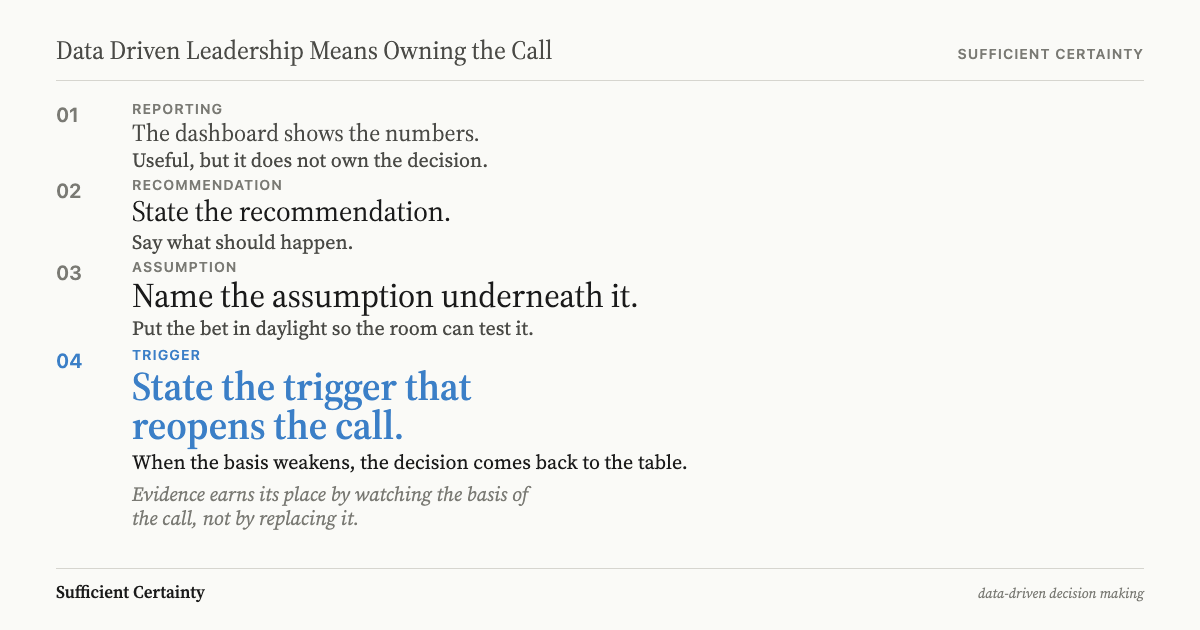
Leadership accountability means owning the recommendation, the assumption carrying it and the trigger that would reopen the decision. Evidence informs the call; it does not take responsibility for it.
Why Leaders Avoid Owning the Recommendation
Boards ask for data because they want a sentence at the end of it: do this, and here is why. A pack without that sentence is clerical work. It may be accurate, but it leaves the decision exactly where it started.
A recommendation is the moment leadership stops describing the situation and starts owning the call. Until somebody names the action, the meeting is still hovering above the decision, safe for everyone except the people who have to live with the outcome.
That is why most frameworks disappoint. I wrote more about that in why most data driven decision-making frameworks disappoint, but the short version is plain enough: they help people arrange evidence after the harder job should already be done. If the recommendation is missing, the framework just gives the hesitation a nicer folder.
A serious recommendation states the action and the conditions that still make it worth taking. Once you put the sentence that way, the argument becomes visible, and other people can attack the right thing instead of admiring the dashboard.
Accountability Means Owning the Assumption
Silicon Valley Bank is a brutal public example because it had no shortage of models or supervisory attention. The Federal Reserve's review says SVB grew from $71 billion in assets at the end of 2019 to more than $211 billion at the end of 2021. The same review says the board did not hold management to account for basic interest-rate and liquidity risk. Then, on 9 March 2023, more than $40 billion of deposits left in a day.
People call that a risk-management breakdown, which is marvellous for everyone who earns a living selling risk machinery. It keeps the spotlight off the original leadership failure. What assumption was carrying the strategy as the bank grew? In plain English, leadership was assuming the funding base would stay put long enough, and that rate moves would not crack the balance sheet first. Those assumptions were not unknowable. They were simply never owned in a sentence blunt enough for the board to test.
Once you write the assumption in plain English, the conversation improves at once. The board can stop admiring the model and ask whether deposits are behaving the way the strategy needs them to behave, and what signal would prove they are not. That is the conversation people avoid because it pins ownership to a sentence instead of a spreadsheet.
The real failure was that leadership never said, plainly enough, this strategy only works if these deposits stay this sticky and rates move within a tolerable band. Once the assumption is written in daylight, it can be tested. Left buried inside models, it acquires the false dignity of mathematics, which is very handy if nobody wants to own the call.
Roger Estall and I wrote Deciding because we kept seeing exactly this trick. People would elevate a calculation into a decision and then treat anyone challenging the calculation as if they were attacking reason itself. The Universal Decision-Making Method pulls the assumption back onto the table, where it belongs.
Write the recommendation your board pack avoids, then name the assumption and trigger that make it yours to own. Start the Walk →
Incomplete Evidence Still Requires a Call
The infant formula shortage in the United States shows what happens when leaders wait for a neat picture that will never arrive. By 17 February 2022, when Abbott announced its voluntary recall, complaints and inspection findings were already colliding with internal coordination failures. The FDA's Evaluation of Infant Formula Response later identified 15 problems across the response.
In rooms like that, people start asking for a cleaner dashboard, as though one more reporting cycle will turn uncertainty into permission. I have seen the same thing in regulated industries. Complaints pull one way, commercial consequences pull the other, and people reach for process because process cannot be cross-examined. It is useful until people start hiding inside it. Then it becomes a shelter for indecision.
That is why I keep coming back to enough information to make a decision. Asking for more data is often just a polite way of postponing authorship. Sometimes the evidence is incomplete because the world is incomplete. The job is to decide which uncertainty matters now, and which can be watched after the call.
I have watched executives say they are waiting for better information when what they really mean is that they do not want their name attached to the decision. Every serious call carries leftover uncertainty. Leadership starts when you stop pretending the next report will rescue you from that fact.
Set the Trigger Before You Need It
USPS is one of the few public cases where the dashboard had a job instead of a fan club. Its Office of Inspector General review says doing nothing would have left USPS nearly $160 billion in the red over 10 years. Management named 175 initiatives and marked 58 as top priority. It then used a dashboard for weekly reviews, with monthly Finance and Planning checks against assumptions and targets.
This is one of the rare cases where the dashboard served the decision instead of replacing it. Leadership made the call first, named the assumptions carrying it, and then used data to see whether the basis was rotting. The UK Corporate Governance Code 2024 is reaching for the same idea in committee language. A board should be able to say what it watched and who had to act when the numbers turned. Vague confidence is what people write when they would rather not say.
People invoke a data-driven culture when the harder question is ownership. Who is watching the assumption, and who has to say the decision is off track? Leaders should treat monitoring as part of the decision itself, with a named owner and a threshold that reopens the call. Without that, the next board pack is just a tidy bundle of expired assumptions.
When someone tells you the organisation needs more leadership accountability, ask a rude question. When the next board pack lands and the chief executive asks for your recommendation, what sentence will you say that the dashboard cannot say for you? If you cannot say it, the dashboard is already sitting in your chair.
You could present the next board pack and still leave the decision, its assumption and its reversal trigger unsigned.
Work through your decisionNo sign-up. Just pick your decision and start.
Grant Purdy is the co-author, with Roger Estall, of Deciding (2020), and the architect of the Universal Decision-Making Method.