
Enough information to make a decision is not a volume threshold. It is the point where the assumptions your commitment depends on have been surfaced, tested, and either accepted or reduced. More data past that point is delay dressed as diligence.
A CFO I worked with spent eleven months trying to gather enough information to make a decision about a supplier consolidation. She had a 200-page risk assessment, internal cost projections going back four years, and a procurement team that had visited every shortlisted factory twice. When I asked what specific piece of information would change her answer, she went quiet. She did not lack data. She had never identified what the decision actually rested on.
Her problem was not rare. I have seen it in boardrooms, project teams, and government agencies across four continents. The people waiting for more information almost never lack data. They lack clarity about which assumptions their decision actually depends on. Once you reframe the question that way, the answer changes completely.
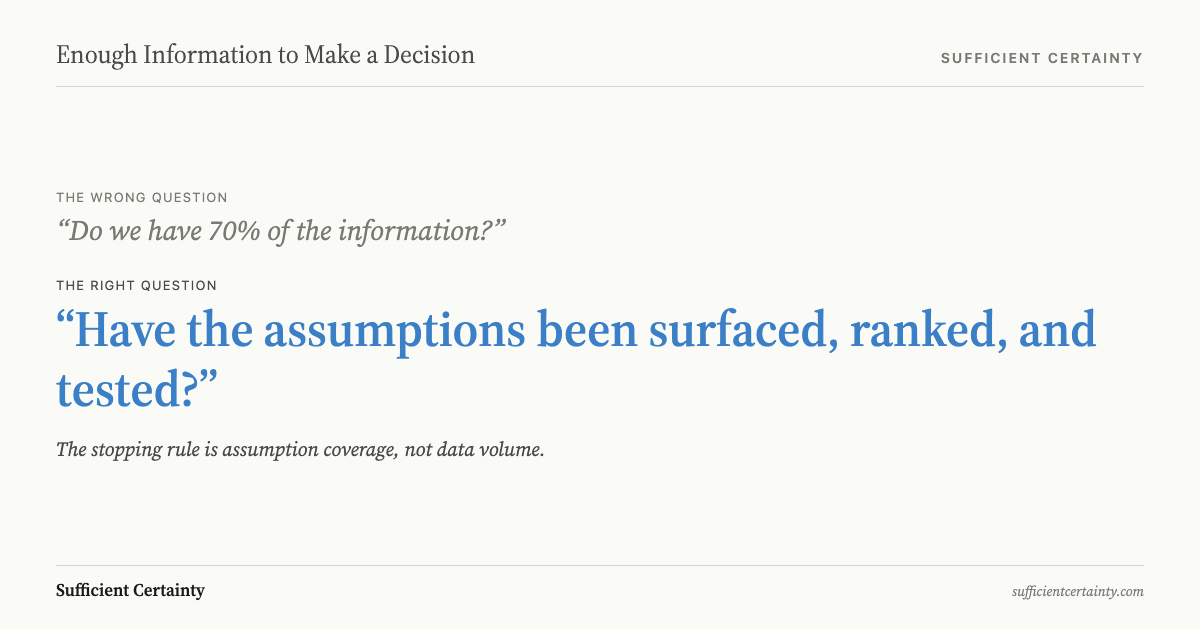
You have enough information to make a decision when additional research would not change which option you choose. The practical test is to name the assumptions the decision rests on and ask whether the critical ones have been addressed. If more data would only confirm what you already believe without testing what could break the choice, you already have enough.
Having enough information to make a decision means the assumptions the decision rests on are clear, ranked by how much they matter, and either accepted or addressed.
Why "How Much" Is the Wrong Question About Enough Information
Colin Powell's 40 to 70 percent rule has been repeated on business blogs for three decades. Bezos restated 70 percent in his 2016 shareholder letter. Both sound practical. Both answer the wrong question.
Seventy percent of what? The percentage model is attractive because it sounds disciplined. It is also convenient for anyone selling information: seventy percent of infinity is still infinity. If the information covers market analysis, financial projections, and competitor data but nobody has surfaced the assumption that input costs will remain stable, you might have 95 percent of the available information and still miss the thing that kills the decision. The percentage treats information as fungible, like fuel in a tank. It is not. Three pages testing your critical assumption are worth more than 200 pages confirming what you already believe.
Herbert Simon won a Nobel Prize in 1978 for showing that real decision-makers face bounded rationality, meaning they work with incomplete information and limited time. His answer was satisficing: stop searching when you find a solution that clears a minimum acceptable threshold. That was useful. But satisficing sets the threshold at the outcome level. It asks "is this good enough?" The question I am interested in is whether the assumptions underneath have been tested. That is a different stopping rule.
Gerd Gigerenzer documented this for decades. His team showed that simple heuristics deliberately ignoring most available information often match or beat complex models. A three-step decision tree for classifying high-risk heart patients outperformed a 19-point logistic regression. Three variables versus nineteen, and the simpler rule won. That finding should alarm anyone commissioning another round of analysis, but it never seems to reach the people writing the checks.
What Fast Decision-Makers Track Instead
In 1989, Kathleen Eisenhardt studied eight microcomputer firms and found that fast strategic decision-makers used more real-time information, not less. They tracked operational data continuously (cash position, sales figures, engineering milestones) and used experienced counselors to pressure-test their reading of the situation. Their counselors existed to challenge assumptions, not to produce another round of findings. The slow firms commissioned more analyses, covered more ground, and performed worse. They had the most paper in the room and the least clarity about what their decisions actually rested on.
I have watched that pattern repeat in committee rooms for four decades. The committee requesting another round of analysis is avoiding the act of deciding, which is a different problem with a different fix.
The Universal Decision-Making Method makes the stopping rule explicit: have the assumptions that determine the outcome been tested? Stage 3, Recognise assumptions, identifies what the decision rests on and ranks each assumption by influence on the outcome and confidence. A critical assumption has high influence and low confidence. That is where your attention belongs, not spread across another report that covers everything except the thing the decision rests on.
Apply the stopping rule to the decision in front of you and find out whether more information changes anything material. Start the Walk →
The Stopping Rule for Enough Information to Make a Decision
The method's fourth stage, Sufficient certainty, is where the call gets made or sent back. Either the critical assumptions hold, or they do not. If the outcome turns out poorly despite sound assumptions, that is a separate problem.
The method gives the Decider a targeted response to a critical assumption: find out whether that specific thing you are relying on is true. Not "run another analysis." Test that one assumption. If it holds, the decision can proceed. If it does not, you have learned something that no additional volume of data would have surfaced, because volume was never the problem.
That distinction matters. Most organizations treat the question of having enough information to make a decision as a volume problem, which is also why evidence based decision making gets mistaken for endless collection instead of a written stop rule. They commission reports and hold meetings, none of which necessarily touches the assumption that will make or break the call. I have seen this play out for decades: the meeting calendar grows while the critical assumption sits untested. The consulting industry does well out of this arrangement. Another round of analysis means another invoice. Nobody pays a consultant to write one sentence: "You already know enough. Decide."
What counts as sufficient certainty depends on the stakes and the person making the call. Roger Estall and I were clear about this in Deciding: what is sufficient for one Decider will not be sufficient for another. A board approving a supplier change in a stable market might reach sufficient certainty quickly. The same board facing the same decision during a trade war might not. Every percentage-threshold rule misses this because it assumes information is the bottleneck. Usually it is not. The bottleneck is that nobody has asked what the decision actually rests on.
The CFO I mentioned had enough information to make a decision nine months before she finally made it. She had not identified the three assumptions her consolidation rested on, and nobody had asked whether those assumptions had been tested. If your organization's response to uncertainty is commissioning another report, ask who benefits from that commission. The information-sufficiency question lives in the wider picture of decision quality, and it starts with assumptions, not volume.
How to know when you have enough information
In practice I use a test that takes less time than most people spend reformatting their slides. I list the assumptions the decision depends on. Not twenty. Usually three to five. Then I ask one question about each: if this assumption turns out to be wrong, does the decision still stand? The ones where the answer is no are the critical assumptions. Everything else is background noise dressed up as diligence.
Once the critical assumptions are visible, the information question answers itself. For each one, I check whether I have evidence that makes me confident enough to act. Not proof. Not certainty. Confident enough given what is at stake. If the evidence is there, I have enough information. If it is not, I know exactly which gap to close, and I can go after it directly instead of asking the team for more data as if data were a bulk commodity.
I once worked with a port authority board considering whether to approve a $40 million dredging contract. The project team had produced an environmental impact study, a geotechnical survey, three rounds of stakeholder consultation, and a shipping-demand forecast that ran to 2045. What they had not done was check whether the state government would renew the port lease beyond 2031. That was the assumption carrying the weight. The rest was furniture. One phone call to the relevant department would have settled the matter in a morning. Instead the board asked for another round of cost modelling, which tested nothing that mattered and cost five weeks.
That pattern is so common I have stopped being surprised by it. The team gathers information around the edges because the edges feel safe. The central assumption sits untouched because touching it might produce an answer nobody wants to hear. Asking for more data is often a way of postponing the one conversation that would actually resolve the uncertainty.
The practical test has three steps. First, name the assumptions the decision rests on. Second, rank them by influence: which ones, if wrong, would change your answer? Third, check whether you have evidence on those specific points. If the critical assumptions have been tested and you are confident enough to proceed, stop gathering. You have enough. If one critical assumption is still unresolved, you now have a precise brief instead of a vague request for more analysis. That brief might be a single phone call, a site visit, or a conversation with someone who has the data you need. It is almost never another 80-page report.
This is what the Universal Decision-Making Method does at its core. Stage 3 surfaces assumptions. Stage 4 tests whether your confidence in the critical ones meets the threshold for the stakes involved. That threshold is what Roger Estall and I call sufficient certainty, and it is personal to the Decider. A routine procurement and a bet-the-company acquisition have different thresholds, because the consequences of being wrong are different. What they share is the same underlying question: have the assumptions that matter been tested?
I covered the science behind decision making separately. Here the point is operational. The next time someone in your organization says they need more information before they can decide, ask them to name the assumption they are trying to test. If they cannot, the request is not for information. It is for delay. And if they can name it, you will usually find the answer is closer and cheaper than anyone expected.
You could ask for more data and still avoid what your decision depends on.
Work through your decisionNo sign-up. Just pick your decision and start.
Grant Purdy is the co-author, with Roger Estall, of Deciding (2020), and the architect of the Universal Decision-Making Method.