
Decision fatigue research built an entire field on four laboratory studies that did not replicate. The brain-as-battery model is dead. What survives is simpler and more useful: process load, not willpower depletion, explains why organisations stall. The practical question was always about the apparatus, not the person.
In 1998, Roy Baumeister published four experiments in the Journal of Personality and Social Psychology. Participants who resisted chocolates gave up faster on a subsequent puzzle. Participants who suppressed emotions performed worse on a grip task. The paper proposed a single explanation: self-control draws from a finite pool that empties with use. It has 8,000 citations. Decision fatigue research spawned 600 papers and gave popular culture a tidy metaphor: your brain is a battery that decisions drain.
Decision fatigue research built a field of 600 papers on four laboratory experiments claiming that self-control depletes like a battery. Three large-scale replications found the depletion effect indistinguishable from zero. The experience of fatigue after repeated decisions is real, but the mechanism most researchers assumed, a fixed resource that empties with use, is not supported by the evidence.
What produces decision fatigue in organisations is not a depleting biological resource but governance apparatus that never establishes . The research built on Baumeister's metaphor for two decades. The metaphor is wrong. The experience is real; people are genuinely exhausted after sequences of organisational decisions. But the mechanism is structural, not biological. It is the accumulated machinery of governance that exhausts people before they reach a verdict.
Decision fatigue research is the academic literature that studies whether repeated choices reduce later judgment quality, willingness, or consistency.
What the decision fatigue research program claimed
Baumeister's resource model was elegant. One pool, shared across all acts of self-control. Resist a temptation, and you have less capacity for the next choice. Make enough sequential choices, and quality degrades. The model predicted that glucose would restore performance (it appeared to, briefly, in underpowered studies) and that any form of self-regulation would deplete the same reservoir. For organisations, this was permission to blame the individual: your people are tired, give them a break. It absolved the governance machinery entirely. Nobody had to ask whether the committee structure itself was producing the exhaustion.
The program that followed accepted the resource model and ran with it. Decision fatigue became a popular explanation for bad judicial rulings, impulse purchases, and poor afternoon choices. If you heard that judges grant more paroles after lunch, that was the resource model at work. The study has since been explained as a statistical artefact of case scheduling. Six hundred papers built on four experiments with 67 participants. I have seen consulting firms build billion-dollar practices on slimmer evidence, so this was not unusual. What was unusual is that someone eventually checked.
Use the five steps on your tired team's decision and distinguish process drag from the battery story. Start the Walk →
Why the decision fatigue mechanism collapsed
In 2016, twenty-three laboratories attempted to replicate the core ego-depletion effect. The aggregate effect size was d=0.04: indistinguishable from zero. In 2021, thirty-six laboratories repeated the exercise with a preregistered protocol. d=0.06. The fixed-resource model is not a weak effect awaiting better measurement. As a general mechanism, it is absent. I have written separately about whether decision fatigue is real; the short version is that the experience survives but the explanation does not.
The replacement model tells you something useful about organisations. Michael Inzlicht and Brandon Schmeichel proposed it in 2012: after initial effort, people do not lose capacity but shift motivation. Attention moves toward reward and away from further exertion. The reward-to-effort ratio changes. Incentivise "depleted" participants, and they perform normally. That cannot happen if the resource is genuinely spent. The issue was never a fuel tank but a cost-benefit calculation that the apparatus rigs against engagement. When the process demands three meetings before it will yield a single decision, rational people disengage.
This distinction matters. If decision fatigue were biological, the answer would be glucose and nap rooms. If it is motivational, the answer is to change what the apparatus demands of people who have to use it. Overcoming decision fatigue means redesigning the process until engagement produces a verdict, not redesigning the person until they can survive the process.
What decision fatigue studies actually measure
I have sat through enough governance cycles to recognise what produces the exhaustion: the accumulated weight of process. A risk register with more items than anyone reads before reaching the actual decision. Approval chains where no single person holds authority to close. Terms of reference drafted by people who will never make the decision those terms describe. The experience is indistinguishable from what Baumeister described in his laboratory, except that no one ran out of glucose. They ran out of reasons to keep engaging with a process that never arrives at a verdict.
In 2020, Pignatiello, Martin and Hickman published the first concept analysis of decision fatigue studies in the Journal of Health Psychology. They searched seven databases, found 17 relevant articles, and discovered the term was being used inconsistently: sometimes meaning ego depletion, sometimes cognitive overload. The field did not agree on what it was measuring. What the analysis did produce was a taxonomy of causes. Decisional antecedents: the volume and complexity of choices presented to the person. Situational antecedents: accountability pressure and time constraints imposed by the environment.
Every item in that taxonomy maps to something governance apparatus generates. These are not accidents of complexity but the output of machinery maintained by people who bill by the hour to run it. The paper concluded that decision fatigue is a state, one that can be induced and resolved. It never asked what induces it at the organisational scale. The answer was in the antecedent list the whole time, filed under "situational" as though accountability pressure were weather rather than architecture.
The question decision fatigue research never asked
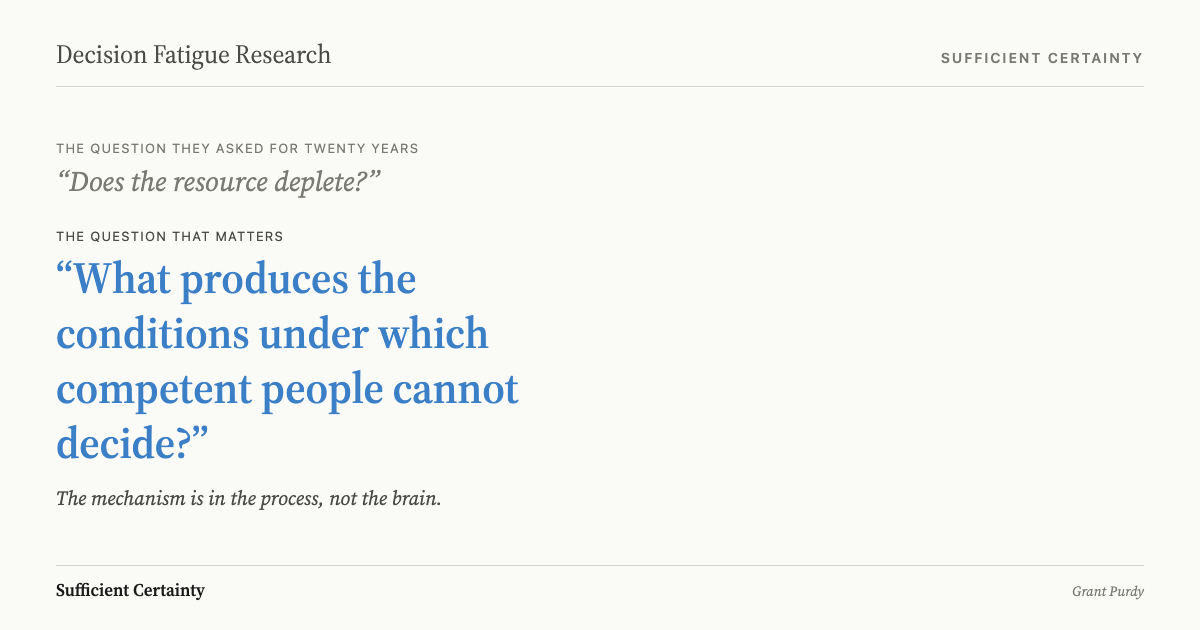
Two decades of decision fatigue research asked: "Does the resource deplete?" The useful question was always: "What produces the conditions under which competent people cannot decide?" The answer is not breakfast or reducing your wardrobe.
In Deciding, Roger Estall and I built the Universal Decision-Making Method around a different question: what assumptions does this decision depend on? The answer is always a small number, assessed for significance. When you can state those and assess confidence in each, you have sufficient certainty. The apparatus never asks that question. It asks for more review and more stakeholders copied in before anyone can close. It generates the antecedents that Pignatiello catalogued and the exhaustion that Baumeister misdiagnosed. The method exists because the apparatus will not reform itself.
The mechanism sits in the committee structure and the incentives of the people who designed the process. Decision fatigue research spent two decades investigating the wrong organ.
You could repeat the battery story and misread your next exhausted team.
Work through your decisionNo sign-up. Just pick your decision and start.
Grant Purdy is the co-author, with Roger Estall, of Deciding (2020), and the architect of the Universal Decision-Making Method.