
Is decision fatigue real? As an experience, yes. As a biological mechanism, no. Three major replications killed the ego depletion model. What remains is a process problem: too many reviews, too many approvals, and too little clarity about what has actually been decided. That is real and fixable.
Is decision fatigue real? The fatigue is real as an experience. The mechanism most people cite, a finite pool of willpower that empties with each choice, is not. Three preregistered replications returned effect sizes near zero. What exhausts decision-makers is not a biological limit but process exhaustion from governance structures that demand repeated effort without reaching a verdict.
You have heard this story. The mind is a battery. Every decision drains it. By afternoon the battery is flat and your judgement has gone with it. Barack Obama wore the same suit to conserve his. Mark Zuckerberg wore the same t-shirt. The productivity literature has repeated this story for more than a decade. It is widely shared and wrong.
Decision fatigue is real as an experience. The mechanism most people attribute it to, a fixed pool of mental energy that empties with each choice, is not. Three large-scale replications have found the ego-depletion effect statistically indistinguishable from zero. What exhausts decision-makers in organisations is not a biological limit. It is process exhaustion from governance machinery, and the Universal Decision-Making Method that Roger Estall and I developed exists because we kept seeing the same machinery produce the same exhaustion.
The question of whether decision fatigue is real asks whether the felt decline in decision quality reflects a measurable phenomenon even if its mechanism is disputed.
The decision fatigue mechanism does not replicate
The ego-depletion model was proposed by Roy Baumeister in the late 1990s. Self-control draws on a limited resource, the theory said. Use it on one task and you have less for the next. The model generated a research program of hundreds of published studies and became the theoretical foundation for the entire decision fatigue concept. It was also good business. Productivity consultants and self-help authors built a cottage industry on willpower as a depletable commodity you could optimise with the right morning routine.
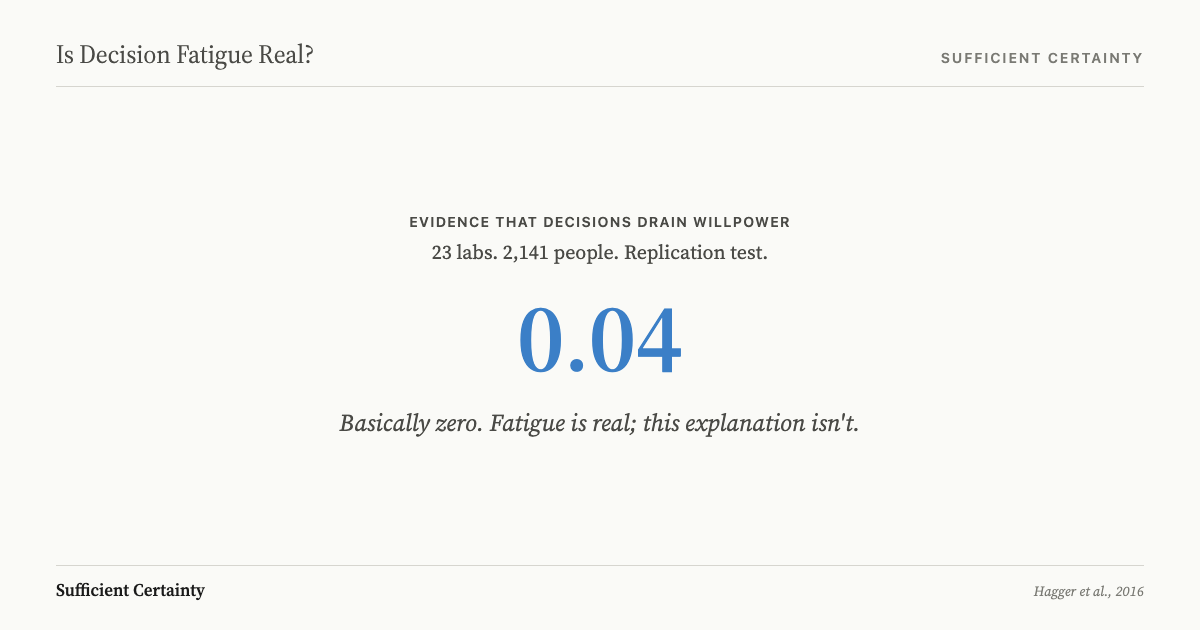
In 2016, Hagger and colleagues ran the first large-scale preregistered test. Twenty-three laboratories. 2,141 participants. A standardised two-task protocol. Every laboratory predicted they would find the effect. The aggregate result was an effect size of 0.04, with a confidence interval running from −0.07 to 0.15. The effect was not small. It was absent.
Five years later, Kathleen Vohs, one of the researchers who built the model alongside Baumeister, led an even larger replication. Thirty-six laboratories. 3,531 participants. Two procedures designed by the theory’s own architects to give it every possible advantage. Effect size: 0.06, nonsignificant. Bayesian analysis found the data four times more likely under the null hypothesis. When the people who invented a theory design their best-case replication and still cannot find their own effect, the theory is dead.
I am not surprised by this. The ego-depletion model always described the wrong level of the problem. It looked at the individual and assumed the cause was biological. I have sat in boardrooms where six competent directors could not close a decision after three months of meetings. Nobody in that room was short on sleep or willpower. What they had was a governance process that generated forty-page committee packs without ever naming the three assumptions the decision actually rested on. The failures I have watched across nearly fifty years were never about tired individuals. They were about structures that exhausted everyone who came near them. That is why Roger Estall and I wrote Deciding.
Examine the draining decision with the five steps and check whether the problem sits in your process, not your battery. Start the Walk →
The most cited proof of decision fatigue is a scheduling trick
The 2011 study of Israeli parole boards is still the most cited real-world evidence for decision fatigue. Favourable rulings dropped from roughly 65% at the start of each session to near zero by the end, resetting after meal breaks. The implied effect size was enormous: 1.96. Judges, the conclusion ran, were running out of mental energy and defaulting to the safe decision.
In 2016, Andreas Glockner ran simulations showing that a rational judge, working cases with no cognitive depletion at all, would produce an identical decline. The mechanism is simpler than exhaustion: favourable rulings take longer to deliberate, around seven minutes on average, than unfavourable ones, around five minutes. As remaining session time shrinks, judges stop starting cases they expect to run long. Favourable outcomes are selectively pushed out of later time slots. Unfavourable ones fill the gaps. The dramatic cliff in approval rates is a scheduling artifact, not a depleted brain. But a scheduling artifact does not sell books about mental energy, so the depletion story persists.
The assumption behind the hungry-judges narrative was that declining approval rates reflect cognitive depletion. Nobody had tested a simpler possibility: that case complexity and case ordering are not independent. They are not. This is exactly the kind of unexamined assumption that produces bad conclusions. The method Roger Estall and I built starts by asking what assumptions are in play. That single question would have prevented a decade of misinterpretation.
Where decision fatigue disappears
The strongest field test of decision fatigue to date found no evidence of it. In 2025, Andersson and colleagues analysed 231,076 phone calls handled by 174 nurses in Sweden’s national telephone triage service. They tested whether nurses showed increased reliance on personal defaults or higher urgency ratings as shifts progressed. Bayesian analysis ruled the effect out entirely. The battery model predicts clear deterioration across a shift of hundreds of decisions. The deterioration is not there.
Those nurses worked without risk committees, appetite statements, 47-item registers, or quarterly compliance reports standing between them and each call. They had clear protocols and defined authority. The decision cycle was short: patient calls, nurse triages, outcome is recorded. No committee reviewed the decision afterward. No register catalogued it. Compare that with what a board director faces when asked to approve a restructure, and the source of the exhaustion is obvious. Strip away the apparatus and the fatigue vanishes.
What organisations actually experience
The exhaustion that executives describe is genuine. I have watched it across mining, finance, aviation, and public health.
Board packs run to dozens of pages. Standing agendas review the register but never the decision. Appetite statements get drafted by people who will never have to live with the outcome. Assurance reviews confirm the process was followed without asking whether it produced anything useful. Each layer adds its own cycle of review, its own demand on the people who are supposed to be deciding. The cumulative weight pulls their attention from the only question that matters: do I have enough confidence to proceed?
In Deciding, Roger Estall and I called this the ‘risk management’ millstone. It is a belief system, not a discipline. Belief systems start with the answer rather than with careful definition of the problem. The answer here is “risk management.” The question nobody asked was whether any of it helped the person who had to commit.
Across my career I have yet to find an organisation claiming to practise ‘risk management’ that did not, in reality, run separate processes for risk management and for actual decision-making. None of the organisations I worked with reached for their risk register when they needed to respond to COVID-19. None consulted their appetite statement. When the decision mattered, the apparatus was irrelevant. That tells you what it was always for.
Decision fatigue is real as an experience, but its cause is process exhaustion from governance machinery, not a biological limit on willpower.
The Universal Decision-Making Method replaces that apparatus. Five steps: frame the decision, develop options, recognise assumptions, sufficient certainty, design monitoring. No register. No appetite statement. No compliance theatre. The five or six assumptions driving most decisions fit on a single page. The structures around them had been producing hundreds of pages about everything except those assumptions.
You could keep blaming your battery and never inspect the process draining you.
Work through your decisionNo sign-up. Just pick your decision and start.
Grant Purdy is the co-author, with Roger Estall, of Deciding (2020), and the architect of the Universal Decision-Making Method.