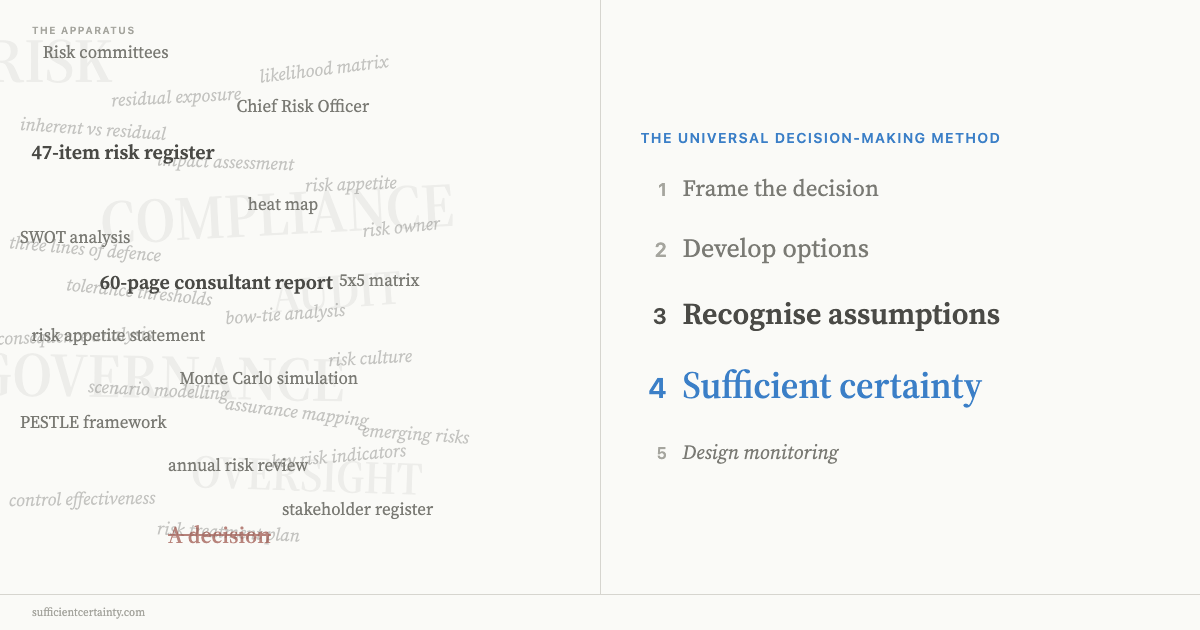
Decision fatigue in organisations is the cognitive breakdown that occurs when the machinery built around decisions consumes more bandwidth than the decisions themselves. The Universal Decision-Making Method replaces that machinery with a structured process for surfacing the assumptions that actually matter. Risk committees, risk registers, risk appetite statements, compliance rituals, consultant reports: the apparatus is vast, and it produces everything except a decision.

I have watched this pattern for nearly fifty years. Executives sit with the same paper on their desk for weeks. Committees meet, discuss, defer, and meet again. The board asks for one more analysis. The risk team produces another register. Six months pass and nobody has decided anything. They are not tired from deciding. They are exhausted from the apparatus that has been built around decisions.

The risk management apparatus versus the five-step Universal Decision-Making Method
The risk management apparatus versus the Universal Decision-Making Method.
Click to expand

Why the willpower explanation is wrong

The ego-depletion model does not explain what happens in organisations. The popular account says you make too many decisions in a day, each one uses up some fixed cognitive resource, and by afternoon your judgement is shot. It is a neat story. The research behind it has been in trouble for years. Replication work has not supported the claim that decisions drain a fixed mental battery. Even the famous parole-after-lunch finding is shakier than people pretend.

The real problem is not the lab evidence. It is that the willpower story does not explain what happens inside organisations. When a board has spent six months unable to close on a restructure, the delay has nothing to do with how many emails anyone answered that morning. The delay comes from a process that gives Deciders everything except what they need: a structured way to name their assumptions and determine whether they have sufficient certainty to act. The decision overload people describe is real. The attribution to depleted willpower is wrong. The cause is process.

The full evidence trail, from Baumeister's original model through three failed replications to a 2025 healthcare study that ruled the effect out entirely, is in Is Decision Fatigue Real?

Is decision fatigue scientifically proven?

The experience is real. People in organisations genuinely reach a point where they cannot face another decision. That is not in dispute. What is in dispute is the mechanism. Roy Baumeister's ego-depletion model, which launched the idea in the late 1990s, proposed a fixed pool of mental energy that empties across the day. A 2016 multi-lab replication across 23 laboratories found the effect size near zero. A 2025 paper in the National Institutes of Health archive (PMC11865449) put the point bluntly: the ego-depletion effect does not replicate, and the fixed cognitive resource it assumes has no solid evidence behind it.

None of this means the fatigue is imaginary. It means the popular explanation does not hold up as a general mechanism. In organisations, a better question is more useful than a better lab study. Not "does it exist?" but "what produces it?" When a board spends six months unable to close on a restructure, the cause has nothing to do with anyone's glucose levels. It has everything to do with a process that generates registers, reports, and committee meetings without ever surfacing the assumptions that actually matter.

Why the standard advice is wrong

The standard advice for decision fatigue treats it as an energy problem, and it is not. Sleep more. Eat well. Decide in the morning. Reduce trivial choices. Barack Obama wore only grey or blue suits. Mark Zuckerberg wore the same grey T-shirt every day. The logic is always the same: eliminate small decisions to save energy for the big ones. Perfectly sensible for what to eat for lunch or which email to answer first. Useless for the decisions that actually stall organisations.

When a board has spent six months unable to close on a restructure, nobody in the room is short on sleep. They have been burdened by the mythology of risk management, not by the act of choosing. Telling them to rest more is like telling a swimmer to breathe better while someone has tied weights to her ankles. The cause is the apparatus.

The apparatus that causes the fatigue

The cause is a belief system. Despite "risk management" having no solid foundation or universal meaning, its advocates created a perception in those responsible for governance that it was good and should be adopted. The entirely untested belief was that practising it was prima facie evidence of sound management. Belief systems inevitably start with the answer rather than with careful and objective definition of the problem. If "risk management" is the answer, Roger Estall and I would ask, what was your question? The response, more often than not, is genuine puzzlement.

Four groups sustain this belief system. First, governance aspirationalists: directors and executives who genuinely want to do the right thing and assume, without compelling evidence, that anything bearing that label will contribute to that. Second, consultants and in-house specialists who fostered the fiction, often with evangelical zeal, that mastery of the artificial edifices and jargon of their scheme was the key to organisational success. Third, standards bodies codifying beliefs into published codes, giving the appearance of creating knowledge through what is, in substance, a committee's opinion. Fourth, regulators imposing compliance obligations that force organisations to seek guidance from the first three groups.

From this confusion grew risk committees, Chief Risk Officers, risk policies, risk appetite statements, and the risk register. The practical task of filling out registers invariably distracts Deciders from gaining the confidence that their decision will deliver the required outcomes. It is very rare that registers are actually used in decision-making, or even accessible to Deciders.

"Risk management" does not pass the pub test in the eyes of most Deciders. It hinders rather than helps them to decide, and so it is either ignored or paid lip service. The apparatus consumes cognitive bandwidth. The decisions do not improve. That is decision fatigue in organisations.

What decision fatigue looks like in organisations

Enron Corporation, the seventh-largest publicly listed company in the United States. By early 2001 its stock traded above $100. Within months it dropped to a few cents and the company went bankrupt. The cause was deceptive and illusory accounting practices that the full apparatus failed to surface. Enron's auditors, the hitherto widely respected Arthur Andersen, had been fulsome in their praise of Enron's risk management practices. Arthur Andersen collapsed in the aftermath. The apparatus was not absent. It was celebrated, right up to the moment everything it was supposed to prevent had already happened.

Boeing 737 MAX. Both manufacturer and regulator maintained the full apparatus. The flight control software relied on a single angle-of-attack sensor. The assumption that one sensor was sufficient for a safety-critical system was never surfaced or challenged. 346 people died in two crashes. The worldwide fleet was grounded. The apparatus was fully assembled. The assumption that mattered most was never named.

Brisbane, Wivenhoe Dam, January 2011. Operators had real-time inflow data, Bureau of Meteorology forecasts, and a rule-based operating manual prescribing exactly when and how much water to release. They followed the manual without questioning whether the assumptions it rested on still held. The subsequent flood caused billions in damage. The inquiry produced 177 recommendations. 177 recommendations is not a decision. It is a catalogue.

Australian Royal Commission into banking. Every major bank had risk committees, Chief Risk Officers, risk appetite statements, risk policies, and formal risk reporting. The full apparatus. The Royal Commission found a deeply disturbing trail of unethical and, in some cases, criminal conduct: knowingly charging for services never provided, harshly treating borrowers who had succumbed to natural disasters, providing investment advice that benefited the institution rather than its clients. The belief system and its edifices, on which shareholders, customers and regulators had relied as evidence of good governance, failed miserably.

In every case, the organisation had more process, not less. The process consumed bandwidth. The decisions suffered.

I wrote about four more decision fatigue examples that follow the same pattern across aerospace, healthcare, construction and banking.

What replaces the apparatus

Roger Estall and I built the Universal Decision-Making Method over decades of work with people making hard decisions in mining, finance, aviation and public health. We did not set out to create a remedy for the apparatus described above. We set out to answer a simpler question: what do people who decide well actually do?

The answer was consistent. Good Deciders, whether airline pilots or board chairs, apply the same five steps. The method makes that structure explicit.

Step 1: Frame the decision. State the organisation's Purpose. Name the opportunity this decision addresses. Define the desired outcome, the intended duration, and the Context across three bands: internal features of the organisation, external stakeholders and dependencies, and wider influences. Most organisations skip this entirely. They jump straight to cataloguing what might go wrong without ever articulating what they are trying to achieve.

Step 2: Develop options. State what you are actually thinking of doing. Primary elements are the core actions. Secondary elements are safeguards, contingencies, and monitoring arrangements. The options are tentative. You are not committing yet. You are stating a direction clearly enough to test it.

Step 3: Recognise assumptions. Every decision rests on assumptions. Some are well-founded. Some are guesses that have never been examined. Name them. Then assess each on two dimensions: its influence on the desired outcome, and your confidence that it will hold. This produces four zones of significance: Critical (high influence, low confidence), Important, Relevant, and Limited. The Critical assumptions are the ones that will break your decision if they turn out to be wrong.

Step 4: Sufficient certainty. Not "have we identified all the risks?" but "do we have sufficient certainty to proceed?" If yes, proceed. If no, adjust the decision or the assumptions and return to Step 3. The method loops between Steps 2, 3, and 4 until you reach that point or conclude that the decision needs reframing. That loop is not indecision. It is the method working.

Step 5: Design monitoring. Name the conditions that would tell you the decision needs revisiting. Specify what you will watch, who will watch it, and what triggers a revision. Build this into the decision before it leaves your desk, not after something goes wrong.

Five steps that cut through decision fatigue. No register. No matrix. No committee. The method applies whether the decision takes ninety seconds in a cockpit or three years in a boardroom.

Decision fatigue at work and in leadership

In practice, the method replaces a mountain of process with the five or six assumptions that drive the decision. A VP of operations at a mid-size manufacturer. A plant-closure decision. A board meeting in six weeks. She has spent $80,000 on a strategy consultant who delivered a 60-page report. Her risk team produced a 47-item register with a colour-coded heat map. She has a SWOT analysis, three scenario models, and a stack of papers she has not opened since the week they arrived. She still cannot decide.

If she sat down with the method, she would spend her time on five or six assumptions that actually drive the plant-closure question. The workforce cannot be redeployed. Relocation costs will fall within a certain range. The market for the plant's output will not recover. Capital expenditure on retooling exceeds the available budget. Each of those is either Critical or Important. Each can be assessed for influence and confidence. The remaining 41 items on her register can be set aside, because they are either Limited in significance or duplicates of assumptions she has already named.

She leaves with a Decision Record: what she decided, what she assumed, how significant each assumption was, and what would trigger a review. That is what her board needs. Not 60 pages of analysis. Clear reasoning she can defend. That is what the method exists for: the person who has to commit, not the person who has to catalogue.

When that person is a board director, the apparatus is even more elaborate. Executive decision fatigue comes not from too many decisions but from too much governance between the executive and the decision.

Sufficient certainty, not maximum certainty

The apparatus described above exists because organisations pursue maximum certainty. They want to eliminate all uncertainty before they commit, so they build more process. One more analysis. One more committee review. One more round of consultation. Each step feels responsible. Each delays the decision. Each consumes the bandwidth that should go to the decision itself. Analysis paralysis is simply the pursuit of maximum certainty by another name.

The blood imports case shows where this leads. Several countries, responding to contamination concerns, suspended imports from suspect sources to achieve maximum certainty that no tainted blood would enter the supply. They got what they pursued. And the resulting shortage killed people. Not from contaminated blood, but from insufficient blood. The Deciders had pursued the greatest possible certainty on one question and created worse outcomes on another. Greater certainty invariably has a price. Sometimes that price is measured in lives.

Sufficient certainty asks a different question. Not "have we covered every risk?" but "for each assumption that matters, do I have enough confidence to proceed, given what is at stake?" It does not mean the greatest certainty possible, because that could be wasteful of resources. It means enough, calibrated to the decision, not to an abstract standard of rigour.

The Universal Decision-Making Method gives you a structured way to know when you are there. Not a formula. Not a score. A way to name what you are resting on and determine whether it is enough. When you reach that point, you decide. When you do not, you adjust. That is what eliminates decision fatigue. Not more energy, not fewer breakfast choices, but a process that uses the energy you have on the decision itself instead of on the apparatus around it.


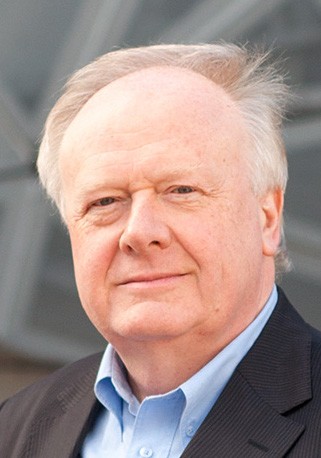
Grant Purdy is the co-author, with Roger Estall, of Deciding (2020), and the architect of the Universal Decision-Making Method.

If you have a decision you are working through, the Walk can help.

Start a Walk