
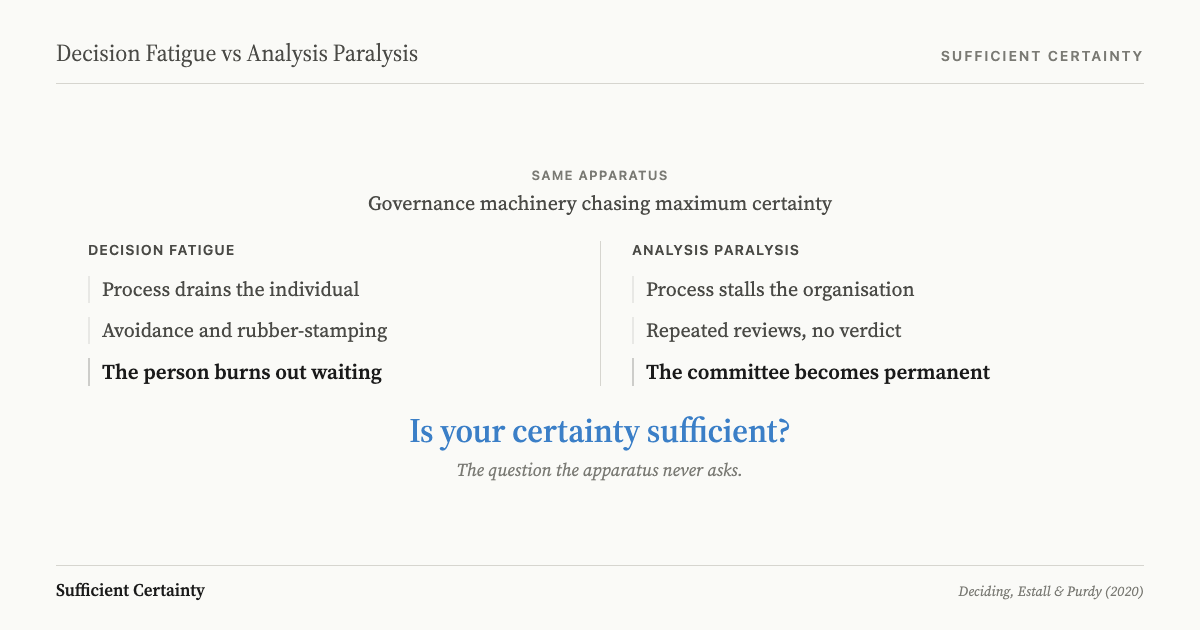
Decision fatigue vs analysis paralysis looks like two different problems. It is not. One exhausts the person, the other stalls the group, and the same overbuilt decision apparatus causes both. Adding a person to the buying group drains the individual and multiplies the delay. Same root cause, two symptoms.
People use "decision fatigue" and "analysis paralysis" as if they mean the same thing. They do not. Decision fatigue exhausts the person sitting in the committee. Analysis paralysis stalls the committee itself. Same room, same afternoon, two different failures.
Decision fatigue vs analysis paralysis is not a difference of degree. One drains the individual because the process never produces clarity. The other jams the organisation because nothing in the process signals when to act. Both result from governance apparatus chasing maximum certainty instead of .
Decision fatigue vs analysis paralysis distinguishes personal depletion during repeated choices from a decision process that keeps delaying commitment.
Decision fatigue vs analysis paralysis: what separates them
| Decision fatigue | Analysis paralysis | |
|---|---|---|
| Experience | Exhaustion from process | Inability to close |
| Who feels it | The individual Decider | The group or committee |
| Visible sign | Avoidance and rubber-stamping | Repeated reviews and "further analysis" recommendations |
| Root mechanism | Process drains energy without producing clarity | Process generates analysis without ever forcing a verdict |
| What it costs | Time and quality of the eventual decision | Delay and mounting costs of inaction |
In both cases the Decider is not weak or incompetent. I have sat through enough committee meetings to see both symptoms in the same room at the same hour. The individual members are visibly drained; they have read the same material three times. And the committee as a whole cannot close. Nobody is stupid. The process is designed to circulate, not to land.
One VP told me: "Every time I think I've decided, someone raises something and I'm back to square one." She wanted to think the decision through properly, not just thoroughly. "Thoroughly" is what the apparatus demands: more review and more sign-off. "Properly" is what the method asks: name what the decision rests on and assess whether confidence is sufficient.
How to tell which one you are facing
The test is one question. Ask the room: "What would change your mind?" If nobody can answer because the process has drained them past the point of caring, that is decision fatigue. They are not confused. They are spent. If nobody can answer because the process has never defined what "enough" looks like, that is analysis paralysis. They are not tired. They are trapped in a loop that has no exit condition.
In practice you will often see both in the same meeting. The individual members are depleted and the committee cannot close. When someone suggests parking the decision for further review, check which symptom is driving the request. If the Decider is spent, the process has too many steps between input and verdict. If the group is stuck, the process has no mechanism that forces a verdict at all. Both need the same underlying repair. But the entry point differs, and misdiagnosing one as the other wastes the intervention.
Work the stuck committee decision through the five steps and see whether exhaustion or over-analysis is only the symptom. Start the Walk →
The same apparatus drives both symptoms
Gartner found in 2019 that B2B purchasing groups now average six to ten people. Seventy-seven per cent of those buyers called their last purchase "very complex or difficult." Only seventeen per cent of the buying cycle involved suppliers; the rest was internal deliberation and governance process. Each additional person at the table simultaneously fatigues every individual and prevents the group from converging. The machinery does both at once, and nobody with budget authority is paid to simplify it.
Four groups keep the apparatus in place. Insurers need it to justify premiums. Regulators need it to demonstrate oversight. Academics build careers publishing about it. Consultants need it to stay billable. Each has a reason to add another requirement and another report. None has a reason to ask whether the Decider already has enough certainty to act.
Herbert Simon settled this in 1955: people do not optimise across every variable. They adopt the first option that meets an acceptability threshold. I have watched committees try to do the opposite for decades. The apparatus asks for exhaustive risk identification and complete certainty. Committees that attempt it do not become wiser. They become permanent. And permanent committees need permanent staff, which is how a process sold as protection becomes a jobs program for the people running it.
Scheibehenne, Greifeneder and Todd found in 2010 that choice overload bites under two specific conditions: high complexity and unclear preferences. Those are precisely the conditions the governance apparatus manufactures. I have never met a risk committee that clarified preferences. They produce ratings and heat maps that tell the Decider nothing about what the decision rests on. Nobody on the committee minds. The ratings give everyone cover. The process ran. The boxes were ticked. If the decision fails, the committee points to the register and says it did its job. That is the point of the register. Not the decision. The cover.
Decision fatigue vs analysis paralysis: what resolves both
In Deciding, Roger Estall and I built the Universal Decision-Making Method around a binary question at Step 4: is your certainty sufficient? If yes, act. If no, get the missing information or change the decision. The apparatus has never asked that question. It generates analysis because nothing in its design forces a verdict.
The blood imports case shows what happens when the apparatus runs unchecked. In the 1990s, the United Kingdom suspended imports of blood-clotting products to maximise certainty about contamination. The resulting shortage left haemophilia patients without treatment and people died. Pursuing maximum certainty on one dimension produced a worse outcome than sufficient certainty would have. It is the same pattern in every boardroom. Maximum certainty means every concern at the table must be fully resolved before anyone acts. The individual burns out waiting. The organisation stalls deliberating. The governance staff who designed the process collect their fees regardless.
Decision fatigue and analysis paralysis are not separate problems. They are two readouts from the same broken instrument. The person is exhausted and the organisation is stuck, and the people who sold them the instrument are booked for next quarter's review.
You could blame fatigue again and miss what stalls your next committee.
Work through your decisionNo sign-up. Just pick your decision and start.
Grant Purdy is the co-author, with Roger Estall, of Deciding (2020), and the architect of the Universal Decision-Making Method.