
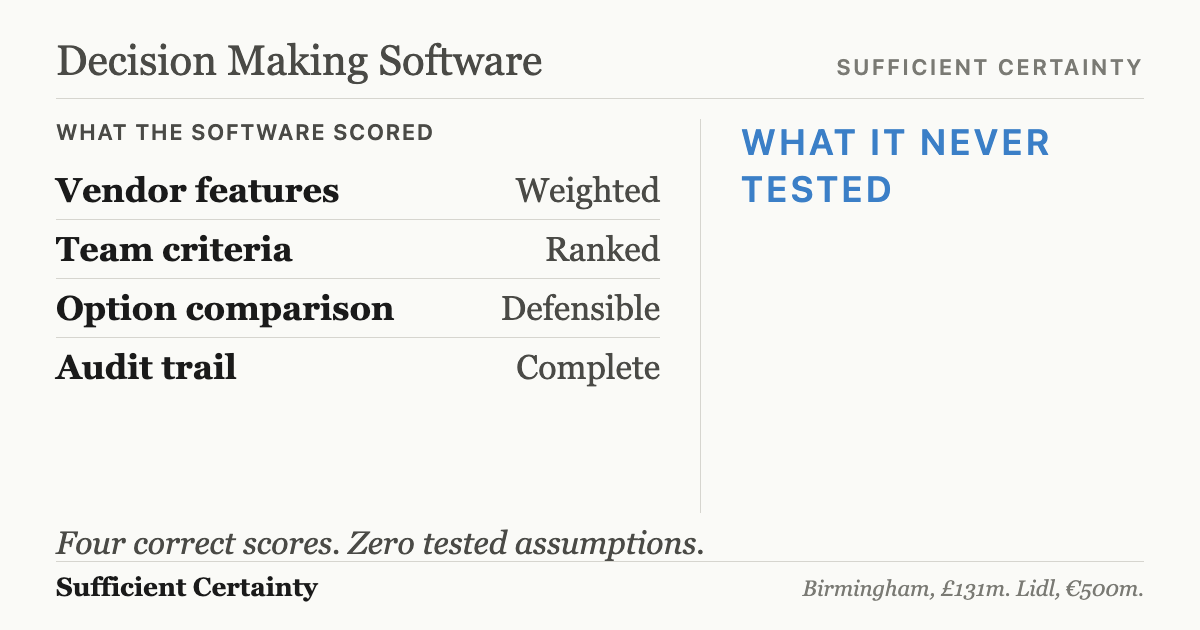
Decision making software scores your options correctly. Every platform on the market does the same thing: weights criteria, ranks alternatives, produces a number. Not one of them tests whether the assumption underneath your top-ranked option will actually hold. That is the step where decisions break.
Birmingham City Council scored its vendors, picked Oracle Fusion, and went live in April 2022. The project, budgeted at £19 million, reached £131 million with the system still not functioning. The council effectively declared bankruptcy in September 2023. The scoring had been correct. The assumption underneath it, that Oracle Fusion could be customised without fundamental process redesign, was never tested.
No decision making software on the market would have caught that. They all do the same thing: score what you listed, rank what you compared, and stop. I built the Walk because nothing else tests whether the assumption underneath your top-ranked option will actually hold before you commit the budget.
Decision making software is any application that structures a choice by scoring, ranking, or visualising options against stated criteria so that a group can compare alternatives and select one.
What decision making software covers
The software does what it promises. A weighted scoring matrix collects criteria from the people who will live with the decision, assigns importance to each criterion, and produces a number for every option. The number is defensible. It reflects what the group said mattered.
Collaboration platforms let distributed teams contribute criteria and vote asynchronously, which solves the scheduling problem that used to stall procurement decisions for weeks.
I once watched a hiring panel use a scoring matrix to select an accounts-payable clerk. The matrix scored correctly against every stated criterion: qualifications, experience, references, interview performance. The panel chose a candidate, and the selection held up to scrutiny. A software platform would have produced the same ranking, probably faster, with an audit trail attached. The problem was not the score.
The problem came later, when the conditions the panel had assumed about the control environment and the integrity safeguards around that role turned out to be wrong.
Decision making software solves a real coordination problem. It removes the subjectivity that stalls procurement committees and the scheduling friction that delays team evaluations. The difficulty is not that the scoring fails. The difficulty is that the scoring succeeds, and the organisation treats a correct score as a sound decision.
When decision making software is enough
For a bounded choice with a containable downside, decision making software is enough. Selecting a catering vendor for an annual event. Choosing between two office-furniture suppliers. The consequences of getting it wrong are real but limited. The assumptions underneath the choice are few and largely visible.
Software handles this well, and the market reflects it: Gartner reported in 2024 that a third of organisations had deployed decision intelligence platforms, with another 17 per cent committed to doing so within six months.
The line moves when the decision carries material commitment and the assumption underneath the preferred option touches people, capital, or the organisation's direction. An enterprise system that will run every financial transaction for a decade. A market entry that depends on a regulatory condition nobody has verified. At that point, scoring options is necessary but not sufficient.
You need something that tests whether the conditions you are assuming about your top-ranked option will actually hold.
That is where the Walk sits. It does not replace the scoring. It picks up where the scoring stops and tests whether what you are assuming about your preferred option is true. If you are choosing between caterers, you do not need it. If you are committing to an enterprise platform, you do.
Write down the assumption underneath the option your scoring matrix just ranked first, and ask whether anyone has tested it. Start the Walk →
What decision making software skips
Lidl spent €500 million over seven years trying to implement SAP for Retail as its enterprise management system. The evaluation had been thorough. SAP was a defensible choice on the criteria Lidl had stated. The project ran from 2011 to 2018, and at the end Lidl abandoned the entire implementation and went back to its old system.
The core conflict was elementary: Lidl valued inventory at purchase price, SAP for Retail used retail price. That assumption about data-model compatibility was never tested before the commitment was made.
Subsequent analysis showed that Lidl demanded customisation rather than process adaptation. Each workaround introduced new dependencies, and each dependency made the next workaround more expensive. After seven years the system was too fragile to operate and too expensive to abandon gradually, so Lidl pulled the plug and reverted to the legacy platform it had been trying to replace since 2011.
The vendor comparison had done its job. It identified which software had the features Lidl needed. What it could not do was test whether Lidl's operating model was compatible with the platform it had just scored highest.
That is what decision making software skips. It operates on what you already know: the criteria you have listed, the weights you have assigned, the options you have identified. It does not surface what you are assuming about those options. I wrote separately about what a risk based decision making tool needs to do, and the answer is the same. The tool must test assumptions, not just rank alternatives.
The Walk forces that test before commitment. You state the assumptions your preferred option rests on. You examine whether each one gives you sufficient certainty to proceed. If one does not, you either find the evidence or change the option. The decision does not move forward until the assumptions hold. Birmingham and Lidl both scored their vendors correctly. Neither tested the assumption underneath. The scoring was sound but the decision was not.
What the Walk produces
The Walk produces a Decision Record. It is a written document that records what was decided, why, what was assumed, and what would need to change for the decision to reopen. Each record is built from the specific assumptions that surfaced during the process, because the assumptions that matter are different for every decision.
A hiring record tests different assumptions from a technology selection. A market-entry record tests different assumptions from a restructure. The record belongs to the people who made the decision, not to the software that scored the options.
I designed the Walk around the Universal Decision-Making Method that Roger Estall and I described in Deciding. It takes you from framing what you are actually deciding through to setting the monitoring that tells you when to revisit. The critical middle step is testing whether each assumption underneath your preferred option gives you sufficient certainty to proceed.
The Walk works for any decision where the downside of getting it wrong is not containable. The full method is described on the method page.
A decision making tool for project management that stops at scoring leaves the project sponsor holding a ranked list and an untested assumption. The decision making tool that catches what matrices miss is the one that tests the assumption before the money moves.
You could score every vendor correctly and still commit to the one whose core assumption nobody tested.
Work through your decisionNo sign-up. Just pick your decision and start.
Grant Purdy is the co-author, with Roger Estall, of Deciding (2020), and the architect of the Universal Decision-Making Method.