
74% of startup failures trace back to one mistake: committing resources before the assumption underneath the commitment was tested. Not the wrong option. The untested premise behind the option everyone liked. This page gives you the method that finds it before the money moves.
I watched an advisory board approve a growth plan in under an hour. The founder's deck ran to twenty-two slides: market size, competitive positioning, customer acquisition costs projected from a three-month pilot, and a hiring plan that would double headcount in four months.
The board discussed the projections, praised the ambition, and moved to next steps. Nobody asked what the plan was actually assuming (not hoping, not projecting, but assuming) about customer retention at the new price point.
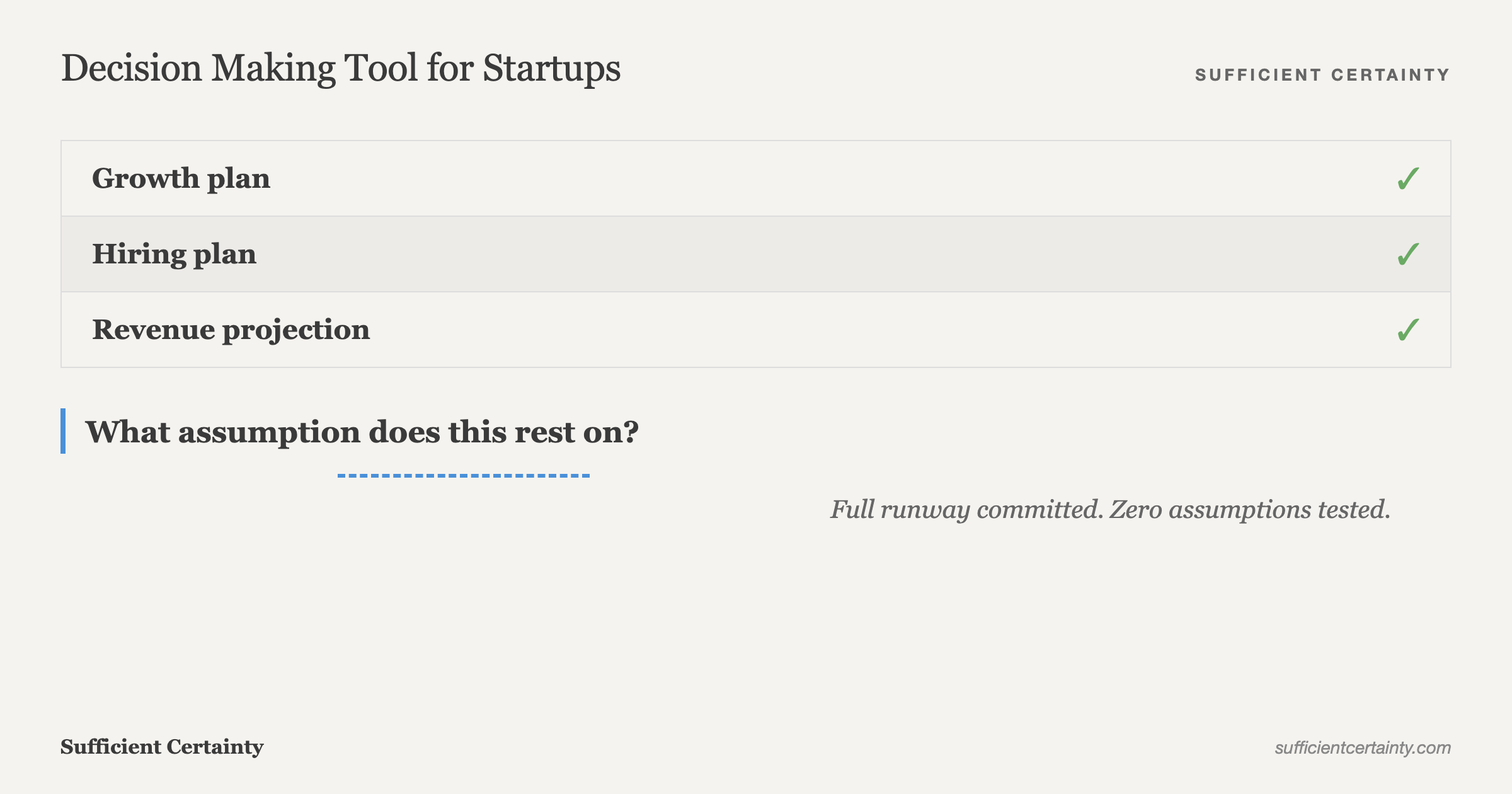
The team had market research, a financial model, and experienced advisors in the room. What it did not have was a decision making tool for startups that forced anybody to name what the growth plan was assuming and what evidence supported that assumption before the hiring commitments locked.
I built the Walk so that a startup team can move from proposal to Decision Document in a single session, with every assumption surfaced and a monitoring signal agreed.
A decision making tool for startups is a structured method that forces founders to separate what they know from what they are assuming before committing runway to a decision.
Why startup decision tools do not test assumptions
Search for a decision making tool for startups and every result on the first page offers a framework comparison or a software product. The listicles rank RACI, RAPID, and decision matrices by team size and use case (as though the tool itself were the decision); the SaaS pages promise dashboards and automated workflows.
Both types assume the startup already knows what matters and needs only to choose between known options. In my experience, that assumption is where decisions break. The thing that kills the decision is not the option they chose but the premise they never tested.
The Startup Genome Project studied 3,200 high-growth technology startups and found that 74 per cent failed due to premature scaling: committing resources before the assumptions behind the growth model were tested. Not one startup that scaled prematurely passed 100,000 users.
That is premature commitment of resources, and no decision making tool that ranks options can prevent it, because the scaling decision rests on assumptions about market readiness that no ranking process surfaces. The Walk forces the team to name those assumptions and test them against evidence.
The revenue assumption nobody tested
The Messenger launched in May 2023 with $50 million in investment, hired more than 300 staff (reporters, editors, sales, operations) within months, and projected $100 million in first-year revenue. Actual revenue was approximately $3 million, and the startup shut down on 31 January 2024 after eight months of operation.
The entire commitment rested on one assumption: that ad-supported non-partisan digital content could generate revenue at scale in a market where digital advertising rates were already declining. That assumption was, according to Axios, "doubted from the start."
The founder committed $50 million. The assumption that justified the commitment was never stated as an assumption and never tested against the available evidence about the digital ad market.
Name the assumption your growth plan rests on and test it before the runway commits. Start the Walk →
When a startup needs the full method
A spreadsheet and a quick team vote are enough when the choice is bounded and the downside is containable: which project management tool to adopt, which meeting cadence to run, which vendor to use for a reversible operational function. A simple comparison matrix handles those decisions well enough.
The full method matters when the commitment is material and the assumption underneath it, if wrong, burns runway the startup cannot recover.
Hiring a team to build for a market the founders have not validated. Committing to a pricing model based on willingness-to-pay data from a different customer profile. Signing a contract that locks resources for twelve months on a revenue trajectory drawn from three months of data.
Those are decisions where a stated assumption, tested evidence, and a monitoring signal are worth the time.
If the wrong answer costs a week of rework, a comparison matrix is adequate. If the wrong answer costs six months of runway, the team needs a method that tests the assumption against evidence first.
The cost assumption the startup never modelled
Zirtual raised $5.5 million, built a virtual assistant marketplace with 400 workers, and ran the business on a contractor model. The company switched its workforce from contractors to full-time employees without re-modelling the unit economics. The burn rate hit $400,000 per month; investors refused a $3 million emergency funding request; and the company shut down overnight in August 2015.
The contractor-to-employee switch was defensible on its own terms: better quality control, stronger culture, reduced legal exposure. That is a sound operational case. The assumption underneath it (that revenue per client could support full-time employment costs at current pricing) was never tested.
The Walk would have surfaced "can revenue per client cover full-time employment costs at current pricing?" as a testable assumption before the switch, not after the runway was gone.
I have seen the same pattern in organisations far larger than startups. A manufacturer I worked with committed to a new product line based on current tax incentives and regulatory conditions. The government changed the rules between the decision and the outcome.
The commitment was rational at the time. The assumption about stable external conditions was never named as something that could change.
For startups, that risk is sharper: the external conditions that hold at seed stage (customer behaviour, competitive landscape, regulatory environment) can shift materially by Series A, and what was a fact at the time of the decision quietly becomes an assumption nobody is monitoring.
How to find the fatal assumption before you commit
Take the commitment your startup is about to make. Run it through five steps before the resources move.
1. State the decision, not the project. "Should we hire five engineers to build the enterprise tier?" is a decision. "Enterprise expansion" is a slide title. If you cannot write the decision as a sentence that starts with "should we," you are not ready to commit resources to it.
2. Date your context. Write down what you know right now: market size, burn rate, pipeline, competitive position. Date it. Three months from now, when the board asks why you committed, this is the evidence you had. If it is not written down and dated, it does not count.
3. Name what you are assuming. This is where startups die. The growth plan assumes retention at the new price point will hold. The hiring plan assumes the sales pipeline will convert at the pilot rate. The product roadmap assumes the regulatory environment will not change before launch. Write each assumption as a sentence. If nobody in the room can name what the plan assumes, the plan is not ready.
4. Test each assumption against evidence. For every assumption, ask: what evidence do we have that this is true? Not hope. Not projections extrapolated from a three-month pilot. Evidence. Rate your certainty. If the assumption that carries the most risk has the least evidence, you have found the thing that will kill you. Test it before you commit, not after.
5. Set a monitoring signal and name an owner. For each critical assumption, write the condition that would reopen the decision. Assign one person (not a team, not a committee) to watch for it. When the signal fires, the team reconvenes. No signal, no owner, no method: just a slide deck that justified a commitment nobody can reconstruct three months later.
At the end, you hold a Decision Document: the decision, the dated context, the ranked assumptions, the evidence, the monitoring signals, and the owners. One page. Revisitable when conditions shift.
If you want to run these steps on paper first, get the free Decision Workbook and work through a real commitment by hand.
The Walk takes a startup team through that full sequence in a single guided session. I built it because I watched too many founding teams commit runway to assumptions they could have named and tested in an afternoon.
The method does not replace a founder's judgement. It forces the team to state what it is judging and on what basis, which is the piece every framework and scoring product skips entirely.
You could score every framework on the listicle and still commit runway to the assumption nobody tested.
Work through your decisionNo sign-up. Just pick your decision and start.
Grant Purdy is the co-author, with Roger Estall, of Deciding (2020), and the architect of the Universal Decision-Making Method.