
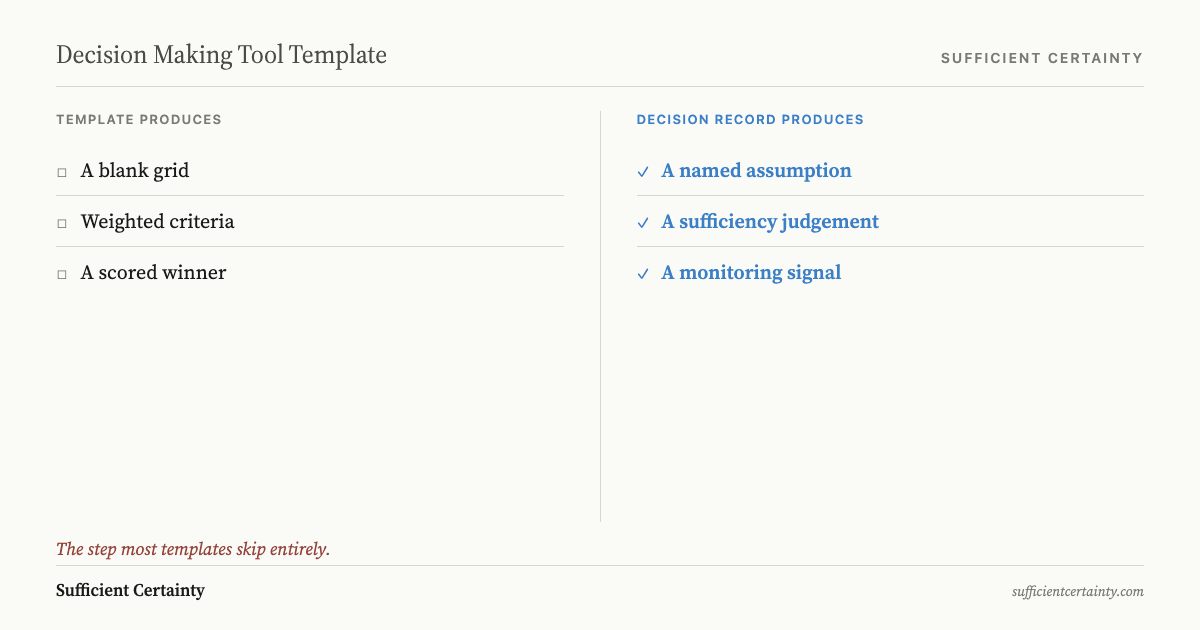
A decision making tool template gives your team a blank grid, a set of weighted criteria, and a scored winner at the bottom. It assumes the hard part is comparison. In nearly fifty years of advising on material decisions, I have never seen one break because the room scored its options incorrectly. They break on the assumption nobody wrote down.
Every free template on the internet will help your team compare options against listed criteria. None will test whether the comparison rests on assumptions that can bear the decision's weight.
Here are five questions your template should answer before the room commits. Most templates cover the first two. The gap starts at question three.
A decision making tool template is a structured form that organises decision options against weighted criteria to produce a comparative score or ranking.
What a scored grid does well
Templates do real work when the options are known, the criteria are agreed, and the team needs a visible comparison before it commits. A weighted matrix or a scoring spreadsheet helps a room see how the choices line up against the factors it considers important, and that visibility has genuine value when everybody already understands the problem they are solving.
A Lawrence Berkeley National Laboratory review of multi-criteria decision analysis examined how these tools behave in practice. Different scoring models produced conflicting rankings from identical input data. The choice of aggregation method changed the winner.
Software tools, the review warned, “can beguile the user with quantitative scores,” creating an appearance of rigour that masks how sensitive the result is to methodological choices the user never sees, let alone tests.
The template’s strength is structured comparison. When a procurement team needs to evaluate three suppliers against price and delivery lead time, a scored matrix does exactly what the team needs: it makes the trade-offs visible and forces the evaluators to be explicit about how much each factor matters. I have used matrices for that purpose, and they worked.
Where templates mislead is in the implicit claim about completeness. The scored output presents itself as the answer; it feels like the end of the process rather than an input to a larger judgement. I have watched rooms treat a high score as a mandate, as though the template had made the decision for them.
Five questions a decision making tool template should answer
1. What decision are we making, and why now? Not “which vendor” or “which site.” The decision is the commitment and the reason it cannot wait. Picking a software platform is a different decision from deciding to consolidate all regional workflows onto a single system. The first is bounded; the second touches every team. Name the real decision before filling in anything else.
2. What options are we considering, and what criteria matter? This is where a scored grid does its best work. List the options, agree on the criteria, weight them. A simple decision tree or a weighted matrix handles this step well. Most templates stop here.
3. What must be true for the preferred option to work? This is the question most templates never ask. Every option rests on assumptions: that demand holds, that the supplier delivers, that the regulation does not change. Name them. Rate how confident the room is in each one. A two-column table works: assumption on the left, confidence level on the right. If the room has not named its assumptions, it is committing to a bet it has not examined.
4. Do we have sufficient certainty in those assumptions? A decision making tool template that skips this step lets the room commit to an assumption it has not weighed. Sufficient certainty is not the same as confidence; it is a judgement that the evidence behind the critical assumption is strong enough to bear the weight of this specific commitment. The method behind the Walk formalises that judgement.
5. What signal would tell us to come back? A decision without a monitoring trigger is a decision the organisation will never revisit, even when the context shifts. Name the metric, the threshold, and the person watching it. If the critical assumption is supplier capacity, name the delivery figure that would force the room back together. If the assumption is regulatory stability, specify the legislative development that would reopen the conversation.
Questions one and two produce a comparison. Questions three through five produce a decision. The gap between comparing and deciding is where most templates leave the room stranded, and where the most consequential mistakes get made.
Name the assumption your scored grid rests on and test whether it bears the weight of the commitment. Start the Walk →
What the workbook looks like filled in
Take a team choosing between three vendors for a two-year services contract. Here is what a typical scored template produces, followed by what the workbook adds underneath it.
Questions 1-2: Scored comparison
| Criterion | Weight | Vendor A | Vendor B | Vendor C |
|---|---|---|---|---|
| Price competitiveness | 40% | 8 | 6 | 9 |
| Delivery quality | 35% | 7 | 9 | 6 |
| Implementation speed | 25% | 9 | 5 | 7 |
| Weighted total | 7.95 | 6.80 | 7.50 |
Vendor A wins the grid. Most templates stop here. The workbook continues.
Question 3: Assumption test
| Assumption | Confidence | Evidence |
|---|---|---|
| Vendor A can deliver at contract volume (pilot was at 50% scale) | Low | Pilot delivered on time. No data at full volume. |
| Regulatory approval granted before Q3 | Medium | Application submitted. Similar approvals took 8-14 weeks. |
| Internal team absorbs integration alongside BAU | Low | No integration resource allocated. Team at capacity. |
Questions 4-5: Sufficiency and monitoring
Critical assumption: Vendor A can maintain delivery quality at the contracted volume.
Sufficiency judgement: Insufficient. Pilot data covers half the required throughput. No reference client operates at this scale.
Monitoring signal: Defect rate above 2% in any delivery month of Q1.
Owner: Operations Lead, reported at monthly steering.
The grid said Vendor A. The assumption test says the evidence behind that score has not been tested at the volume the contract requires. That gap is invisible until someone fills in the second half of the workbook.
What happens when a decision making tool template skips question three
NASA had a hazard assessment template for the Space Shuttle program. Before the loss of Columbia on 1 February 2003, engineers filled in every field during mission reviews and the template produced a clear verdict on foam debris strikes: acceptable risk.
The template’s foundational assumption was a debris-free flight environment, established during the original design. NASA’s risk assessment process had reclassified foam strikes as “in family”: a maintenance issue, not a safety-of-flight concern. The assessment rested on 79+ missions of apparently confirming data, none of which had tested the original design assumption against conditions that differed from those already survived.
During STS-107, a 1.67-pound piece of foam struck Columbia’s left wing at approximately 545 miles per hour. The Columbia Accident Investigation Board found that the debris assessment team’s uncertainty was never communicated to mission management. No manager asked a probing technical question about an assumption that years of apparently successful outcomes had made feel settled. Seven crew members died.
BP’s Texas City refinery told a parallel story before the explosion that killed 15 workers and injured more than 170 in March 2005. The safety scorecard showed personal injury rates significantly below the industry average. By every metric the scoring matrix tracked, the site appeared safe.
The Baker Panel investigation concluded that BP had mistaken improving personal injury rates for acceptable process safety performance. The scorecard measured slips, trips, and falls. It never measured equipment integrity or inspection backlogs, the factors that determined the actual condition of the isomerisation unit.
In both cases the decision making tool template was filled in correctly. The data was real, the scores were accurate within their domain, and the process was followed as designed. Neither template asked question three.
A template is a frame: it includes whatever criteria it was designed to measure and excludes everything else. When the decisive factor sits outside that frame, the template’s output is worse than silent. It is affirmative, telling the room the decision is sound when the room has not yet asked the question that would have changed the outcome.
The printable version
The five questions work on a whiteboard or a blank page. If you want a structured decision making tool template that walks through them in order, the Decision Workbook does that. It includes a meeting template for walking a team through the five questions and a board template for presenting the recommendation on one page. Download is free.
For decisions where the assumption carries real weight, the Walk guides a team through all five questions and produces a Decision Record at the end: a one-page document that names the decision, the critical assumption, the sufficiency judgement, and the monitoring trigger. Roger Estall and I built it because most rooms will not produce that record without structure.
The decision making tool guide covers the wider context.
You could score every option and still commit on the assumption the grid never tested.
Work through your decisionNo sign-up. Just pick your decision and start.
Grant Purdy is the co-author, with Roger Estall, of Deciding (2020), and the architect of the Universal Decision-Making Method.