
Decision making under pressure is not about staying calm. Calm is a demeanour, not a method. The method has to exist before the pressure arrives: which assumptions carry the decision, what would break them, and who owns the call. Build that beforehand or lose it when the clock starts.
At 102 hours, 45 minutes into Apollo 11, the guidance computer started throwing 1201 and 1202 alarms. Then came the 60-second fuel call. Then the 30. Mission Control still had to decide whether the alarms meant abort or carry on. That is decision making under pressure.
Most advice on decision making under pressure flatters the leader by turning the whole thing into a sermon about calm and experience. I have listened to that sermon for years in boardrooms and control rooms, and it survives because calm is easy to admire and even easier to bill for. Method is less glamorous. It also works better.
If the Purpose is clear and the live assumption is named, short time does not make the decision impossible. If nobody has worked out how the decision will be corrected when an assumption fails, the clock becomes cruel. In my experience pressure does not change the job. It strips away the excuses. What determines whether a call is high stakes is not the pressure in the room but the fragility of the assumptions the outcome depends on.
Decision making under pressure is the practice of testing the assumptions a choice rests on before the deadline, so that time constraints reduce scope but not rigour.
What decision making under pressure really tests
In NASA's account of the landing, the Apollo 11 team did not wait for a full explanation of the alarms. They worked on the narrower question. Once Mission Control judged that the 1201 and 1202 alarms reflected computer overload rather than loss of guidance, they had enough certainty for the only decision that mattered, whether a safe landing was still possible with the fuel remaining.
Apollo is useful because the team did not pretend every uncertainty deserved equal rank. They worked out which uncertainty could kill the outcome and which one could wait another minute. I have seen executives do the reverse, giving every loose end equal status until the meeting runs out of time and the decision is made by fatigue. That is not prudence. It is drift dressed up as care.
Roger Estall and I built the Universal Decision-Making Method to stop that drift. I explain the full sequence in decision-making process under uncertainty. Under pressure I want the live assumption named and the abort condition stated. The rest of the diagnosis can wait.
Rehearse the pressured call ahead of you through the five steps and decide what reversal point must exist before alarms fire. Start the Walk →
How decision making under pressure fails when reversal is missing
The FCC's report on Hawaii's false missile alert is vicious on this point. At 8:07 a.m. HST on January 13, 2018, a live statewide alert went out during what was meant to be an internal drill. The public then sat in fear for 38 minutes. HI-EMA needed 13 minutes to issue its first authoritative social-media correction, and the full correction through EAS and WEA did not arrive until the 38-minute mark.
The FCC also concluded that reasonable safeguards and protocols would have prevented both the false alert and the correction delay. People like to blame the operator because blaming one person preserves faith in the machinery. Conveniently, it also lets the people who designed the one-way machinery keep their dignity. Procedure writers love a one-way gate when they never have to reverse a live call.
I have read too many emergency procedures that describe escalation beautifully and mumble about reversal. They are useless when seconds matter. A serious method says who can stop the decision and how the correction is sent. That is part of monitoring, because monitoring in a crisis is not a monthly dashboard. It is the discipline of noticing that an assumption has just failed and dragging the decision back under control.
Qantas Flight 32 shows what the method looks like in a cockpit
Good decision making under pressure reduces a flood of warnings to a sequence people can actually manage. According to the Australian Transport Safety Bureau summary, the uncontained engine failure struck while the A380 was climbing through 7,000 feet after takeoff from Singapore. Debris damaged more than 50 aircraft systems and produced more than 140 cockpit warnings. Even so, the aircraft landed without injury to passengers or crew.
The evidence is embarrassing because it shows trained sequence, not heroics. Managers who admire heroics often do so because sequence would expose how little preparation they funded before the emergency arrived. I have chaired enough incident reviews to know how sentimental people become about performance under strain. They talk about temperament because it cannot be audited, whereas sequence can.
This is the part people mislabel as natural calm. The crew stabilised the aircraft first. Then they sorted the messages by significance and dealt with the next live decision. I see the same failure in executive rooms when someone drops forty concerns on the table and nobody ranks them. The unglamorous work behind making decisions with uncertainty is deciding what must be true now and what can wait.
Why decision making under pressure is built before the pressure
The 2013 New England Journal of Medicine trial put 17 operating-room teams through 106 simulated crises. Teams using crisis checklists missed critical steps in 6 per cent of scenarios. Teams without them missed critical steps in 23 per cent. Ninety-seven per cent of participants said they would want the checklist used if they were the patient. That result humiliates the people still selling courage and composure as if they were a method.
A checklist earns its keep by forcing the sequence into the open before adrenaline and hierarchy make fools of people. Leadership advisers can sell calm far more easily than method, because calm photographs well and method has to survive contact with reality. When Roger Estall and I wrote Deciding, we were trying to make that discipline explicit. People occasionally ask me for my method in a crisis. I tell them it is not a flourish or a speaking style. It is sequence.
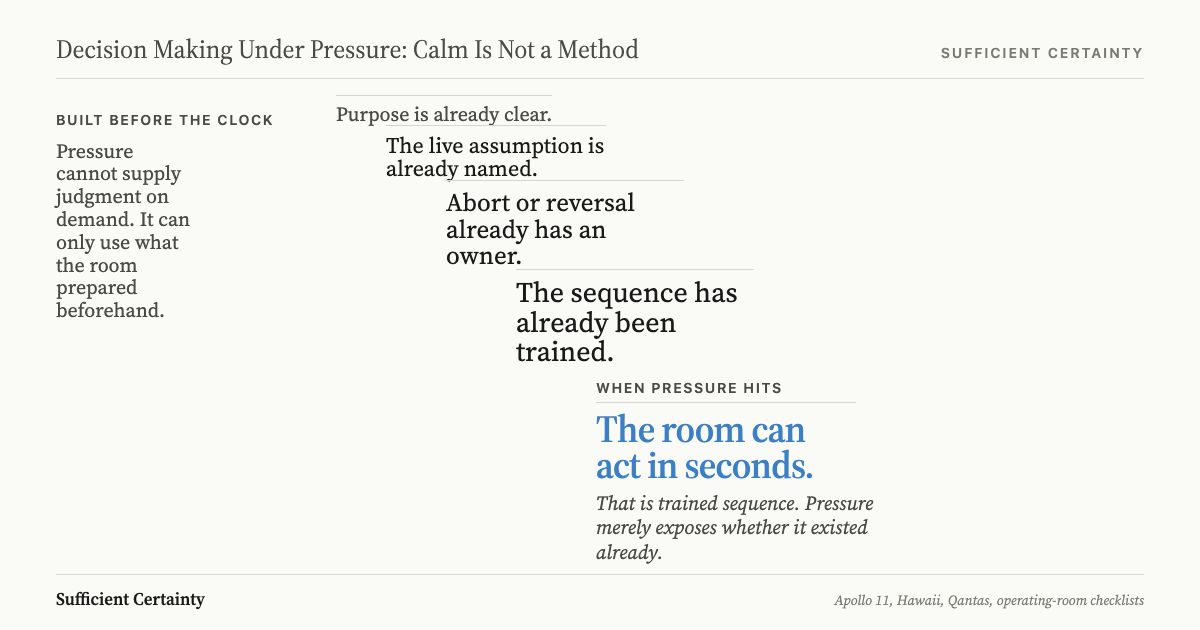
Pressure does not create judgment. It exposes whether the discipline in the broader treatment of leadership under pressure existed before the clock started. If it was not there beforehand, the clock will not kindly supply it.
You could stay calm in the moment and still guess when the alarm hits.
Work through your decisionNo sign-up. Just pick your decision and start.
Grant Purdy is the co-author, with Roger Estall, of Deciding (2020), and the architect of the Universal Decision-Making Method.