
A decision making process under uncertainty works only if it can say what enough looks like before the evidence arrives. After 6.8 million Janssen doses and six clotting cases, the CDC paused in one day. Most boards still cannot describe the threshold that would trigger their own decision.
A director I worked with had six weeks before a board meeting. On her desk were a 34-page market paper and a 14-tab model, with committee minutes breeding in the background. She said she needed a little more work before deciding whether to close one plant and expand another. Nobody around the table objected. More paper meant nobody had to own the call yet. That is how the decision making process under uncertainty is usually bent out of shape before it even starts.
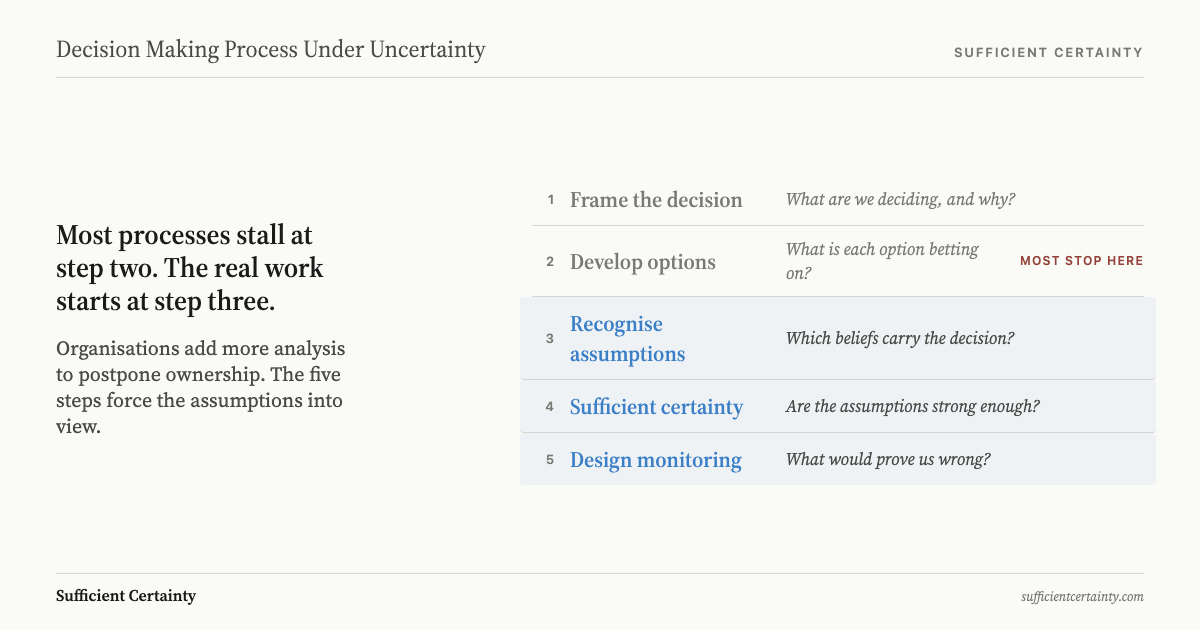
The decision making process under uncertainty means moving from framing a decision through naming assumptions to a point of sufficient certainty before acting. In my experience, boards love the fiction that more analysis can spare them judgement, and that fiction is the central problem in decision making under uncertainty. Consultants rarely complain while the meter is still running.
A decision making process under uncertainty is a way of choosing and revising actions when the most important facts are still incomplete or contested.
Why the decision making process under uncertainty starts with framing
Data without a decision question is scenery. The World Health Organization’s 2025 guidance on modelling for immunisation decisions says the policy question must be defined at the outset and the assumptions examined directly. Quite right. I have no quarrel with models until the room starts treating the modeller as the Decider. Once that happens, the technical work starts running the meeting.
Roger Estall and I put Frame the decision first because the Decider has to state the Purpose and the outcome horizon clearly enough to test whether an option can survive long enough to matter. I use the same discipline for a cockpit call and a capital program: the cockpit gets 90 seconds, while a board can take six months and still ask for another paper, which tells you something about where the appetite for ownership really sits. The decision making under uncertainty example cases show what happens under both kinds of pressure.
Develop options before the facts arrive
The second step is Develop options, and it matters before the future settles down, because the future almost never does. Shell’s scenarios team worked on that in 1972 and 1973 by forcing management to think through an oil shock before the embargo arrived. When the embargo hit in October 1973, Shell later credited that preparation with gains running into the billions through refinery sales and decisions not to replace installations. They had kept choices alive without pretending to have guessed the future.
That is what I want from options under uncertainty. I ask what each option is secretly betting on, and whether that bet deserves the firm’s money or reputation. The moment planners or executives start borrowing confidence from a forecast because it lets them dodge judgement, or leaning on a vivid recent event as though availability bias were evidence, I know the room is drifting toward decision making under deep uncertainty. This is where the decision making process under uncertainty either stays honest or turns into theatre.
Frame the uncertain decision before the facts arrive, then mark what enough evidence looks like for this vote. Start the Walk →
The decision making process under uncertainty turns on assumptions
This is the step most organisations evade because a spreadsheet cannot be left holding the blame. In Deciding, Roger and I used a medium-sized foods manufacturer considering a peanut butter launch with a 10 per cent profit target over 10 years. The real work was naming the assumptions carrying the call, starting with production quality and whether a premium market existed at all.
Once those assumptions are on the page, the fog thins quickly because only a few can sink the decision and the rest is committee upholstery. In my experience, vague registers survive because they are useful to the people maintaining them: they let risk teams and advisers look busy without putting a live belief where a Decider can challenge it. The board secretariat likes the arrangement as well because the pack looks thorough, even when the thinking is evasive. I would rather have one ugly page of exposed assumptions than a polished file of institutional stagecraft. When the system is tangled enough that no single framework can hold it, the discipline does not change; complex problem solving starts with one decision instead of the whole mess. If you want the analytical version of that exercise, I set it out in decision analysis under uncertainty.
Sufficient certainty is the stopping rule
Most bad process under uncertainty has no stopping rule. The CDC and FDA showed one in April 2021. By 12 April, more than 6.8 million Janssen doses had been administered in the United States and six clotting cases had been reported, which triggered a recommended pause the next day. The pause ran from 13 April to 23 April while regulators reviewed the signal and concluded the benefit-risk balance still justified resumed use, with clinical guidance tightened before rollout resumed.
That is Sufficient certainty. One live assumption about safety had become serious enough to stop implementation until judgement caught up with the evidence. Institutions hate that moment because reversing course exposes earlier confidence as borrowed confidence. It is far more comfortable to keep the machine running and hope the numbers stay small.
The decision making process under uncertainty ends with monitoring
The FAA’s response to the Alaska Airlines door-plug blowout on 5 January 2024 shows why the process does not end at approval. On 6 January the FAA grounded 171 Boeing 737-9 MAX aircraft. Return to service depended on inspections and a corrective action plan, with senior FAA leaders continuing to meet Boeing against progress metrics. That is how a Decider keeps the judgement alive while reality answers back.
Roger Estall and I later called the fifth step Design monitoring because too many organisations treat monitoring as housekeeping. In my experience, that demotion is deliberate. The moment you write down what would prove the decision wrong, somebody has to admit what would reopen the call, and that is when the room starts squirming. Call it a nuisance if you like: I keep asking for the trigger that would force a rethink. Monitoring is how the Decider catches a failed assumption while there is still time to revise the decision, and it is the wider discipline of decision making under uncertainty. If nobody has named that trigger, the meeting has not decided anything. It has scheduled its next excuse.
You could ask for one more tab before your next uncertain board vote.
Work through your decisionNo sign-up. Just pick your decision and start.
Grant Purdy is the co-author, with Roger Estall, of Deciding (2020), and the architect of the Universal Decision-Making Method.