
In January 2011, operators at Wivenhoe Dam, 50 kilometres inland of Brisbane, had more information than most Deciders could hope for. Real-time inflow data. Bureau of Meteorology forecasts. A rule-based operating manual prescribing exactly when and how much water to release. They had everything except the one thing that mattered: the manual rested on assumptions that no longer held. The subsequent flood caused billions in damage, and the inquiry produced 177 recommendations. Decision making under uncertainty was not their problem. They had plenty of data. What they lacked was the right question.
The question people ask me most often is some version of "how do I decide when I don't have all the facts?" I have spent nearly fifty years in advisory practice, and my answer has been the same every time: you are asking the wrong question. You never have all the facts. You never will. Every decision is made under uncertainty. The real question is different, and until you learn to ask it, no quantity of data, consultants, or committee papers will help you.
Why Decision-Making Under Uncertainty Feels Impossible
Every decision rests on a mix of facts and assumptions. The distinction matters less than people think, because facts decay into assumptions over time. Setting the price of a new product treats production costs as fact. But production costs change between the decision and its outcomes. Today's fact is tomorrow's assumption.
What matters is not whether you have all the facts. What matters is whether you know which assumptions your decision depends on, how confident you are in each one, and how much influence each has on the outcome you want.
Roger Estall and I developed the Universal Decision-Making Method over decades of work across mining, finance, aviation, and public health. The single most valuable question we found, across every context, was this: "What are the assumptions we are making here?"
That question does more work than any risk register, any Monte Carlo simulation, any scenario-planning exercise. It forces the invisible into the open. Assumptions that remain unstated do not go away. They become the proverbial elephant in the room, and the most dangerous assumptions of all.
Sufficient certainty, not maximum certainty
The Universal Decision-Making Method does not ask Deciders to eliminate uncertainty. It asks them to reach sufficient certainty that the desired outcome will be achieved.
The distinction is not semantic. Chasing maximum certainty has a price, and sometimes that price is catastrophic. When several countries suspended blood imports over contamination concerns, the pursuit of greater certainty on one question caused blood shortages. Mortality increased. People died not from contaminated blood but from insufficient blood. Sufficient certainty means the Decider has surfaced the assumptions, assessed their significance, addressed the critical ones, and judged that what remains is acceptable.
That judgement belongs to the Decider. No formula produces it. No consultant delivers it. As Roger Estall and I wrote in Deciding: "There is no valid formulaic approach that can be used universally to calculate sufficiency. What is sufficient for one Decider might not be sufficient for another."
How to assess which assumptions matter
Not all assumptions carry equal weight. The Universal Decision-Making Method classifies each assumption on two dimensions: its influence on the desired outcome, and the Decider's confidence that it will hold. These two dimensions produce four zones of significance: Critical, Important, Relevant, and Limited.
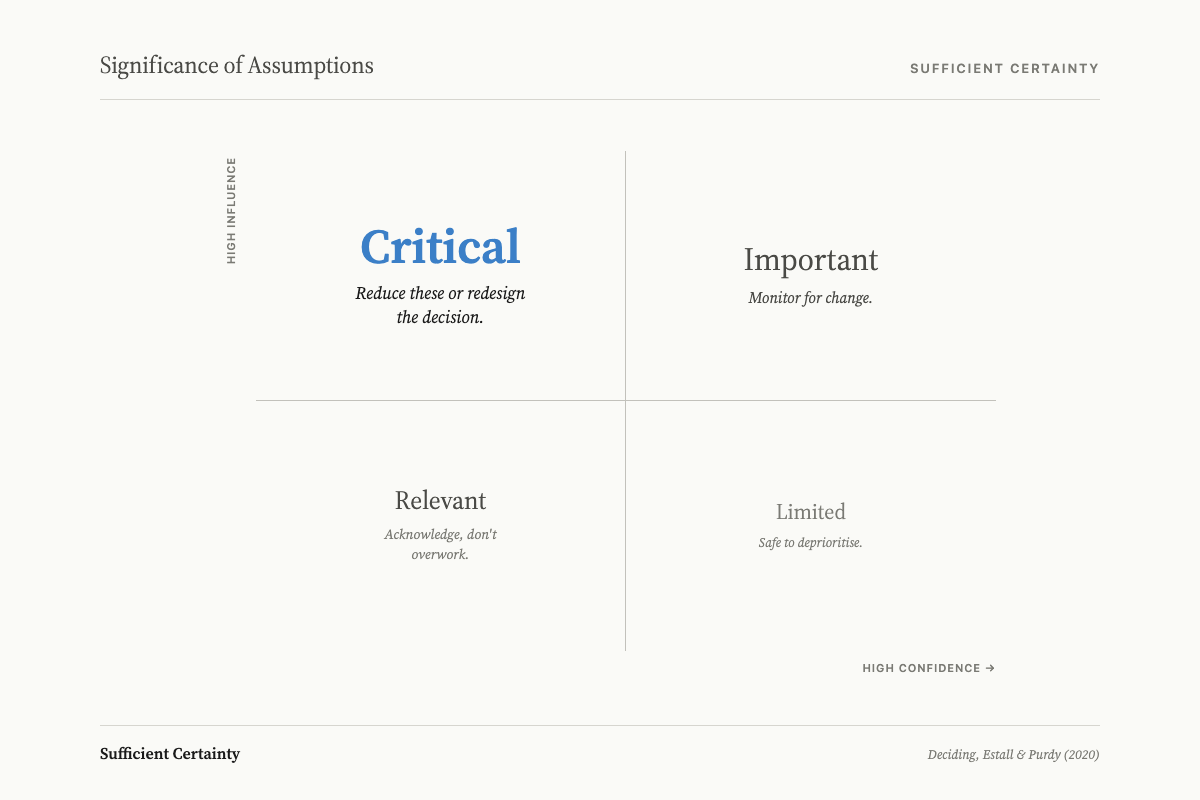
Critical assumptions have high influence and low confidence. They are the ones that will ruin the decision if they break. Limited assumptions have low influence and high confidence and can be noted and set aside. The value of this classification is not in the matrix itself but in the conversation it forces. When a team sits down and asks "how confident are we that this assumption will hold for the life of this decision?", the quality of the decision improves before anyone has taken a single action.
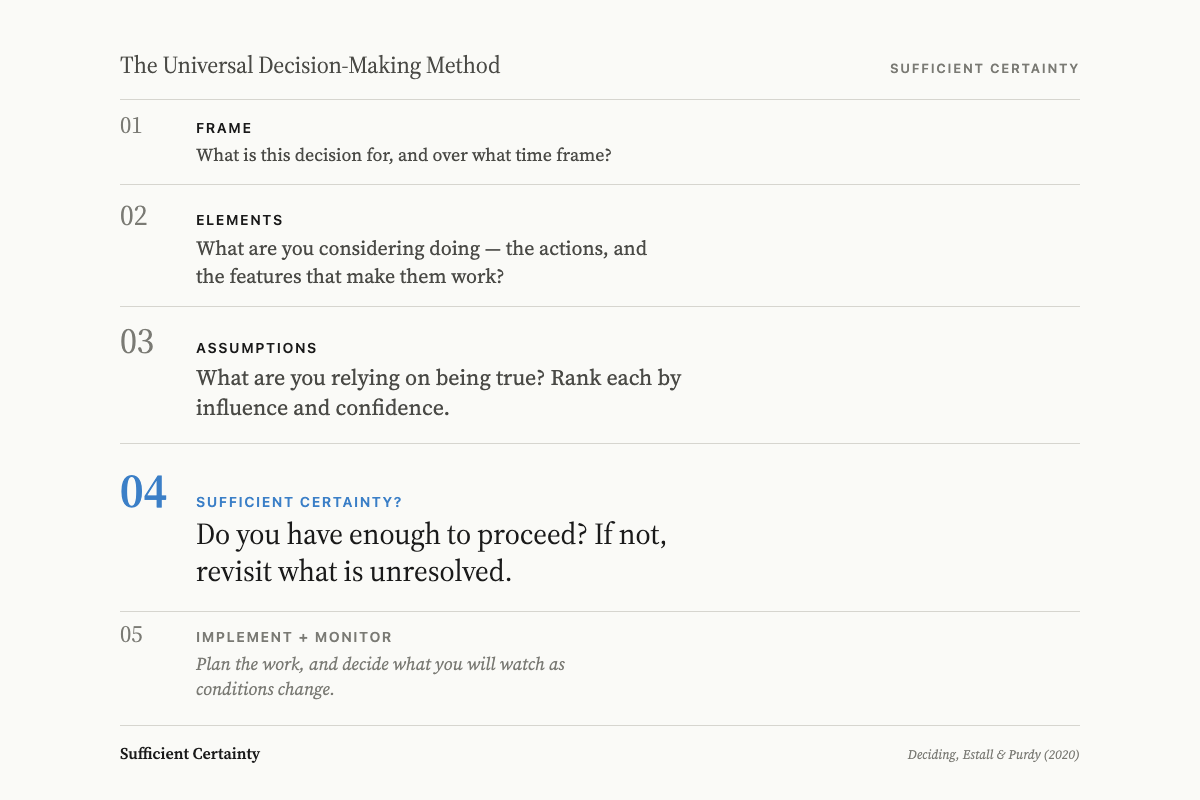
This is step three of five in the method. Surface the assumptions. Classify their significance. Address the critical ones before proceeding. If you cannot reach sufficient certainty after addressing them, adjust the decision and iterate. Decision making under uncertainty is not a one-pass exercise. It is an iterative loop between tentative decisions and assumption testing.
Why more data does not solve the problem
The 2007 Global Financial Crisis demonstrated what happens when Deciders treat models as the decision itself. Ratings agencies and investment banks had sophisticated quantitative models for assessing credit risk. Those models assumed a benign, stable economic environment. When the environment changed, the models continued to produce reassuring numbers. Deciders continued to rely on them. The models were not wrong in their mathematics. They were wrong in their assumptions.
Boeing's 737 MAX certification relied on a flight control system fed by a single angle-of-attack sensor. The assumption that one sensor was sufficient for a safety-critical system was never surfaced or challenged. 346 people died in two crashes. A decision autopsy would have required a single question: what are we assuming about sensor redundancy, and how confident are we?
Enron maintained one of the most elaborate risk-management structures in corporate America. The Australian banking sector passed regulatory reviews for years before a Royal Commission exposed systemic misconduct. The pattern is the same in every case. Extensive analytical machinery that created the illusion due diligence had been done. That illusion is worse than having no machinery at all, because at least then the Decider would know they still need to decide.
Accumulating more data without surfacing the assumptions that data rests on is not decision making under uncertainty. It is theatre.
What to do instead of waiting for all the facts
Captain Chesley Sullenberger had 208 seconds between the moment geese destroyed both engines of US Airways Flight 1549 and the moment he landed on the Hudson River. All 155 aboard survived. He did not have all the facts. He could not know whether the engines could be restarted. He could not know whether he could reach an airport. What he did was what every proficient Decider does: he identified the decision, generated tentative options, tested each against its assumptions, judged which gave him sufficient certainty of the desired outcome, and acted. At 200 feet above the water, he still asked his co-pilot, "Got any ideas?" The reply: "Actually, no." That exchange was the final assumption check. There is no option we have missed.
The 208-second version and the six-month boardroom version use the same method. The difference is proficiency, not process.
If you are facing a difficult business decision and feel paralysed by incomplete information, start with Purpose: not the goal of this decision but the broader Purpose it serves. Name your assumptions and write them down, because every assumption you leave unstated is an elephant in the room. Classify each assumption by influence and confidence, and give your attention to the Critical ones. Build monitoring into the decision before you finalise it: specify what you will watch, who will watch it, and what triggers a revision. Then decide.
Sufficient certainty is the target. Not maximum certainty. Not "one more report." Not "let the committee meet again next month." You will never have all the facts. You have enough when you have surfaced the assumptions that matter most and addressed them honestly. That is what decision making under uncertainty actually looks like. Not more data. Better questions.
Grant Purdy is the co-author, with Roger Estall, of Deciding (2020), and the architect of the Universal Decision-Making Method.
If you have a decision you are working through, the Walk can help.
Start a Walk