
A decision matrix tool works until the decision is one you cannot take back. For a reversible choice the grid is fine: score the options, pick the winner, fix it later if the answer turns out wrong. The moment the choice commits real capital or shuts a door the organisation cannot reopen, the matrix keeps scoring but stops protecting you.
I built the Walk because I watched too many teams use a matrix on exactly that kind of decision. They filled in every cell, produced a clear numerical winner, and discovered months later that the criterion which would have changed the ranking was never on the grid. The arithmetic was correct. The inputs were not. And by then the decision had already been built into contracts, headcount and supplier relationships that could not be unwound.
A decision matrix tool is a scored grid that lists options against weighted criteria and produces a numerical ranking to support a choice between alternatives.
What a decision matrix tool covers
A matrix does one thing well: it forces a team to separate its options and compare them against stated criteria instead of arguing from gut feeling. When the criteria are known and agreed, and when the weights reflect genuine priorities rather than negotiated compromises, the grid produces a useful comparison.
I have no objection to that. For a bounded choice with a short list of known alternatives, a scored matrix is a sensible starting point.
Map any decision onto two axes and the tool's limits become visible:
| Criteria known | Criteria uncertain | |
|---|---|---|
| Reversible | Score and pick. Fix later if wrong. | Score and iterate. Low cost of error. |
| Irreversible | Score, then stress-test the weights. | Stop. Test assumptions before you score. |
Choosing a project management platform sits top-left: reversible, criteria known. The matrix handles it. The question is what happens when a decision sits bottom-right.
The structure also makes disagreement visible. If two people score the same option differently on the same criterion, the room can ask why and settle the gap before moving on. That kind of open argument is more productive than the circular debates I have watched teams repeat for weeks when they have no grid to anchor the conversation.
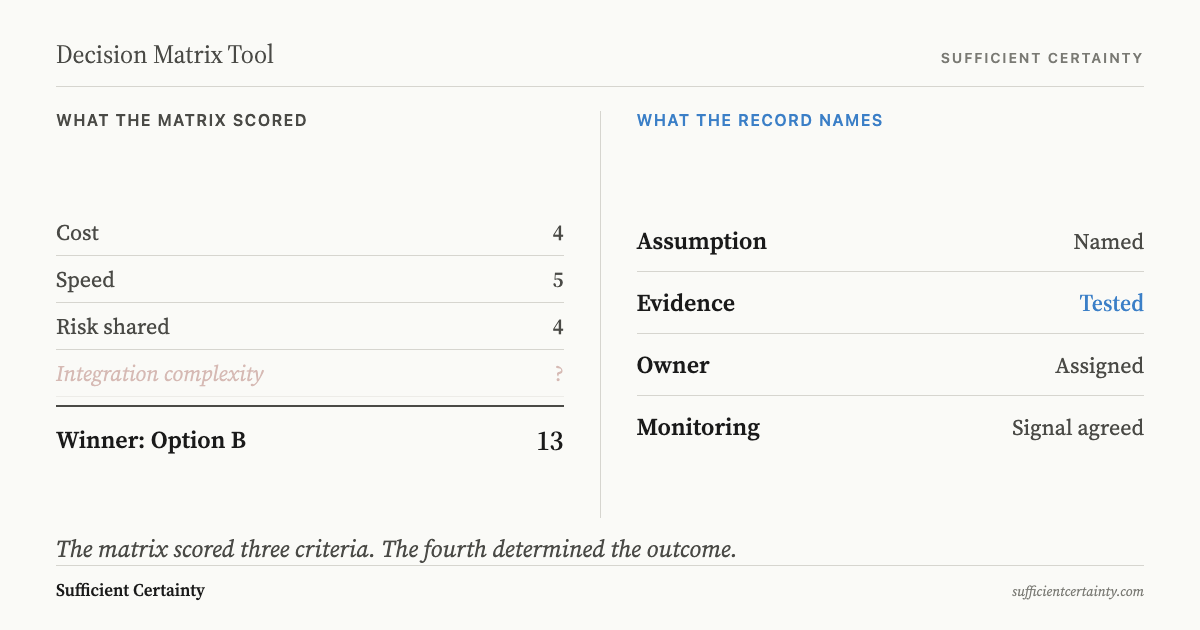
When a matrix is enough
A decision matrix is enough when the criteria genuinely capture what matters and the downside of choosing wrong is containable. Choosing a project management platform for a 12-person team is that kind of decision. If you pick the wrong one, you waste a quarter migrating back; nobody loses their livelihood over it.
Where a matrix becomes dangerous is the moment the downside crosses into territory that affects committed capital or the organisation's licence to operate. At that point the question is no longer "which option scores highest?" but "what are we assuming about the world that must remain true for the preferred option to work?"
A matrix cannot ask that question, because the question lives outside the grid.
The Walk exists for that second question. If the decision on your desk fits the bounded pattern, build the matrix and use it.
Name the criterion missing from your matrix and write the assumption it would have tested. Start the Walk →
What a decision matrix skips
Louis Anthony Cox proved in 2008 that standard scored matrices fail to correctly rank most randomly selected pairs. Ranking inversions are not edge cases; they are structurally guaranteed.
A risk rated "high" by the matrix can have a lower expected loss than one rated "medium" (and often does). The matrix produces a number, and the number is wrong, and nobody in the room can see it because the grid looks precise. That is why any serious risk matrix alternative starts by testing the inputs, not by rearranging the cells.
Thomas, Bratvold and Bickel reviewed 30 engineering papers in 2014 and found that 75% of all scores on 5-point matrices landed on 3 or 4. The matrix appears to offer five categories of discrimination. In practice it offers two.
The scale direction itself changes who "wins": ascending or descending is a design choice buried in the template, and nobody in the room chose it consciously. That is an assumption embedded in the tool's architecture, invisible to the people using it. A formal multi-criteria decision analysis inherits every one of these assumptions and adds more of its own: criterion weights, scale anchors, aggregation rules.
Boeing's 787 Dreamliner program is what this looks like at scale. Boeing used a matrix to evaluate outsourcing 65-70% of the airframe to international suppliers. On any standard risk matrix the decision looked manageable:
| Contained | Serious | Catastrophic | |
|---|---|---|---|
| Likely | Medium | High | Critical |
| Possible | Low | Medium | High |
| Unlikely | Low | Low | Medium |
Boeing's matrix placed supplier risk bottom-left: unlikely failure, contained consequence. The program landed top-right: likely failure, catastrophic consequence. The criteria that would determine whether the program succeeded were not on either axis: integration complexity for novel carbon-composite materials and quality control for processes nobody had attempted at this scale.
The result was 40 months of delay and more than $11 billion in overruns. Five named suppliers (including Alenia and Vought) produced defective components. Boeing sent hundreds of its own engineers to supplier sites to fix problems the selection matrix never anticipated.
The Walk would have forced Boeing's room to state the desired outcome in full: not "reduce cost and share risk" but "deliver a reliable aircraft on schedule." That reframing changes which criteria belong on the grid.
Step 3 of the Universal Decision-Making Method would have surfaced the assumption that 50-plus suppliers could integrate carbon-composite components without Boeing's direct oversight. That assumption would have ranked as Critical: high influence on the desired outcome, low confidence, given that nobody had done this before at this scale.
Roger Estall and I wrote in Deciding that the decision is the decision, not the model output. A matrix can help expose relative influence and confidence, but we reject a universal formula for sufficiency. Do not let a rank or a weighted total impersonate judgement.
The moment a room treats the matrix score as the decision, responsibility leaves the table. People defend the total because owning the assumption would force them to say what could still go wrong.
What the Walk produces
The Walk produces a Decision Record. Without it, nobody six months from now can tell you what the room believed at the time or who was supposed to notice when that changed. The record names the decision, ties it to the organisation's Purpose and dates the Context so the reader knows how fresh the evidence is.
Then it does the part a matrix cannot: it names the critical assumption the preferred option rests on and specifies both the owner and the signal that would reopen the call. That combination is what separates a live decision from a forgotten one.
A decision matrix tool gives a team a ranked list. That list answers the question "which option scored highest on the criteria we chose?" The Decision Record answers a different question: which assumption is doing the load-bearing work, and who is watching it?
The second question is the one that determines whether the decision holds or breaks in the months after the meeting ends. Most post-decision failures I have investigated trace back to an assumption nobody named at the time.
If the assumption is supplier capability, I want a delivery milestone or defect rate that forces the room back together when performance drops below threshold. If the assumption is market demand, I want the order pipeline watched from day one with a named person responsible for raising the flag.
That is what I mean by Design monitoring: naming the signal in advance and assigning the person who acts when it appears.
No decision making tool I have encountered produces that record by default. A quarterly review tells everybody, too late, that the old assumption already expired. A decision you cannot take back deserves more than a ranked list. It deserves a named assumption, a named owner, and a signal that forces the room back together before the consequence arrives.
You could keep scoring options against criteria nobody tested and hope the ranking holds.
Work through your decisionNo sign-up. Just pick your decision and start.
Grant Purdy is the co-author, with Roger Estall, of Deciding (2020), and the architect of the Universal Decision-Making Method.