
A decision making tool for teams should produce one record the room can point to when the decision is questioned. Not a vote, not a score: a dated document that names what the team assumed and what evidence it judged sufficient.
I sat in a cross-functional meeting last year where the team used a weighted scoring model to choose between three supplier options. The scores were close, the discussion was civil, and the recommendation went to the steering committee the same afternoon.
Two weeks later the same three people who had dissented in the original meeting reopened the question. Nobody had tested the assumption underneath the winning option: that the supplier's delivery timeline was achievable given the team's own integration backlog.
The team had a facilitator and a scoring model. What it did not have was a process that separated what the team knew from what it was assuming. I built the Walk so that a team can move from question to Decision Record with every assumption surfaced and the monitoring signal agreed before anyone commits.
A decision making tool for teams is a structured method that requires the team to surface the assumptions underneath the preferred option and judge whether the evidence supports the decision before the team commits.
Why a decision making tool for teams fails when dissent is assigned
Google's Project Aristotle studied 180 teams across the company and evaluated more than 250 team attributes to find what makes teams effective. The starting assumption was that team composition, the mix of skills and relevant experience, would predict performance.
The re:Work guide reports that individual intelligence did not predict team performance; the single strongest predictor was psychological safety, whether members felt safe to take interpersonal risks without fear of punishment or embarrassment. Teams with high psychological safety were rated twice as effective by executives.
That finding matters because it explains why the most popular decision making tools do not fix team decisions. Dot voting and group decision frameworks give teams a mechanism for expressing preferences; none tests whether the team can speak honestly about what it assumes. A team that scores options but suppresses doubt about the underlying question produces the same result as a team with no tool at all.
The standard fix for suppressed dissent is to assign a devil's advocate. Charlan Nemeth's research at Berkeley tested exactly this: controlled experiments comparing assigned devil's advocate dissent with authentic dissent found that assigned devil's advocates produced a paradoxical effect.
The group generated more arguments supporting the majority view, not challenging it. Role-played dissent was discounted because colleagues knew the person did not actually hold the position; the result was cognitive bolstering of the majority, not genuine challenge.
The devil's advocate condition performed no better than the no-dissent condition on solution quality. That is the cost of assigned disagreement.
The Walk does not assign anyone to disagree. It surfaces what the team actually assumes about the question and asks whether those assumptions have been tested.
The dissent is structural: built into the process of examining what the decision rests on, not role-played by someone who will drop the act when the meeting ends. A team member who sees an untested assumption is not playing a part; they are pointing at a gap in the evidence.
Name the assumption your team is carrying into the next decision and write the signal that would bring it back to the table. Start the Walk →
The assumption teams never tested
The cleanest case is the one where the team did not change but the process did. In April 1961, President Kennedy's advisory group produced the Bay of Pigs invasion, a catastrophic failure built on assumptions nobody in the room had challenged: that 1,400 Cuban exiles could overthrow a government of seven million, and that US air cover would not be needed.
The group's social dynamics suppressed challenge; senior advisors who had doubts held back because the room did not reward dissent, and the intelligence estimates that contradicted the plan were not interrogated.
Eighteen months later, the same advisors managed the Cuban Missile Crisis without triggering nuclear war. The team was the same; the process was not.
Kennedy restructured how his team made decisions. Members were assigned to advocate for specific options and then cross-examined by others. Kennedy deliberately left the room during key sessions to prevent his authority from suppressing challenge.
Robert Kennedy was assigned to argue against the air-strike option specifically to prevent premature closure. The Executive Committee met 36 times over 13 days, and the process kept multiple options alive until the evidence was judged sufficient.
I have used this case with leadership teams who assumed their people were the problem. Same team, different process.
Every decision making tool for teams on page 1 of a search would have given Kennedy's advisors a better voting method or a collaboration platform. That is not what Kennedy needed. What he actually did was redesign the conversation so that assumptions could not go untested. The Walk structures that conversation from the start: it separates the decision from the authority that distorts answers and surfaces what the team assumes before anyone advocates for an option.
When teams need the full method
I would not ask a team to use the full method when the downside is containable. A scoring model or a pros-and-cons list is enough. A team choosing between two project management platforms or scheduling a product demo does not need structured assumption testing; the cost of being wrong is a mild inconvenience and a rebooking process. That is a routine call, and a priority matrix handles it.
The full method matters when the assumption underneath the preferred option reaches beyond the meeting room. A cross-functional team choosing a supplier whose delivery timeline determines a product launch date is not making a routine call; nor is a programme team consolidating two business units where the integration assumption has not been tested independently.
In my experience, those are the decisions teams most often rush, because the urgency that created the team in the first place is the same urgency that suppresses the question nobody wants to ask. Those decisions carry assumption loads that a scoring model cannot discharge, because the model scores the options without testing what the options rest on.
The distinction is not complexity; plenty of complex decisions are routine. What matters is what happens when the assumption underneath fails. When the consequences reach beyond the meeting room, the team needs more than a decision making tool for teams that tallies preferences. It needs the full Universal Decision-Making Method: frame the decision, surface the assumptions, and judge whether the evidence is sufficient before naming the signal that would bring the decision back to the table.
What a decision making tool for teams must actually produce
I want one document on the table before anyone commits. At the top: the decision and the Purpose that justifies it. Below that: the dated Context, so the reader knows how fresh the evidence still is.
Yesterday's fact can become today's assumption without anybody noticing, and reports that present last quarter's numbers as current context are already stale. Then the harder half: the critical assumptions and the person who must reopen the call if those assumptions start to fail.
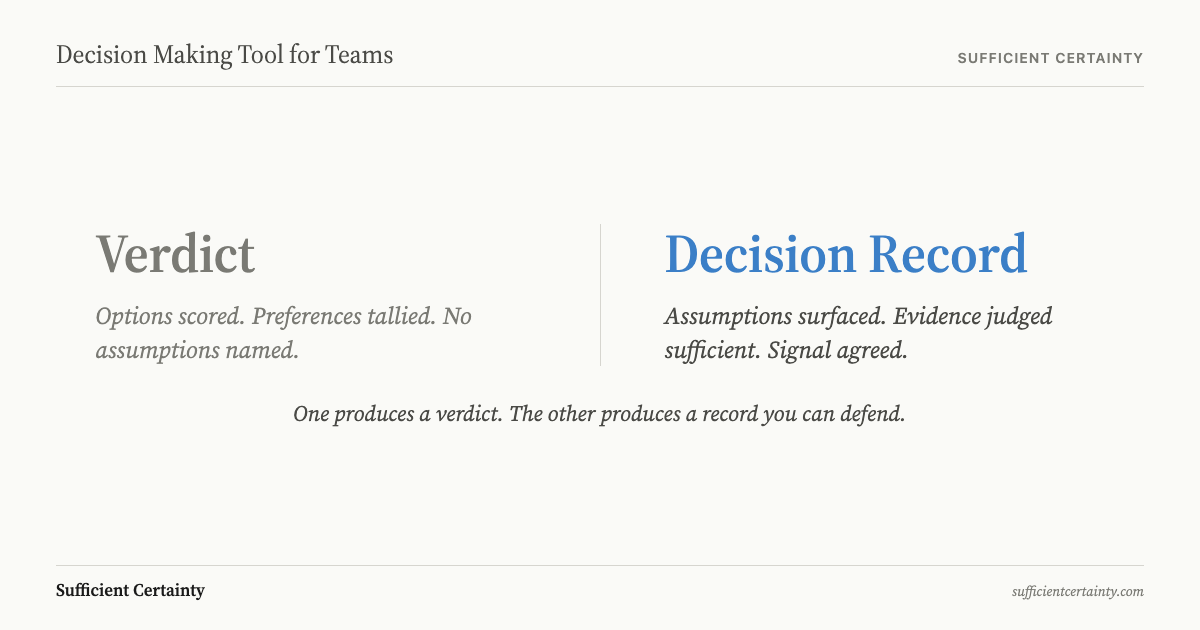
Most decision making tools for teams produce a vote or a score. I have yet to see one that produces a record naming what the team was assuming and what evidence it judged sufficient.
When the decision is revisited six months later, the team has a number in a spreadsheet but no trace of the reasoning. The new members who joined after the original meeting have to reconstruct the argument from memory. That is why teams keep reopening the same decisions: the output of the first conversation was a verdict, not a record.
The Walk takes a team through the full method in a single session: the decision framed against the organisation's Purpose, the assumptions surfaced and ranked by significance, and the evidence judged against the threshold of sufficient certainty. A monitoring signal and owner are agreed before anyone commits.
At the end the team has a Decision Record it can produce when the decision is challenged or when the underlying assumption changes. The team does not need a consultant or a two-day offsite. A single session finishes in the room where the decision lives.
Roger Estall and I wrote Deciding because the gap between what teams decide and what teams can later defend is where most organisational decision-making actually breaks. The Walk exists because teams deserve a decision record that outlasts the meeting, and the smallest artefact that does this is a one-page document naming the assumption and the evidence threshold the team judged sufficient.
You could score every option in the room and still leave the assumption the whole team carried in untested.
Work through your decisionNo sign-up. Just pick your decision and start.
Grant Purdy is the co-author, with Roger Estall, of Deciding (2020), and the architect of the Universal Decision-Making Method.