
The effects of analysis paralysis go deeper than delay. Operational damage, financial waste, and human cost accumulate while the organisation keeps reviewing instead of deciding. People misdescribe the harm as lost time. It is not lost time. It is an active failure to commit when the evidence was already sufficient.
The effects of analysis paralysis are not limited to lost time. They include operational damage, financial waste, and human cost that accumulates while the organisation keeps reviewing instead of deciding. People misdescribe the harm as delay. It is not delay. It is an active failure to commit when the evidence was already sufficient.
In 2022, contamination concerns and a whistleblower complaint shut Abbott Nutrition's Sturgis plant, and parents across the United States started hunting infant formula from shop to shop. For many babies formula was not a convenience, it was the only food available. The official process could point to the steps it had taken, while families could point to empty shelves. Those are the effects of analysis paralysis people keep misdescribing as delay. People sometimes ask why I sound impatient about this. I sound impatient because I have watched the same mistake defended for years in the language of caution.
I have no interest in pathologising people for defects in machinery. Roger Estall and I built the Universal Decision-Making Method because we needed a way to tell the machinery when enough is enough. The method does not tell anyone to think less. It tells the process when to stop. The analysis paralysis article deals with how organisations get stuck there; here I want to stay with the bill that arrives after the machinery spends another week admiring its own caution.
The effects of analysis paralysis are the operational, financial, and human losses that accumulate when delay is mistaken for careful control.
The effects of analysis paralysis can make the original risk worse
The FDA's September 2022 review of its infant formula response says the recall and production pause were necessary for safety, and it also admits the pause helped produce a shortage in a supply chain already under strain. That is the point. The process reduced one danger on paper while helping create another in the real world. The Purpose was to keep vulnerable children safe, not to produce a cleaner file on contamination.
I have watched boards do the same thing with plant closures and system replacements. They behave as if the only respectable move is to keep sanding down one uncertainty while the rest of the situation deteriorates. Supply tightens and people improvise, so the supposedly careful option starts manufacturing its own harm. The people supervising the delay still get to call themselves prudent. The people living with the shortage do not.
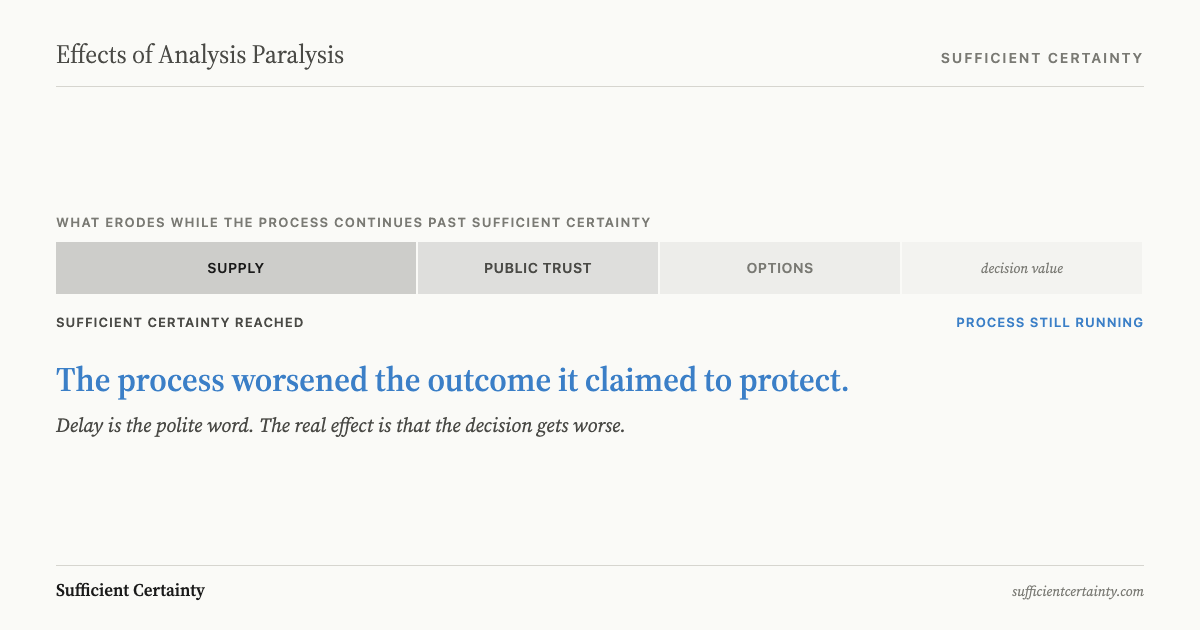
The effects of analysis paralysis include decision decay
The Janssen vaccine pause in the United States, from April 12 to April 23, 2021, shows the next effect in hard numbers. By April 21, nearly 8 million doses had already been administered, and the CDC's own risk-benefit analysis showed what delay meant during an active pandemic. For every 1 million doses given to women aged 18 to 49 years, vaccination over the following month was estimated to prevent 297 hospitalisations and 6 deaths, against 7 expected TTS cases. During a live pandemic, ten days is not neutral time just because the memo approving the pause is beautifully footnoted.
Rader et al.'s 2023 Vaccine study of 401,398 survey respondents found a persistent drop in confidence in the Janssen vaccine after the pause. That is decision decay. By the time the committee comes back feeling more comfortable, the public has already marked the option down. We have seen the same thing in restructures and technology programs: comfort goes up inside the room, trust goes down outside it.
The arithmetic was plain before the pause began. The committee that ordered it could survive ten days of deliberation without personal cost. The unvaccinated population could not pause transmission while the room felt its way toward comfort. Sufficient certainty had already been reached, and every additional day bought reassurance for the few at the price of exposure for the many. That is what decision decay does. It transfers risk from the people who can afford to wait to the people who cannot.
Count what delay is doing to the decision in front of you and mark where paper progress is masking decay. Start the Walk →
Paper progress looks like movement until you count the cost
The Northern Ireland Audit Office review of major IT projects, published on July 4, 2025, examined 29 projects with a whole-life cost of GBP5.2 billion. Twenty-four were trying to replace legacy systems. The average contract extension was almost eight years, and about one third had been extended by ten years or more. Eight-year extensions are not evidence of prudence. They are evidence that a program can keep moving without deciding anything.
I made a similar point in analysis paralysis in business, but the Northern Ireland report shows the scale of the habit. Paper has a wonderful way of impersonating judgement. Vendors keep billing and program overseers keep convening, while governance staff and consultants explain why one more assurance gate would be terribly responsible, especially for the people running the gate. The public keeps the obsolete systems.
I have sat in rooms where the quarterly program update ran to forty slides and the executive summary said "on track with revised timeline." That phrase does all the heavy lifting for any program that stopped being about the outcome and started being about its own continuation. Nobody commissioned a slide on what the delay cost the public this quarter.
Why this damage is so often misread
Roger and I wrote Deciding because we were tired of watching serious decisions disappear into machinery with no sensible stopping point. The problem with analysis paralysis is not private overthinking. It is a public process failure, and processes with no stopping point are always popular with the people paid to service process rather than end it. You do not fix that by telling people to be more decisive. You fix it by building a stopping rule into the machinery before it starts running.
Calling this overthinking is a courtesy it has not earned. It is organised delay, usually administered by people who can survive the wait better than the people carrying the consequence.
You could call this analysis paralysis caution and watch your next delay compound real costs.
Work through your decisionNo sign-up. Just pick your decision and start.
Grant Purdy is the co-author, with Roger Estall, of Deciding (2020), and the architect of the Universal Decision-Making Method.