
Analysis paralysis is what happens when a decision process has no stopping condition. People call it overthinking. It is not. It is a structural defect: nothing in the process defines what would count as enough evidence to act. Insert that definition and the paralysis resolves itself.
Analysis paralysis is what happens when a decision process has no stopping condition. People call it overthinking. It is not. It is a structural defect: nothing in the process defines what would count as enough evidence to act. Insert that definition and the paralysis resolves, because the team can see the point at which further analysis adds nothing.
A McKinsey survey of 1,259 managers found that the average Fortune 500 company wastes 530,000 working days and roughly $250 million a year on ineffective decision-making. Decisions that never get made, or that take so long the opportunity evaporates before anyone acts. That is what analysis paralysis actually costs.
Most advice tells people to set deadlines or stop overthinking. That treats the symptom. If the process itself has no stopping condition, no amount of personal discipline will supply one. You can impose a deadline, but if the process generates another round of review on the day the deadline expires, the deadline was decoration. The analysis runs because the process permits it. The people selling "decisiveness coaching" are treating a plumbing problem with a motivational poster.
Analysis paralysis is a failure to commit because evaluation keeps expanding and no agreed point of sufficiency ends the review.
What analysis paralysis costs
McKinsey’s 2019 global survey deserves more attention than it gets. Managers spend 37% of their working time making decisions. More than half of that time is spent ineffectively. Not because the managers are incompetent. Because the process they operate within has no convergence point.
Reports that produce more reports. Data requests that generate more data, which raises more questions, which triggers more data requests. The committee is convening. The consultant is billing. Nobody is deciding. The 530,000 days McKinsey counted are not days of laziness. They are days of activity that resembles progress without producing resolution.
Only 20% of respondents said their organisations excel at decision-making. The other 80% are not staffed by indecisive people. They are staffed by capable people operating inside systems that cycle indefinitely because nothing in the system says “stop.”
The most revealing finding: faster decisions tend to be higher quality. Speed does not undercut merit. The steering group, the three rounds of board review, the exhaustive due-diligence marathon: these are sold as quality controls. McKinsey’s evidence suggests they function more often as quality destroyers, extending the analysis past the point where additional information changes anything. I have seen this in every sector I have worked in. The apparatus is not there to improve the decision. It is there because someone insisted it be there, and nobody has the authority to dismantle it.
The machinery that most organisations rely on, risk registers and approval chains, was never designed to produce a decision. It was designed to produce documentation.
Mark the point where more analysis stops helping by running the slipping decision through the five steps. Start the Walk →
Nokia had the data. Nokia could not act.
Nokia held roughly 40% of the global mobile phone market in the early 2000s. Its engineers understood, well before the market shifted, that the Symbian operating system could not compete with what Apple and Google were building. The analysis was done. The conclusion was clear. The organisation could not convert any of it into a decision.
Researchers Timo Vuori and Quy Huy documented the mechanism in a 2016 study published in Administrative Science Quarterly. The divisions could not talk to each other. Hardware and software had conflicting priorities. Every potential pivot required alignment across groups that could not agree on what the data meant, even though they all agreed on what the data said. The culture would not move. Not because people did not care. Because the process would not let them. Leadership had chosen process-bound, analytical decision-making. It produced volumes of analysis. It did not produce a pivot.
The MeeGo operating system arrived in 2010. By then, irrelevant. Nokia’s smartphone market share fell below 5% by 2013. The mobile division was sold to Microsoft. Seven years of available information, seven years of governance machinery in motion, and the final outcome was a fire sale.
In the terms of the Universal Decision-Making Method, Nokia’s engineers had reached sufficient certainty at Step 4 that Symbian would fail. The three available responses all pointed in the same direction. But Nokia’s process had no Step 4. It had review cycles. A decision resolves or it does not. A review cycle just schedules the next meeting.
This is what analysis paralysis looks like when the Deciders are competent, the data is available, and the stakes run into billions. The constraint is not intelligence or courage. It is architecture.
The stopping condition that analysis paralysis lacks
Barry Schwartz’s research on maximisers and satisficers is often cited as a psychology finding. I think it is more useful as a process finding. In a 2006 study with Sheena Iyengar and Rachel Wells, Schwartz identified two decision-making styles. “Maximisers” exhaust every option before choosing. “Satisficers” define what “good enough” means and stop searching when they find it.
Maximisers in the study negotiated starting salaries 20% higher than satisficers. Objectively, they won. Then they reported lower satisfaction and higher rates of depression. Optimising past the point of sufficiency destroyed the value it was supposed to protect.
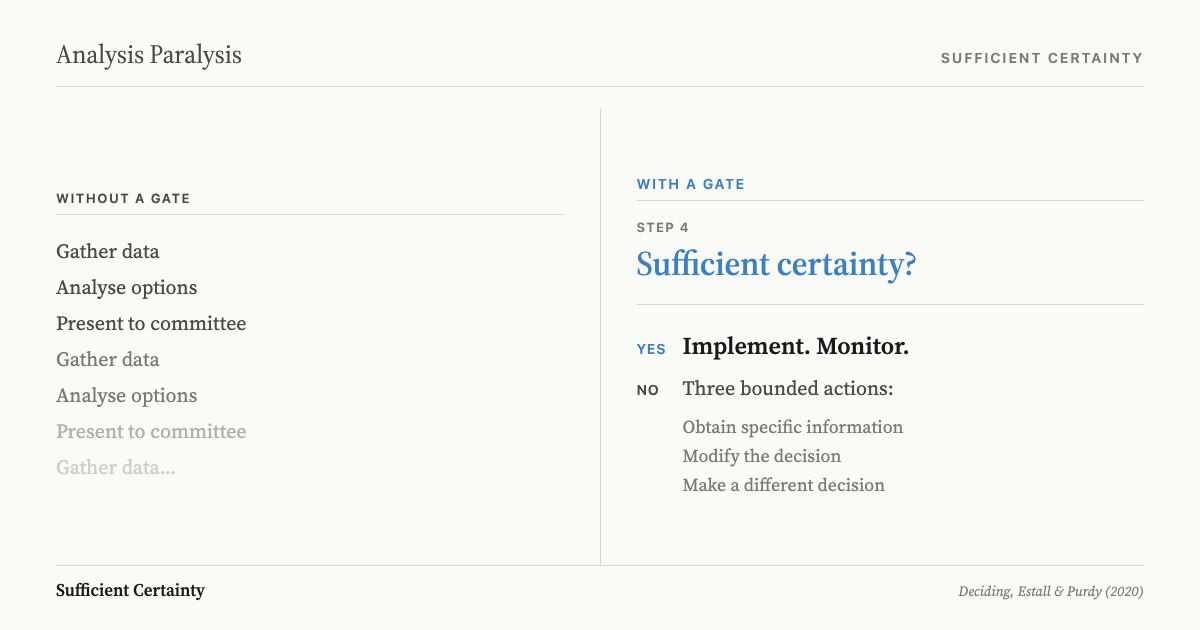
Most governance processes are maximiser systems. They instruct people to keep analysing until certainty is achieved. The method Roger and I developed is a satisficer system. It poses one question at Step 4: do you have sufficient certainty that this decision will deliver the outcome you intend? If yes, implement. If no, two bounded actions are available: obtain more information about a specific assumption, or modify the decision to increase certainty of the intended outcome. If neither resolves the gap, a third: make a different decision entirely. None of those actions is “go back and analyse more thoroughly.”
There is no formula for what counts as sufficient. It is judgment, applied against a stated Purpose, in the light of identified assumptions. That is what makes it a decision and not a calculation. The people who sell risk matrices and certainty scores are selling the illusion that judgment can be replaced by arithmetic. It cannot.
A 2010 meta-analysis by Scheibehenne, Greifeneder and Todd reinforced the point: across 50 experiments, choice overload was not a universal cognitive limitation. It was context-dependent. The context that reliably produces paralysis is a process without a defined sufficiency test. Supply the test, and the paralysis resolves.
If your organisation is stuck, the problem is probably not the people. It is the process. I have spent fifty years watching capable people blamed for indecision that was manufactured by the system they operate within. The method does not tell you what to decide. It tells you when you have analysed enough. That is the piece most governance machinery was never designed to provide.
I wrote about the structural causes of analysis paralysis separately, about how to overcome it with the five steps, about why the analysis paralysis solution is a stopping rule, not a personality fix, and about the effects of analysis paralysis once the machinery runs past sufficiency.
You could open one more spreadsheet and still miss the moment this decision needed you.
Work through your decisionNo sign-up. Just pick your decision and start.
Grant Purdy is the co-author, with Roger Estall, of Deciding (2020), and the architect of the Universal Decision-Making Method.