
Executive decision coaching catches the weak call hiding in a strong board paper. The pack is polished, the appendices are numbered, and the recommendation sits on page three. Nobody in the room has named the one assumption the commitment depends on. That is the gap the coaching closes before the paper hardens.
Last year Deloitte and the Center for Audit Quality reported on 266 audit committee members. Cybersecurity topped the oversight list for 69 percent of them, with enterprise risk management close behind. Committees also wanted better pre-read material.
I see the same thing in every boardroom: the recommendation is typed, the board pack is polished, and the real judgement is still hiding underneath. That suits governance staff who want a tidy pack more than a hard argument. It suits consultants who can sell more apparatus once the real choice stays muddy. It also suits committees that do not mind delay because delay spreads blame.
In practice, I use the Universal Decision-Making Method to make one accountable choice explicit enough for challenge now and monitoring later. I use it for a live decision, not a chat about leadership style. The executive keeps the call; I am there to stop borrowed confidence passing for judgement.
Executive decision coaching is structured support for one live business choice held by a senior decision-maker.
Executive decision coaching starts before governance review
By the time a weak recommendation reaches a committee, it has hardened. Directors see the paper and not the reasoning that produced it. The AICD guidance on board papers asks whether the recommendation fits strategy and surfaces assumptions, while the ASX Principle 7 recommendations expect the board to review the risk management framework itself. A tidy pack still lets weak thinking through. Board secretariats know which version gets praise, and it is usually the one that looks complete rather than the one that admits uncertainty.
I do this work upstream. In the full decision method we Frame the decision, Develop options, Recognise assumptions, and test Sufficient certainty before the pack starts telling the room what it is allowed to think. If the pack is carrying the decision, and one untested assumption is carrying the pack, I want that written down while the executive can still change the call. I would rather expose uncertainty early than send up another handsome paper for approval.
In my experience, status arrives early. Once the recommendation is in the board pack, people defend the draft because the stationery now has rank. I would rather challenge the call before that happens than watch smart people protect a document simply because it has circulated and picked up ceremonial authority.
Why executive decision coaching is not another adviser
Most executives near a board decision do not need one more adviser. Powered By Decisions sells decision-engineering speed. DecisionCoaching.us sells assessments and development tools. Those products may soothe the buyer (often half the sale). They do not solve the moment when an executive has to own a live call and explain why the room should trust it.
When an executive is deciding on a site closure or a control-failure response, the missing piece is seldom one more opinion. Legal may have spoken and finance may have run the numbers. You can buy expertise; you cannot outsource ownership. A consultant can provide analysis, but they cannot stand in front of the audit committee carrying the consequence if the analysis missed the live assumption. I explain the boundary more fully in decision coaching versus consulting.
Bring the board decision hardening in your pack through the five steps and expose the judgement the paper hides. Start the Walk →
What the committee actually needs to see
A good committee does not need a performance of certainty. It needs reasoning it can interrogate. Under APRA’s CPS 220, the board is expected to judge whether the framework is appropriate and effective. The performance of certainty gives cover to advisers who want their analysis admired. Managers hide there too when they do not want their assumptions questioned. Committee members are not innocent either; asking for another pack is often easier than forcing a real answer.
I have watched committees spend half an hour polishing the wording of a recommendation because nobody wrote down what had to be true for it to work. Roger Estall and I make the same point in Deciding: a paper can carry the recommendation and still omit the reasoning. Until the live assumption is named, the committee is not testing judgement. It is editing prose.
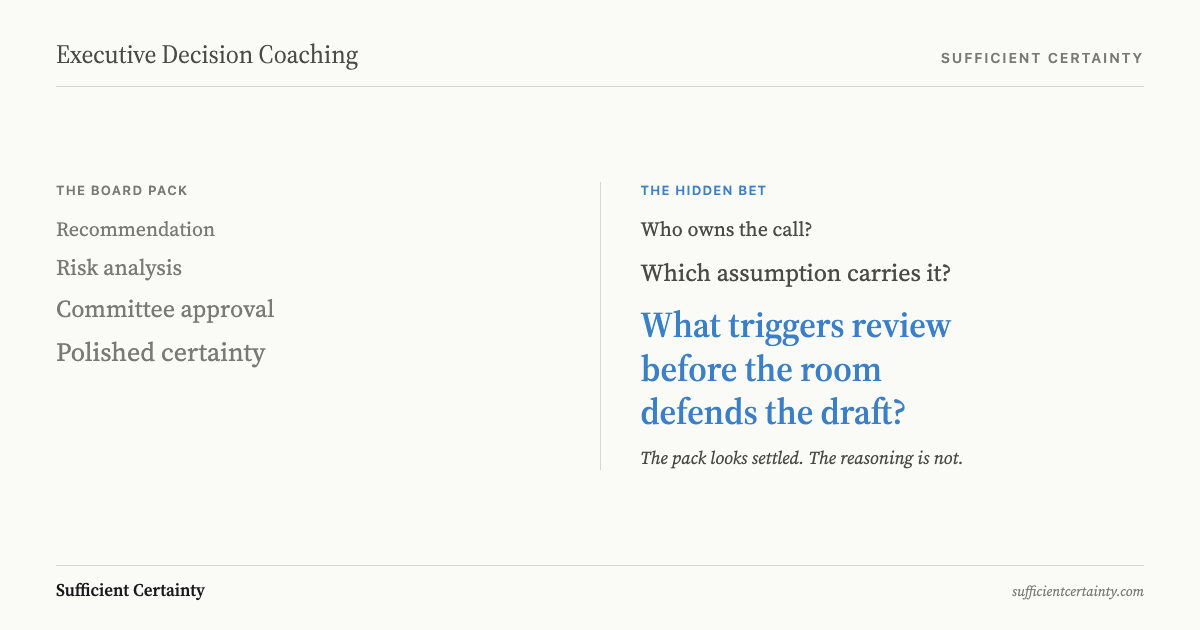
That is where executive decision coaching earns its keep: the decision record shows who owns the call, the live assumption beneath it, and the evidence that should trigger review before the board starts defending the draft.
When this work earns its keep
It earns its keep when assurance exists on paper and responsibility still sits with the executive. The NSW serious defects report reviewed 492 apartment buildings, found serious defects in 23 percent of them, and noted that 98 percent used a private certifier. That is borrowed certainty: the certificate travels neatly through governance, while someone still has to decide what it proves and what must be watched.
I use this before a board submission and before an audit committee asks for "more comfort" (usually code for delay). If you want the broader frame, start with decision coaching. This executive variant is narrower: I want the accountable reasoning on the page before the room starts mistaking formatting for thought. By then the issue is whether the executive can defend the wager the pack is quietly asking everyone else to accept.
You could polish the board pack and still hide the judgment your committee needs.
Work through your decisionNo sign-up. Just pick your decision and start.
Grant Purdy is the co-author, with Roger Estall, of Deciding (2020), and the architect of the Universal Decision-Making Method.