
Decision coaching vs consulting is not a branding distinction. Consulting supplies analysis and recommendations. Decision coaching sharpens the client's own judgment on one live choice. The consultant carries the finding. The coach ensures the Decider can defend the call without leaning on anyone else's paper.
A board chair I worked with had a 96-page consultant's report and a board paper recommending the sale of a regional business. He had enough analysis to wallpaper the room. He still asked me one plain question: what, exactly, am I being asked to decide? That is where decision coaching vs consulting stops being a category label and becomes a practical problem.
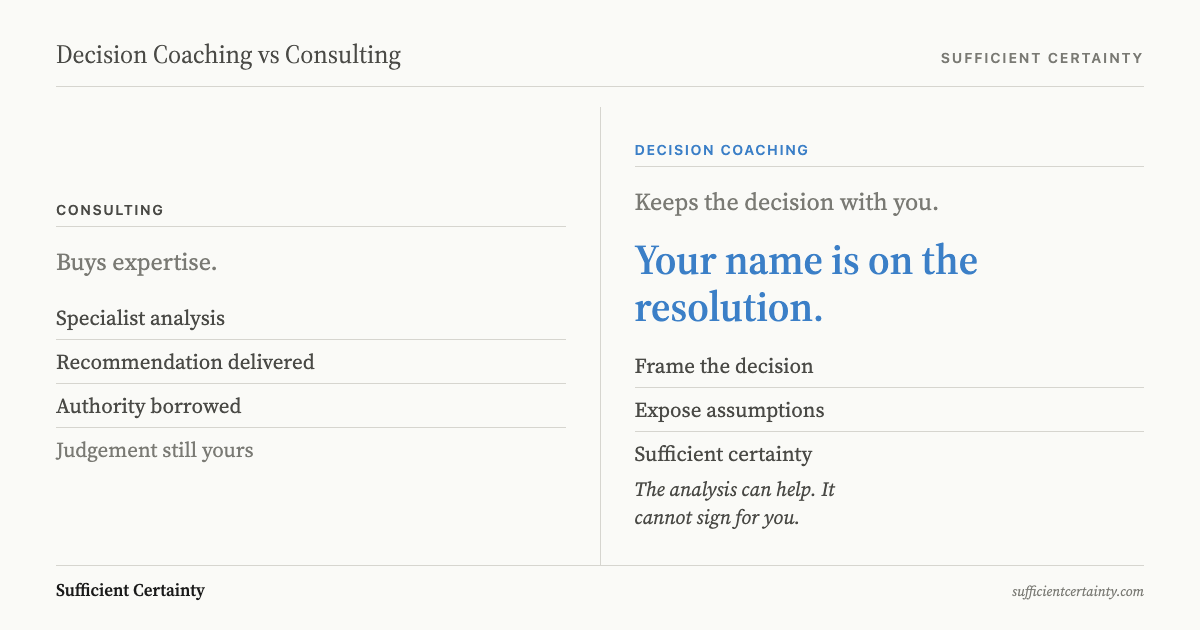
I am not anti-consultant. That would be childish. If you need specialist tax advice, a valuation, engineering input, or a market scan, buy it. The trouble starts when a board or executive team buys analysis and then pretends the hard part has been outsourced with it. It has not. I have set out elsewhere what a decision consultant sells, and what never leaves the buyer's desk. The consultant's name is on the report. Your name is on the resolution.
Decision coaching vs consulting distinguishes support that sharpens a client's judgment from advice that supplies expert analysis or recommendations.
Who owns the call?
Boards can buy advice. They cannot rent out the resolution. The Australian Institute of Company Directors says the same thing in formal governance language: boards may seek outside professional advice, but decisions are still made by board resolution. Advice is input. Accountability stays where it was. That aligns exactly with what this process is for.
Ownership confusion is what makes competent people look indecisive. Paul Rogers and Marcia Blenko showed it neatly in Harvard Business Review. In their survey of executives at 350 global companies, only 15% said their organisation helped the business outperform competitors. Their examples were not stories of stupid people short of data. They were stories of ownership blurred across functions. At one automaker, marketers and product developers both believed they owned key product choices, and delays followed. At John Lewis, buyers acted without properly involving the people who had to execute, and sales fell. Another deck would not have solved either problem. Clear ownership might have.
I have watched this confusion many times. A board asks advisers for recommendations, a management team asks for another sensitivity analysis, a risk function adds another layer of review, and everyone behaves as though movement is the same thing as a decision. It is not. This work starts by removing the places people hide.
Bring the decision sitting underneath the report through the five steps and isolate the judgement no adviser can supply. Start the Walk →
Consulting is for expertise, not for judgement
Consulting earns its keep when the real gap is expertise. The Economist Intelligence Unit study for PMI found that firms often bring in outside experts because they need specialist knowledge. If you are dealing with tax structuring, cyber architecture, mine closure liabilities, or a complex acquisition, outside expertise may be exactly what is needed. I have never argued otherwise.
The same study also found that organisations completed only 56% of strategic initiatives successfully on average, and that 61% often struggled to bridge strategy and day-to-day execution. Expertise can improve the analysis and still leave the decision unresolved. I see the same thing in difficult business decisions where the analysis is sound, the modelling is respectable, and the executive still cannot tell you what assumptions the recommendation rests on. The bottleneck is no longer expertise. It is judgement.
I am not talking about generic executive coaching here. I have set out what executive decision coaching looks like before a board paper hardens. Koortzen and Oosthuizen, writing in the SA Journal of Industrial Psychology, separate consulting from coaching by role, and that is useful as far as it goes. My version is narrower: one live decision and the person who has to live with the result.
After the report arrives
You see the contrast most clearly after the expensive work is already done. West Monroe's 2026 research on decision speed found that 73% of leaders said slow decisions and slow execution cost their organisations up to 5% of annual revenue. The culprits were not mysterious. Too many approval layers, unclear decision rights, and people hiding indecision behind the respectable word "caution." In other words, the report had arrived, but the organisation still did not know how to own the call.
No one doubts that work was done. The document is usually handsome. It has appendices, scenario tables, and the faint smell of due diligence. What it often does not have is a disciplined answer to four questions. What are we trying to achieve? What are the real options? What assumptions must hold for this option to work? Do we know enough about those assumptions to proceed? When those questions remain unanswered, the apparatus usually slides into analysis paralysis and calls it prudence.
I am particularly impatient with the theatre that follows. Another steering group. Another briefing note. Another lap of corridor politics before the matter returns to the board. If the issue is missing expertise, fix the expertise gap. If the issue is that nobody has tested the reasoning of the accountable Decider, then more paper is just a delay mechanism with good typography.
Use both, but in the right order
The sensible answer is not to choose a camp and join it like a football club. Use consulting when you need outside knowledge. Use this process when the question has become: given the analysis now on the table, do we have enough certainty to commit? That is where the method earns its keep.
My job at that point is simple. Force the real choice into the open, make the assumptions visible, and ask whether certainty is sufficient. The decision coaching process runs through those steps in short rounds, not one marathon session. If it is, decide and record what will be watched afterwards. If it is not, get the missing information, alter the decision, or choose another option. The output is a Decision Record, not another consultant document. Roger Estall and I made the same point in Deciding: outside advice can inform the call, but it cannot own it for the Decider. That is when decision coaching vs consulting matters most, after the expert work is finished but before the accountable Decider commits.
If you want the broader context, start with the overview of decision coaching.
You could buy another consultant and still avoid the next judgment only you can make.
Work through your decisionNo sign-up. Just pick your decision and start.
Grant Purdy is the co-author, with Roger Estall, of Deciding (2020), and the architect of the Universal Decision-Making Method.