
The framing effect means someone has already chosen your answer before you see the question. A board paper headed two hundred and thirty jobs saved and another headed one hundred and seventy redundancies describe the same arithmetic, but the frame picks the winner before judgment begins. Experience will not catch it. A deliberate rewrite will.
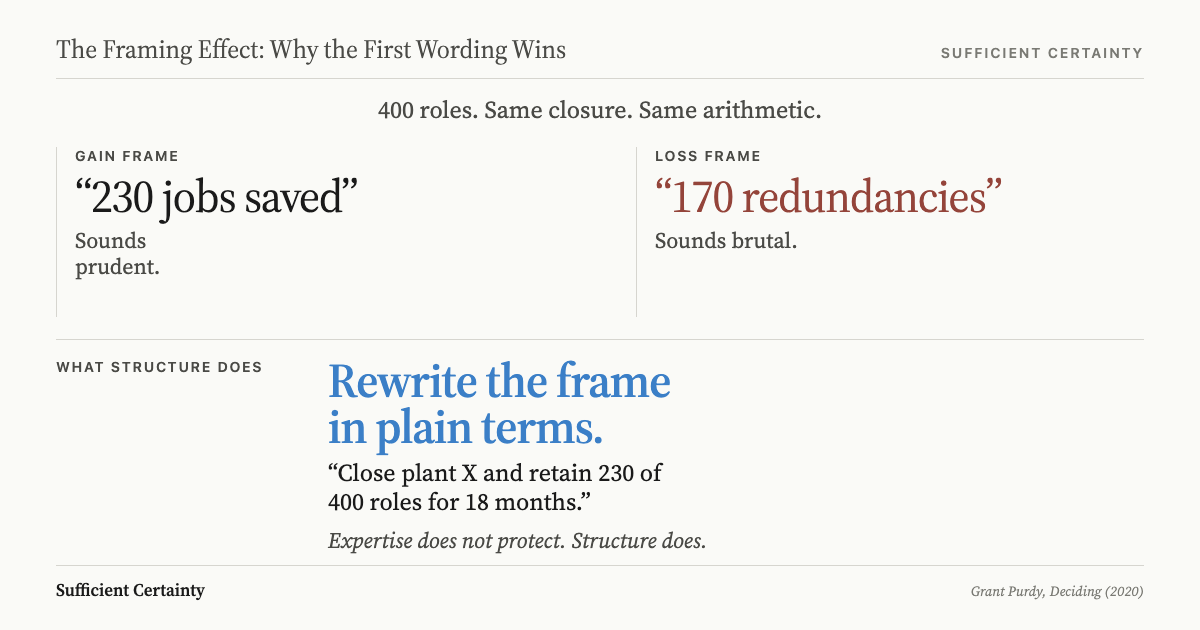
A board committee I worked with had a 31-page paper on a plant closure, a one-page annex headed "230 jobs saved", and another headed "170 redundancies". The arithmetic was identical, but forty minutes in half the room called the recommendation prudent and the other half called it brutal. Nobody noticed that the first brief had chosen the emotional weather before the discussion started. That is the framing effect.
That is why I rewrite the question in plain terms before the room starts arguing.
Amos Tversky and Daniel Kahneman showed this cleanly in 1981. They asked people to choose between programs for an outbreak expected to affect 600 people. When one option was phrased as lives saved, 72 per cent preferred the sure result. When the mathematically identical option was phrased as deaths, only 22 per cent chose the equivalent sure result. The numbers stayed put, but the wording changed which regret felt respectable. I still meet executives who think this sort of thing only happens to psychology students. That little comfort never lasts long in a boardroom.
The framing effect is a decision-making bias where the wording of a question steers the answer, neutralised by requiring a deliberate reframe before any option is assessed.
What the framing effect actually does
In the Asian disease problem, one version makes caution feel humane and the other makes risk feel dutiful. That is why I treat framing as the first real move in a decision. By the time the room starts comparing options, the paper may already have decided which loss sounds responsible.
I have watched the same trick in closure papers and capital requests. Call a proposal "protecting 80 per cent of margin" and you get one discussion. Call the same proposal "giving up 20 per cent of capability" and you get another. If nobody rewrites the line, the loudest draft wins. That is how big organisations smuggle the answer into the paper before the meeting starts. A pre-filled problem framing canvas is the polite version of the same trick.
People like to pretend wording is decorative, as if language were wallpaper. It is not. In committees the wording tells people what a serious person is allowed to fear, and once that cue is in the room they start defending the tone before they have tested the substance.
Rewrite the decision you need to make through the five steps and catch the wording that already chose an answer. Start the Walk →
Why the framing effect survives expertise
McNeil, Pauker, Sox, and Tversky showed that in the New England Journal of Medicine in 1982. People from patients to experienced physicians shifted between surgery and radiation depending on whether the numbers were expressed as survival or mortality. The physicians moved as well. I like this study because it kills a comforting excuse: expertise does not stop the wording from leaning on you.
Kuhberger's 1998 meta-analysis pulled together 136 studies with more than 30,000 participants and found the effect was reliable across populations and settings. Warnings about the bias did not make it disappear. A great deal of corporate training rests on the charming idea that if you teach people the label, the bias will leave the building. It does not, which is awkward if your business model is the workshop.
This is why I do not take comfort from seniority or from a room full of technical nouns. They make the frame harder to detect because the defence arrives dressed as expertise. When a surgeon or finance director can explain the wording beautifully, people mistake elegance for immunity. When the wording survives on elegance alone, it is time for reframing the problem rather than another round of applause.
In my experience, teams still slide from presentation to preference without separating problem solving and decision making. A tidy deck gets treated as evidence that the decision has been framed properly. It has not. Quite often the first sentence is only the preferred answer wearing office clothes.
How the framing effect narrowed Samsung's recall
The public paperwork on the Galaxy Note7 shows how this goes in a big organisation. The first U.S. recall covered about 1 million phones because the batteries could overheat and cause fire, as the Consumer Product Safety Commission notice records. That kind of notice frames the event as a cleanup problem: identify the affected units and pull them back so the market settles. Tidy frames are seductive, especially when the brand is bleeding in public.
A month later the expanded recall told consumers to power down every Note7, including replacement and exchange phones. By 23 January 2017 Samsung's own account, What We Discovered, said batteries from both suppliers showed separate defects and announced an eight-point battery safety check. That sequence supports a plain inference. The affair was first treated as a bounded recall administration job, then later handled as a wider question about whether the design and release process was sound enough for the market. That was the live decision all along.
Once a large organisation gives a problem a respectable label, the frame starts protecting the people who wrote the first brief and the senior people who now need that brief to look sensible. It gives the PR machine a line to repeat as well. I have seen the same thing in duller settings than a phone recall. The label narrows the investigation and makes dissent sound unhelpful. Soon complex problem solving has been demoted to paperwork management, and the live decision is sitting outside the room. I have catalogued three cases where the wrong frame produced the wrong answer at that kind of scale.
How I stop the framing effect before the room performs
If one brief says "230 jobs saved" and another says "170 redundancies", I make the authors write both versions on the same line and then collapse them into one neutral sentence: "Close plant X and retain 230 of 400 roles for the next 18 months." Once the emotional heading is stripped off, I ask the only question that matters: what decision is actually left? That question opens the wider set of problem framing techniques I use before analysis starts.
I stop the framing effect by doing that before anybody starts arguing, because the heading was already doing political work. The room usually hates the rewrite. The authors lose a slogan and the sponsors lose cover. The meeting has to look at the choice without its costume.
I also make the sentence carry its real duration and its Purpose. "Save 230 jobs" is not a decision until you say for how long and what it does to the organisation's reason for existing. Frames love the next quarter because a longer horizon exposes the trade-off and a shorter one lets the pain become somebody else's problem.
Roger Estall and I wrote that discipline into Deciding, and we set it out plainly on this site in the Universal Decision-Making Method. I trust structure more than awareness. Clever people are perfectly capable of hiding a weak choice inside respectable wording.
Neglect problem framing, and the meeting is only theatre with minutes.
You could accept the brief's wording and answer the question someone already rigged.
Work through your decisionNo sign-up. Just pick your decision and start.
Grant Purdy is the co-author, with Roger Estall, of Deciding (2020), and the architect of the Universal Decision-Making Method.