
Complex problem solving fails when the room discusses the problem and nobody writes down the decision it requires. Complexity is not the obstacle. The obstacle is a conversation that circles the difficulty without ever naming the choice, the assumptions behind it, or what would count as a sufficient answer.
The U.S. Fish and Wildlife Service had 23 salt marsh units at Edwin B. Forsythe inside a 15-refuge system, and the budget stopped paying off at about $980,000. Bright people see a brief like that and ask for a grand framework, which usually means more paper and a longer meeting. The team did something better. It reduced the mess to one decision at a time. That is complex problem solving, and the reduction itself comes down to problem framing techniques applied before any framework gets bought.
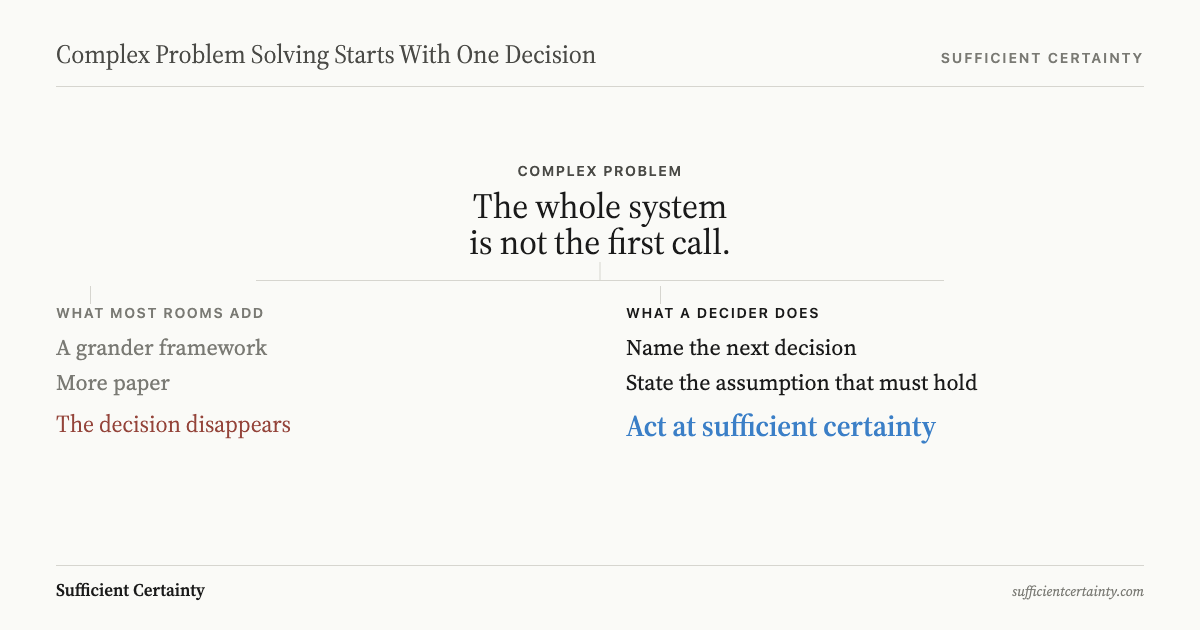
I have seen boards do the opposite. They try to solve the whole system in one heroic sweep, then ask for a bigger method when the first one collapses under its own jargon. For me, complex problem solving starts when I stop the room and ask for the next decision. That is where problem solving and decision making split, and that is how I use the Universal Decision-Making Method. I cut the tangle down to that decision. Then I expose the assumption it rides on and move with Sufficient certainty. Complexity does not disappear, but it stops serving committees and the people who sell them bigger frameworks.
Complex problem solving is the discipline of breaking a tangled situation into explicit decisions, constraints, and trade-offs that can be judged separately.
Why complex problem solving starts smaller than people expect
The marsh project is useful because the team never pretended the Atlantic coast could be settled in one go. In the USGS open-file report, managers chose one action for each unit under each cost limit. They used a tool that could be revised as conditions changed. Benefits rose until about $980,000 and then flattened. Once the room asks what the next unit needs, the problem becomes concrete enough to decide.
I explain the step-by-step version in the wider sequence, but the principle is blunt: if the Decider cannot say what comes first, the method has not started.
The report also notes that the tool can be updated as new information arrives. That matters because sea levels rise and budgets tighten while committees keep pretending last month's paper settled the coast. Once old paper is treated as a verdict because reopening it is awkward, complexity has won by paperwork.
Break the big problem into the next decision and push it through the five steps with a written monitor. Start the Walk →
Complex problem solving fails when the key assumption stays hidden
Flint shows that a sprawling system can still turn on one hidden assumption. After the city changed source water in April 2014 without maintaining corrosion control, the Flint Water Advisory Task Force later produced 36 findings and 44 recommendations. By late summer 2015, one home tested above 1,000 ppb lead and many others were above the federal action level. The decision looked technical and bureaucratic. The real question was plain: was the water safe without corrosion control?
I have sat in rooms where people hide behind systems language because plain English would pin the bet on somebody's desk. Committees like that because it spreads responsibility, and so do in-house champions and outside advisers, because once the sentence stays foggy nobody has to say the water might be unsafe. That is where the analytical version of that exercise can go bad. A model can sort the evidence. It cannot take ownership for you.
The EPA inspector general later said management weaknesses delayed the response. I am sure they did, but that description is too polite. When responsibility is dissolved across offices and procedure becomes the hiding place, delay is not an accident. It is the product. I have watched the same pattern in private boardrooms. The difference is that in Flint the people paying for institutional caution were drinking the water.
Sufficient certainty is the stopping rule
I keep coming back to the RECOVERY trial because it handled a much larger mess without pretending it could settle Covid-19 in one sweep. More than 11,500 patients were enrolled across over 175 NHS hospitals. In the dexamethasone arm, 2,104 patients received the drug while 4,321 received usual care. Recruitment stopped on 8 June 2020 because the steering committee judged it had enough to decide whether the drug helped. A week later the trial team announced that dexamethasone cut deaths by one-third in ventilated patients and by one-fifth in patients on oxygen. That finding changed standard care worldwide within days.
That is how I think about Sufficient certainty. I do not wait for uncertainty to vanish. I decide what would count as enough for this decision and these consequences. Delay often dresses itself up as care, which suits advisers and committees because nobody gets blamed for asking for one more paper. The room feels prudent while the decision rots on the table.
Monitoring keeps complexity from becoming theatre
Cloudflare's outage on 18 November 2025 is a useful modern case because the repair was not a grander control tower. A database permission change bloated a Bot Management file past a 200-feature limit, and core traffic started failing at 11:20 UTC. Core traffic was largely normal by 14:30, and all systems were normal by 17:06, as Cloudflare's outage write-up records.
The better lesson sits in the follow-up. In Code Orange: Fail Small, Cloudflare describes staged configuration deployment with health checks and rollback, plus backup authorisation paths for 18 key services. That is the right instinct. When the system cannot be made simple, I want the next failure fenced tightly enough that it confesses early and cheaply. That is the real work of monitoring, not a memorial service after the outage.
What I do when a problem is too big to hold in my head
When a room tells me the problem is too big to hold in anyone's head, I ask what has to be decided by Friday. Roger Estall and I used a peanut-butter buying choice in Deciding for a reason. People get more honest when the decision looks almost embarrassingly ordinary. Price and health claims only matter if the Decider can say why they matter. The same discipline scales to plant closures and acquisitions, because bigger problems do not change human evasions, they just reward them more generously. When the tangle sits inside a strategy conversation, strategic problem solving applies the same sequence to a wider context.
The broader problem of decision-making under uncertainty is full of this sort of theatre, but the local test is simple. Complex problem solving begins when somebody names the first hard decision and the assumption carrying it. Most of the fog serves somebody, usually the consultant selling more apparatus or the committee trying to spread ownership so thinly that nobody has to own the bet.
You could chase the grand framework and miss the next decision hiding inside it.
Work through your decisionNo sign-up. Just pick your decision and start.
Grant Purdy is the co-author, with Roger Estall, of Deciding (2020), and the architect of the Universal Decision-Making Method.