
A governance model arrives as a picture before the decision it was meant to govern has been framed. To simplify governance, start with the next live decision: name one Decider, record what the call depends on, and set the condition that forces it back onto the table.
To simplify governance, start with the next live decision, not the committee chart. I have seen a governance model arrive as a picture before the decision it was meant to govern had even been framed. A board pack would carry a Three Lines diagram, a RACI chart spread across two pages, and minutes from a risk committee that had not made the decision. Everyone could point to a box. No one could tell me who would own the call if the plant closure went wrong.
That is why most simplification projects miss the point. They reduce meeting numbers or redraw reporting lines while leaving the decision ownerless. Governance gets simpler only when you remove every layer that cannot name its decision, its Decider, or the signal that would reopen the call before the loss hardens.
Simplifying governance means stripping out every committee, role, or report that cannot clarify who owns a decision or test it before the consequence hardens.
Why governance gets too complicated
I have watched organisations lay committees and reporting lines over live work, then act surprised when the next important decision is still ownerless. In Deciding, Roger Estall and I wrote about this habit from the inside: the structure arrives first, then everyone tries to invent a purpose for it afterwards.
You can see the same habit in search results for the term itself. They treat the chart as a menu choice, as though governance were mainly about picking a pattern. That is board furniture. It invites people to shop for layouts instead of naming the person who will carry the consequence. If you want the wider frame, read the broader piece on organisational governance, but the point here is simpler: governance is not the chart, it is the quality of the decision the chart produces.
Start with one decision owner, not another committee
Three Lines flatters auditors because it looks tidy on paper and arrives too late for anyone who still has time to stop a bad call. Even the CRO Forum's 2021 paper concedes blurred boundaries, "1.5 line" complexity, and checks that often happen after the decision, when they can improve the report more easily than the call.
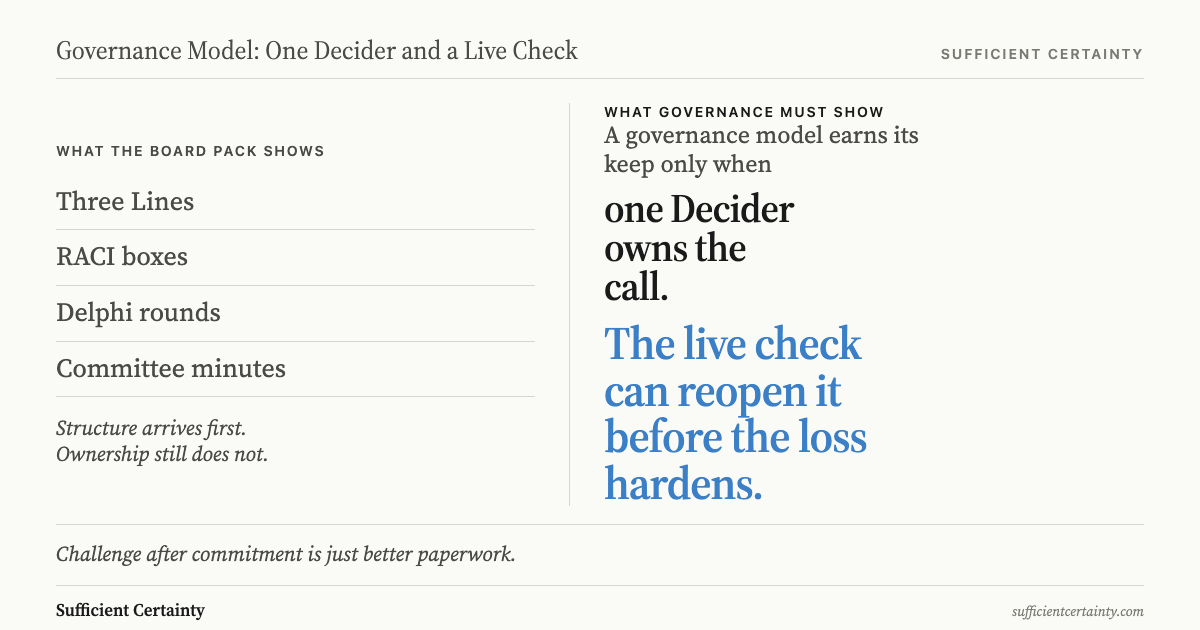
I have never found that surprising. Once advice and challenge are pushed into separate lines, management starts behaving as though accountability moved as well, even though one person still made the call and the model merely makes that easier to forget. I made the same criticism in my piece on the IIA Three Lines model: challenge belongs close to the Decider, before commitment, not in a later layer that writes a cleaner report after the damage.
Map your live governance call through the five steps and expose whether RACI, Delphi, or the org chart is hiding the decider. Start the Walk →
Keep challenge close to the person who decides
RACI is useful only when it stops pretending to be democratic. Bob Kantor wrote in CIO in March 2025 that in almost 100 per cent of his project-rescue work there was no shared understanding of roles, and Cassie Solomon says in her note on RACI 2.0 that the A should really mean the Approver, the person who decides or vetoes the call. That is the only part that matters. If two people are said to own the same decision, neither of them really does.
This is also where governance and management part company. Management can gather advice and prepare options. Governance earns its keep only if authority and accountability stay attached to the same live call.
I use the Universal Decision-Making Method because it starts there, but the principle matters more than the label: if the Decider and the check are separated, the arrangement has already started to fail.
Use committees to surface disagreement, not to hide the call
Rob de Loë and colleagues reviewed 63 policy Delphi studies and found the label covered wildly inconsistent practice. That is the point of the review: Delphi can expose disagreement, but it cannot carry responsibility for the final call.
RAND's 2023 guidance makes the same problem look bureaucratic rather than theoretical. After more than 70 years of use, the guidance across disciplines is still thin; two or three rounds are usually enough, and push it further and people either drop out or change their answers just to get finished. Any setup that treats that kind of convergence as a governed decision is fooling itself, because even after the panel settles one person still has to own the call.
What to keep when you simplify governance
A useful setup is not elaborate. Keep one named Decider, one challenge close enough to change the call, and one signal that brings the decision back before the loss hardens. A live check matters because governance is supposed to catch a bad call while there is still something to save, not explain it neatly once the money has gone. That is why I distrust advice that begins with committee architecture. It starts with the answer and leaves the decision to clean up afterwards.
When I read Audit Scotland's May 2025 report on NHS Scotland, what struck me was not a lack of structure. The system spans 22 NHS boards. The problem was that planning and governance had become so complex that accountability and decision-making were hard to follow, with one senior figure carrying both strategic and operational direction while also holding the system to account. Complexity like that suits the machinery, because committees keep their territory while the person left holding the decision carries the blame.
Roger Estall and I built the Universal Decision-Making Method because we kept seeing this confusion turn up in different uniforms. What matters is whether the next important call will be framed and tested properly, and whether it will be checked soon enough for the organisation to recover if it was wrong. Monitoring that arrives after commitment is not governance, it is filing with better stationery. The fuller scaffold sits in the piece on governance framework, but the core test is simple.
If your governance model cannot tell you who owns the product-recall decision, and what signal would force that call back onto the table before the damage spreads, it is office wallpaper.
You could adopt the next governance model and still not know who owns the call.
Work through your decisionNo sign-up. Just pick your decision and start.
Grant Purdy is the co-author, with Roger Estall, of Deciding (2020), and the architect of the Universal Decision-Making Method.