
Governance vs management is clear on paper and invisible in practice. Management runs the operation. Governance tests whether the commitments management makes rest on assumptions strong enough to survive. Most organisations separate the two in a chart and merge them in every meeting room.
A chief executive I worked with took the same plant-expansion paper through four rooms in six weeks. The executive team wanted another cost note. The risk committee wanted a revised appetite statement. The board strategy committee wanted a new scenario table. By the time it came back to management, the paper had grown from 12 pages to 37. Nobody could tell me who was actually meant to decide. Each room had added conditions. None had accepted accountability. Everyone thought they were doing governance. What they were actually doing was management at a higher altitude, and badly, because nobody in those rooms was going to carry the consequences of the delay.
The textbook split is simple: governance sets direction, management carries it out. People love it because it sounds orderly. But it hides the harder question, which is who can commit the organisation and who merely gets to comment. Get that wrong and the governance structure becomes the most expensive letterbox in the building.
Governance vs management is the division between setting decision authority and working within it. Governance names who decides and who checks. Management carries the decision through.
Governance vs management is only useful if the Decider is clear
The G20/OECD Principles of Corporate Governance put governance with the board: set direction and hold management to account for performance within that direction. Management runs the business within those conditions. Straightforward enough. The split is sound until nobody names the person who actually owns the decision in front of them. Then it becomes an argument about hierarchy instead of an answer.
Roger Estall and I wrote in Deciding that the Decider is the person with the authority for, and accountability for, the decision and its outcome. I still find that test more useful than any board-versus-management diagram. If the board is deciding a major capital commitment, say so. If management is deciding how to deliver it, say so. If six people can all send the paper back for more work, you do not have governance. You have a queue.
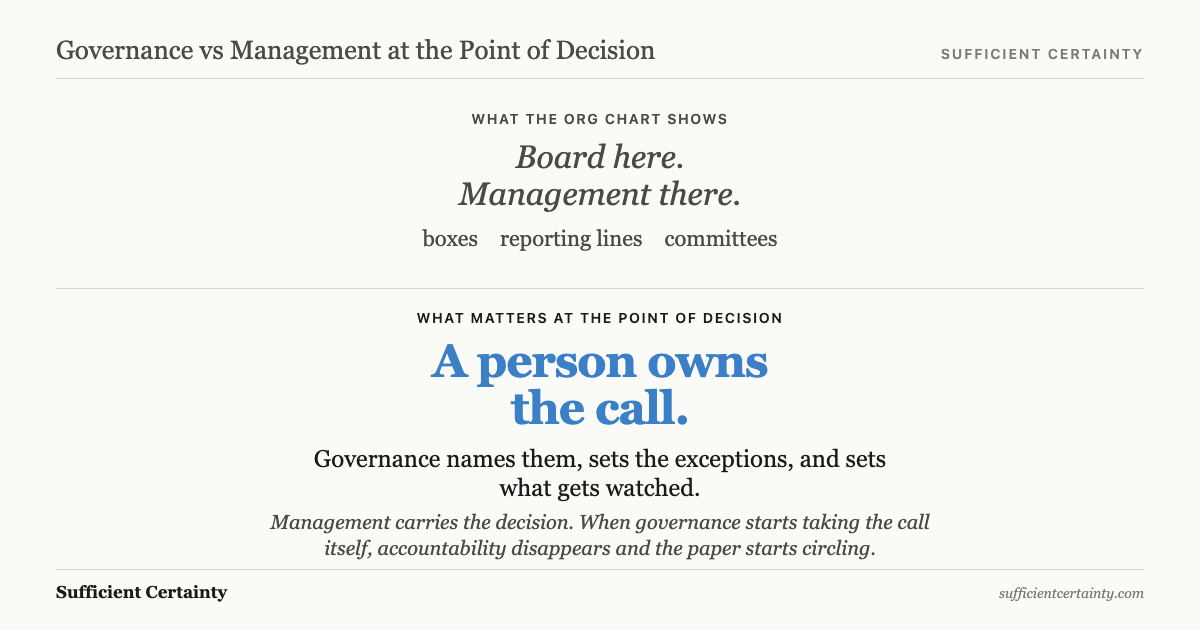
Governance vs management fails when governance starts doing the work
The clearest live example I found was the 2024 internal governance review by Registers of Scotland. The organisation had become over-reliant on its executive management team. Governance groups were regularly getting involved in operational decisions. Unclear pathways were slowing work or sending decisions sideways. Nobody had redesigned the system. They had layered more governance on top of existing management until the two were indistinguishable, and the people sitting on those committees had influence without consequence while management kept the nominal accountability.
I have seen boards do this for a reason that sounds respectable: they want assurance. They do not trust the paper or the pace, so they ask for one more review. Every extra touch shifts the real authority without admitting it. Management still carries the outcome, but governance has started shaping the operational call. Nobody ends up fully accountable, and the organisation slows while both sides wait for the other to commit. Every governance failure I have examined started the same way. There is an industry of advisers and governance specialists who make a comfortable living from that confusion. They have no incentive to settle the boundary, because the boundary problem is their product.
Separate one live call into judgement and execution, then see whether governance owns oversight or keeps doing management work. Start the Walk →
Paper frameworks do not settle the argument
More structure does not settle the boundary. McKinsey's 2025 survey of 193 leaders found that 93 percent had a governance framework or policy document, yet almost half had no formal governance procedures. Forty-four percent placed the head of risk more than one level below the chief executive, and those firms were measurably worse at handling uncertainty. That is paper governance in its natural habitat: the chart exists, but the decision system is still weak where authority should be sharpest. I wrote separately about why a governance model without a named Decider is wallpaper regardless of how many committees it depicts.
This is why I have little patience for arguments about governance versus management that end with a tidy side-by-side table. Tables flatter the organisation. They imply the boundary is stable once the boxes are labelled. The real test is practical: when a decision becomes expensive or awkward, does authority stay where it belongs, or does it drift upward into a committee that cannot carry the consequences? Consultants love the table format because it turns one clear decision into four rounds of analysis. I made a related point in my critique of the IIA Three Lines Model: once role labels become institutional furniture, the accountability behind them thins out.
Good governance watches judgement, not activity
The UK National Audit Office review of mega-project governance makes the same point at larger scale. The UK government's major project portfolio covers 227 projects worth £834 billion. The report treats good governance as clear authority matched to clear accountability, with the investing body still firmly in control of scope. It warns against locking in budgets before anyone properly understands deliverability. That is a decision problem before it is a delivery problem, and no amount of governance architecture fixes it once the commitment is made.
What should governance do, then? Name the Decider for each class of decision and set the exceptions that must come back upward. Then check whether people are testing assumptions before they commit and designing monitoring before they implement. Most governance machinery only samples outputs after the fact, which is like checking whether the building is straight after the concrete sets. That is why I treat governance as a condition for sound management rather than a rival to it. The Universal Decision-Making Method makes that concrete.
If you are arguing about governance vs management in your own organisation, I doubt the real problem is vocabulary. Two questions settle it: who can commit the organisation on this decision, and what will tell you quickly that the call is working or failing? If those answers are muddy, the structure chart is beside the point. The full argument about how to fix organisational governance starts with that test. And if the people who benefit most from the muddle are the ones running the committee, you have found the real problem.
You could leave your next board meeting debating details nobody there must carry.
Work through your decisionNo sign-up. Just pick your decision and start.
Grant Purdy is the co-author, with Roger Estall, of Deciding (2020), and the architect of the Universal Decision-Making Method.