
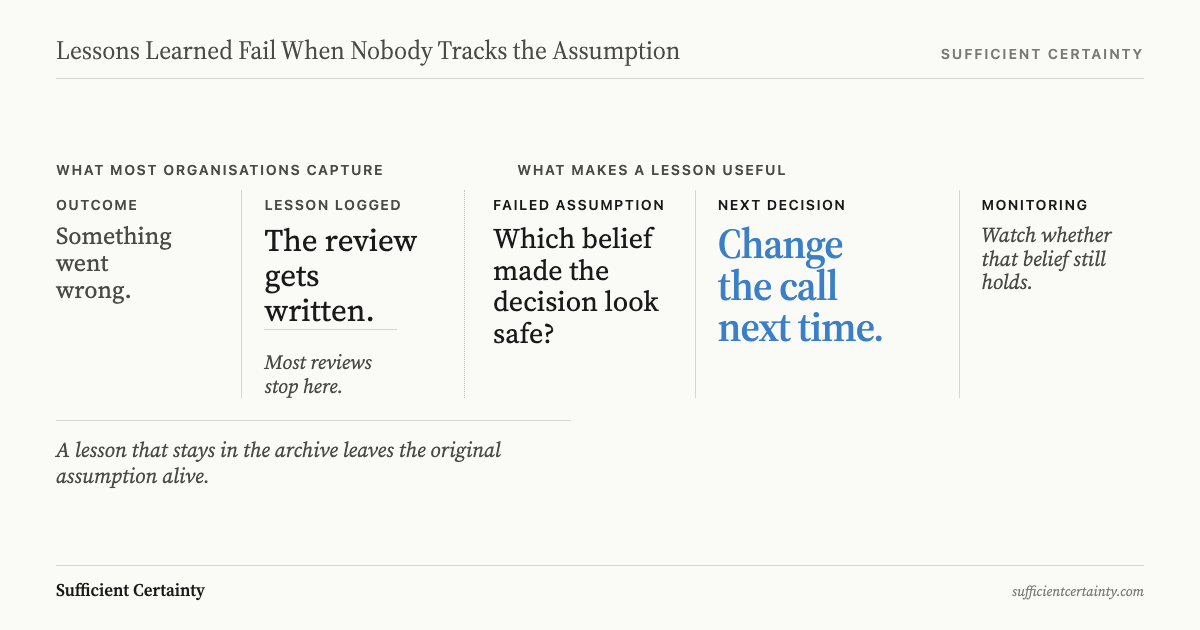
Lessons learned exercises fill archives and action logs without changing the next decision. The missing step is the same every time: nobody ties the lesson to the specific assumption that failed or names what the next Decider must check before committing again.
The lessons learned archive is usually immaculate. The sign-off sheet gets passed round and the action log grows fat. In my experience, that is when I know the real lesson is still missing, because nobody has said which assumption failed or what the next Decider must do differently.
Most organisations do not fail to capture lessons. They fail to pin the outcome to the belief that caused it, then carry that correction into the next decision. The review becomes a record of damage instead of a change in judgment.
Lessons learned are recorded insights from a completed project or decision that explain what happened, which assumptions failed, and what should change next time.
Why lessons learned turn into filing
The dominant model treats learning as a paperwork job. The PMI guidance talks about the session and the repository you search later. Fair enough, if your ambition is an orderly cupboard. Cupboards do not improve judgment. They mainly comfort the people who need to prove the review happened (usually the same people who designed the ritual).
I keep seeing archives full of entries that say communication was poor or handover was late. That is wreckage, not learning. It tells the next Decider nothing about the belief the plan rested on, or why sensible people trusted that belief at the time. The lesson was never rewritten as an assumption.
After a failed project, my question is narrower than most review teams would like. What did we believe about timing or capability, and which belief proved false? Until the room answers that, the action log is stage scenery. People can close tasks all month and carry the same bad premise into the next commitment. That is the heart of decision quality, not the size of the archive.
NASA had the system and repeated the mistake
NASA is useful because nobody can pretend the machinery was missing. After the Mars failures of the late 1990s, the US Government Accountability Office reported that NASA had no assurance lessons were being applied to future missions. A formal lesson from Mars Observer was that interrupted communication deprived investigators of thermal data just before contact was lost. Mars Polar Lander later failed without equivalent diagnostic visibility, which tells you the lesson had been stored without altering the next design decision.
A decade later the picture had barely improved. NASA's inspector general found in its 2012 review of the repository system that only 16 of 28 project managers used it during the acquisition life cycle, and only 6 of those users thought it was useful. Most centres still had not tied lessons to management or engineering standards. The repository was alive and respectable, which was excellent news for anyone who needed a system to point at.
NASA did not mainly lack access to prior write-ups. It had a system that let managers say the lesson existed while engineers kept building as if it did not. That is a comfortable arrangement if your job is to defend the machinery rather than challenge the assumptions underneath it. The better question was never asked: what does this decision rest on, and what would make us stop?
Turn your last painful project decision into a five-step review and name the assumption your lesson needs to carry forward. Start the Walk →
A real lesson names the failed assumption
The cleanest example I found in the research came from war planning, not project management. In its review of Operation Iraqi Freedom, the GAO said the plan assumed Iraqi army units would capitulate and provide internal security. Because nobody built branch plans for the day that assumption failed, the consequence was unsecured munitions and later improvised explosive devices. That is what a buried assumption looks like when the bill arrives.
That is how I read most lessons learned documents. If I cannot see the assumption, I know I am being asked to admire the filing rather than the learning. A sentence about poor coordination is cheap. A sentence that says the plan relied on local forces to hold order gives the next team something to test. I spell out that discipline in assumptions in decision making.
Lessons learned should change the next decision
The Ockenden review into maternity services at the Shrewsbury and Telford Hospital NHS Trust shows the same failure in a setting where the human cost is harder to look away from. The review covered 1,486 families and 1,592 clinical incidents. It concluded that lessons were not learned and the same care failures kept harming mothers and babies. In the maternal-death cases reviewed, 75% showed significant or major concerns in care.
The trust had plenty of reviews and kept the same beliefs about adequate staffing and when concerns had to be escalated. That is why I get impatient with tidy talk about reflection and learning culture. Plenty of organisations have both phrases on the wall, and a consultant invoice to prove it. The harder question is whether anyone is forced to change the next decision when the old assumption has plainly failed. Hospitals meet that question every time a root cause analysis in healthcare ends with an action plan awaiting sign-off.
Roger Estall and I wrote Deciding after watching this trick in too many industries. A lesson has not been learned until it changes the next decision; if the next team can still reuse the same bad assumption, the review was theatre. Sarah needs a review that alters the basis on which her team will commit money or safety, not another repository to soothe the people who file it.
The practical test is simple. Before anyone signs off the review, show me the failed assumption and show me what changes next time. If you cannot do that, you do not yet know whether you have enough information to make a decision.
A proper review also changes what gets watched. If you do not alter the monitoring around the next decision, the old assumption is still sitting there, waiting for another excuse.
Call the exercise whatever you like: lessons learned, post-project review or sprint retrospective. If the next Decider can still rely on the same bad assumption, you did not learn a lesson. You kept an archive, which is marvellous news for the people who run the archive and useless news for everyone who has to live with the next decision.
You could file the next lessons learned and repeat the same assumption.
Work through your decisionNo sign-up. Just pick your decision and start.
Grant Purdy is the co-author, with Roger Estall, of Deciding (2020), and the architect of the Universal Decision-Making Method.