
A problem framing canvas template usually starts after the real mistake. By the time the team opens the canvas, the sponsor's answer is already hiding inside box one. No number of sticky notes fixes a question that was wrong before the workshop began. Test the question first, then build the canvas around it.
A manufacturing executive once put a problem framing canvas on the screen and told me the board paper was due on Friday. Plant B had been losing money for months. The canvas had 38 sticky notes, six cheerful boxes, and no sentence that said what the board was actually being asked to decide.
I do not object to canvases. I object to canvases that arrive with belief already tucked into the first box. That is how belief systems work. They start with the answer and then recruit a worksheet to make it look respectable. I use the Universal Decision-Making Method to stop that trick before the room starts filling boxes.
A problem framing canvas is a one-page decision tool that tests the opening question, records how long the decision must hold, and dates the frame before work begins.
Why most problem framing canvas templates start too late
On Miroverse, Design Sprint Academy's template moves from business context to customer context and then into a problem statement. Mural's workshop canvas promises bold ideas in fifty minutes. Miro's problem statement library points the same way. Different logos, same superstition: trust the opening brief and move quickly enough that nobody notices the real decision was never tested.
Nobody needs a survey to know organisations are bad at diagnosis, but Thomas Wedell-Wedellsborg reported in Harvard Business Review that 85% of senior executives thought their organisations were bad at it, and 87% thought the cost was significant. I believe him because I keep seeing the same racket. Workshop vendors sell speed, and sponsors get respectable activity while the actual decision stays politely unnamed. These canvases fail because they treat the frame as settled input, so the worksheet starts defending the opening sentence and the room falls for the framing effect.
Take the pricing call you need to make through the five steps before another canvas smuggles in the sponsor's answer. Start the Walk →
What makes a problem framing canvas fail in the room
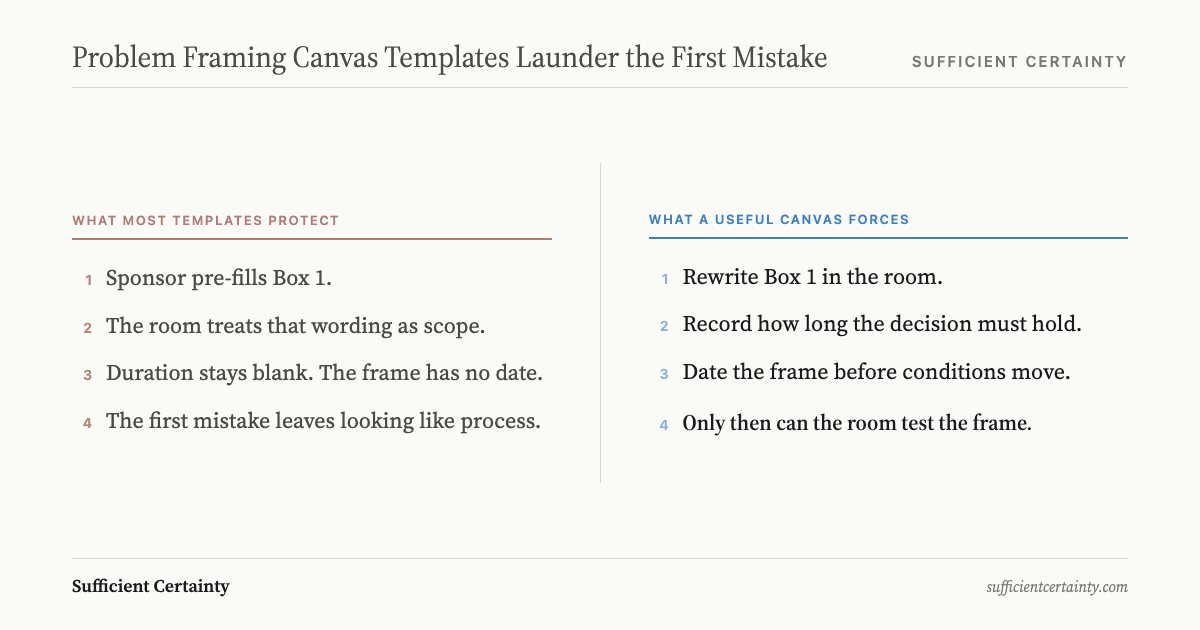
The failure usually starts before the workshop. The sponsor or consultant pre-fills box one. That manufacturing executive's canvas asked "How do we improve Plant B performance?" The wording already contains the politics. It quietly rules out the harder question, whether the board is really deciding if Plant B should stay open at all, because nobody wants to be the person who tears up the sponsor's first sentence in front of the room. By the time the meeting starts, the canvas is already providing cover.
Sponsors use the canvas as a shield. Once the opening box is on the wall, disagreement can be brushed aside as "out of scope" or "not what we are here to solve" (meaning "not what the sponsor wants challenged"). That is a neat trick, paid for by the workshop budget. It lets the sponsor keep saying the process was open while every useful objection gets treated as bad behaviour. Obedience comes dressed up as collaboration.
A useful canvas lets the room rewrite that question in plain English and tie it back to Purpose. I am not looking for brand wallpaper. I want one sentence that says what this decision is for and why it is live now. If nobody can say that without reaching for workshop language, the canvas is camouflage. The sponsor is using the sheet to make a conclusion look like process.
When that rewrite happens, the room often discovers that box one named the sponsor's preferred activity, not the decision. That is what happened with the Friday board paper. Thirty-eight sticky notes had been protecting everyone from a question they could have asked on Monday morning.
A pricing decision shows why the date matters
A canvas without an expiry date is broken at the point that matters most. A plant decision that must hold for eighteen months is not the same as a six-week stopgap, just as "cost plus 12%" is not the same price once inputs move or a rival cuts. Cost-plus is just a market bet wearing an accountant's tie. The date belongs on the sheet because time changes the decision, and pretending otherwise is how tidy workshops produce dirty follow-up work.
This played out with a pricing committee that had set their margin two quarters earlier. Raw material costs had shifted. A competitor had undercut them in a key market. The original frame still sat on the whiteboard, undated, looking as permanent as the company logo. Nobody questioned it because the canvas had no place to record when the frame was written or what it assumed about the world outside. The committee spent ninety minutes refining a number that rested on conditions that no longer held.
The date belongs there for a reason. When the board paper comes back weeks later, we should be able to ask whether the frame still matches current conditions or whether the room is now defending a fossil. Most templates give you nowhere to do that, which is convenient if you like stale assumptions and inconvenient if you like sound decisions. They treat Context as scenery instead of a dated record of what this decision depends on. Roger Estall and I wrote the method in Deciding for decisions that must hold after the workshop glow wears off.
When to bin a problem framing canvas
I bin a template quickly. If box one arrives pre-filled, or if the sheet gives the room no right to rewrite the question and no place to record duration and date, it is stage furniture. It exists to protect the sponsor and calm the room. It does not exist to help anyone decide.
Use the canvas before the workshop, not as cover inside it. If your template gets you to ideas before the decision is named, reopen the question, which is what I mean by reframing problems. If you want the wider method, read the problem framing guide. If the frame still feels wrong after all that, the problem is upstream of any canvas.
You could fill another canvas and still send Friday's board paper without the real decision.
Work through your decisionNo sign-up. Just pick your decision and start.
Grant Purdy is the co-author, with Roger Estall, of Deciding (2020), and the architect of the Universal Decision-Making Method.