
Reframing problems is overdue once the facts no longer fit the question. The real difficulty is not recognising that the frame is wrong. It is that the room has already committed to the original question and reframing feels like admitting the work so far was wasted. It usually was.
Reframing problems usually starts after the meeting has already become expensive. I have sat with a board staring at a 24-page investment paper and a savings number already promised upstairs, while the same evidence was being used to argue for two different decisions. That is when it stops sounding academic and starts looking like basic hygiene.
People delay because reopening the question threatens promises already made. Another spreadsheet feels safer. So does another review, or a consultant with a deck full of rounded rectangles, usually after charging for the privilege. In my experience, that tidy-looking sequence is how organisations walk deeper into a mistake while calling it discipline.
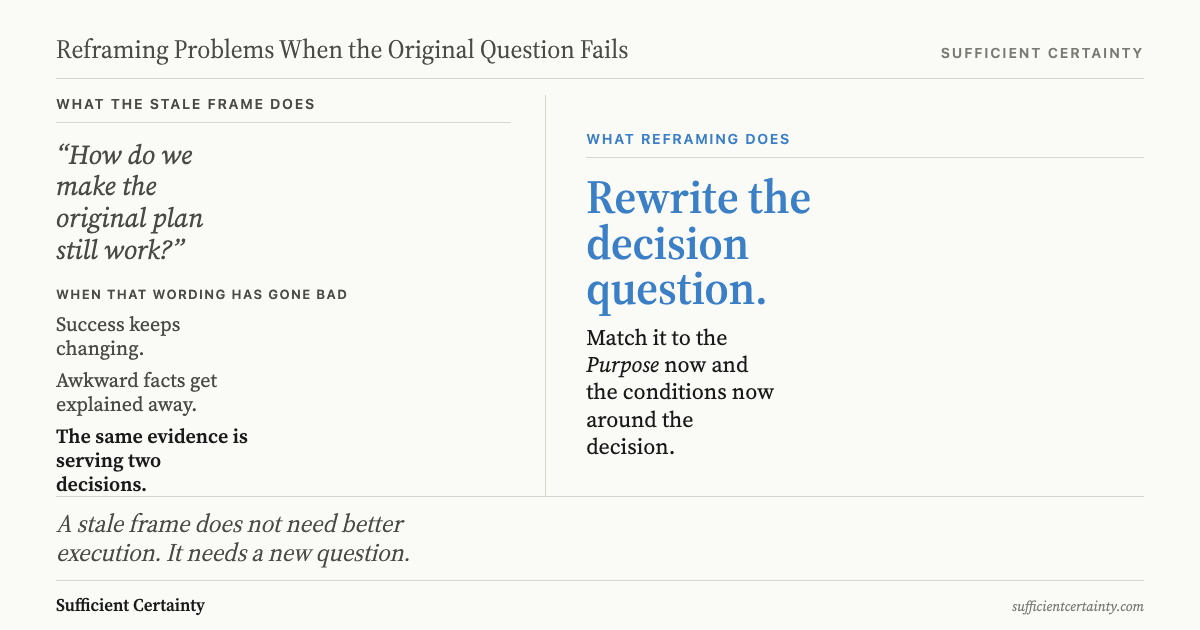
Reframing a problem means writing a new question when the current one no longer matches the facts, so the team stops solving a problem that has already changed.
Reframing problems starts when the room is solving two decisions
I know the frame has gone bad when people looking at the same facts think they are deciding different things. One person thinks the issue is cost, another thinks it is continuity, and both keep speaking as if the disagreement lives in the numbers. The disagreement usually lives in the sentence that opened the meeting.
I watch for two signs. Success changes meaning halfway through the paper, and awkward facts get explained away instead of reopening the question. Once that starts, the room is no longer deciding. It is protecting wording that should already have been retired.
I have watched cost programs continue under their original heading long after supply fragility had turned the live issue into continuity of service. Because the paper still said "efficiency", people acted as if the decision had not changed. They were solving two different problems under one title and calling the confusion disagreement.
I have seen the same thing happen in slow-moving businesses that congratulated themselves on stability while the ground kept shifting under them. Nobody announced a crisis. A few assumptions simply expired, then a few more, and the old frame stayed on the wall because no one had been told to take it down. That is why I treat problem framing techniques as discipline at the start and suspicion afterwards. A good frame lasts longer, but only if someone notices when it has started to rot.
Reframing problems is resisted because the old frame pays people
Ronald Heifetz and Marty Linsky describe the trick neatly in A Survival Guide for Leaders: people treat adaptive trouble as a technical task, because technical work lets the existing bargain survive. Quite right. The executive who promised the saving keeps face, and the analyst whose model has acquired status keeps the altar standing. The adviser who sold the process is hardly eager to stamp the invoice "waste".
This is why stale frames attract process. A stale frame likes a risk register or a model refresh, because each of those lets the room look busy without reopening the bargain. The machinery is not neutral. Someone owns it, and someone bills for it.
That is also why stale frames sound so respectable. They arrive wrapped in procedure, and the procedure has beneficiaries. I can mention the framing effect until everyone nods wisely, but wisdom is cheap when the old question is still protecting budgets and egos. Once the question changes, some earlier work becomes scrap, and people feel that very quickly.
Roger Estall and I wrote Deciding after watching this performance too many times. Belief systems start with the answer and recruit language afterwards. A stale frame does the same thing. It stops asking what is true and starts asking what can still be defended without somebody important going red in the face.
Reframe the problem your team keeps protecting and watch the old question lose its grip. Start the Walk →
Kodak shows the cost of delaying a reframe
Kodak did not fail because the future arrived without warning. It failed because film cash kept buying permission to ignore the warning. Chunka Mui's account and Henry Lucas and Jie Mein Goh's paper show the same protected frame at work: digital was treated as a nuisance to be managed around the film franchise, not as the business already replacing it.
Kodak had plenty of signals. Engineers had shown what digital would do. Consumers were changing their behaviour. Competitors were not asking permission from the film business. Yet the profitable past kept chairing the meeting. When that happens, evidence is not weighed, it is domesticated. I have written separately about why serendipity in decision making depends on a frame wide enough to hear a signal the room did not invite.
That frame gave management an easy lie to live with. As long as the old margins were rich, digital could be parked in the lab or postponed for one more planning cycle, because nobody had priced what each week of waiting cost. The live question should have been brutal and simple: what business are we really in now? The question Kodak kept asking was gentler and lethal: how long can we preserve film without frightening ourselves?
In the Universal Decision-Making Method I would have forced that room back to Frame the decision, then named the signals that had to reopen it. Digital adoption was not a side note. It was the decision environment changing in public while management kept calling it background noise. By the time Kodak behaved as though the frame had changed, the market had moved on and the bill had arrived. Target and Boeing paid similar prices for similarly protected frames.
Lego recovered when the question changed
Lego nearly talked itself into oblivion the same way, except it recovered in time. The 2003 annual report recorded a loss before tax of DKK 1.4 billion. The 2005 annual report showed the business back in profit after it stopped flattering itself with side adventures that had been feeding on the core.
Jorgen Vig Knudstorp asked what Lego was actually for. Once the answer was construction play, the parks and clothing lines stopped looking bold and started looking like expensive vanity. That is why I keep coming back to Purpose. When Purpose is blurred, management can waste years mistaking distraction for strategy and applause for evidence.
The useful part of that case is the brutality of the correction. Once the question changed, whole lines of effort lost their glamour at once. That is what a real reframe does. It makes yesterday's cleverness look like an expensive detour.
A managing director once told me, "Grant, you have a habit of ruining neat strategic briefs," and he was right. I keep asking whether the question still fits the job, because once it does not, the brief becomes a prop.
How I force a reframe without stopping the decision
The wider discipline sits in the problem framing overview, but the move itself is simple. I reopen Frame the decision in writing. I put the old question beside a blank line and ask what Purpose the decision serves now, and what has changed enough to make the old wording unsafe.
I insist on writing the new question down because rooms are full of people who think they have agreed when they have merely stopped arguing. A sentence on paper is harder to fake agreement around. It also lets me test whether the new frame has actually narrowed the decision or merely renamed the muddle.
Then I rewrite the sentence and test it against the outcome we actually want. I use the sequence in the method to keep the room from wandering off into debate club, and I Design monitoring around the signal that would force the question open again. Reframing problems early usually speeds the decision, because half the argument was attached to a question that had already expired.
I also decide in advance what evidence will count as a reopen signal. Without that, Design monitoring becomes a ceremonial phrase and then disappears into the minutes. Someone has stolen the tent, and the room is still discussing the stars. Better execution does not rescue a stale frame. It only helps the organisation hit the wrong target faster.
You could defend the old question and carry a dead problem into tomorrow's meeting.
Work through your decisionNo sign-up. Just pick your decision and start.
Grant Purdy is the co-author, with Roger Estall, of Deciding (2020), and the architect of the Universal Decision-Making Method.