
Shell scenario planning did not predict the 1973 oil crisis. It broke the official forecast inside the company before events did, and that mattered more. The value was not foresight. The value was permission to doubt the house number while everybody else was still married to it.
In most boardrooms the five-year forecast is treated like scripture. I have watched people wrap a shell scenario planning exercise around that forecast so nobody has to say the obvious thing: the number is a bet, not a fact.
Shell scenario planning, developed from the early 1970s by Pierre Wack, was a structured process for breaking the official forecast inside the company and forcing managers to test live decisions against assumptions they had stopped questioning. It did not predict the 1973 oil crisis. It made the comfortable forecast look exposed before the embargo arrived, which mattered more than prediction.
The Shell story is worth getting right because it shows the line between testing a decision and performing one. Most retellings turn it into a foresight myth: the clever planners who saw the oil shock coming. The useful lesson is rougher than that, and it has nothing to do with prediction.
Shell scenario planning broke the official future inside the company and forced managers to test one live decision against the assumptions they had stopped questioning.
What Shell scenario planning actually did
Shell had a formal single-line forecasting system, a planning rhythm, and all the usual respectability that gathers around a number once enough senior people have repeated it. By the early 1970s the oil market was shifting under the floorboards. Producer governments were gaining power, and the old assumption of obedient supply was weakening. Michael Jefferson and Vlasios Voudouris lay out the background. Shell's problem was not a lack of intelligence. It was that one view of the future had been allowed to behave like settled fact.
Pierre Wack's contribution was not clairvoyance. In his later Harvard Business Review essays, the complaint is plain: forecast-led planning had stopped helping managers decide. So the scenario team did something subversive. It put other futures in front of senior people, including futures where producer power rose and cheap oil stopped being the organising assumption. Angela Wilkinson and Roland Kupers trace the sequence through 1971 and 1973. Art Kleiner reports that Group Planning circulated the possibility of oil moving from about $2 a barrel toward $10. Once that number is alive in the room, a capital plan built on permanently cheap oil stops looking sensible. It starts looking exposed.
By May 1973, five months before the embargo, internal attention had narrowed to the scenario the team called Rapids: severe turbulence in the oil market. When the Arab oil producers announced the embargo in October 1973, Shell was not starting cold. Its managers had already spent time inside a world where the comfortable forecast failed.
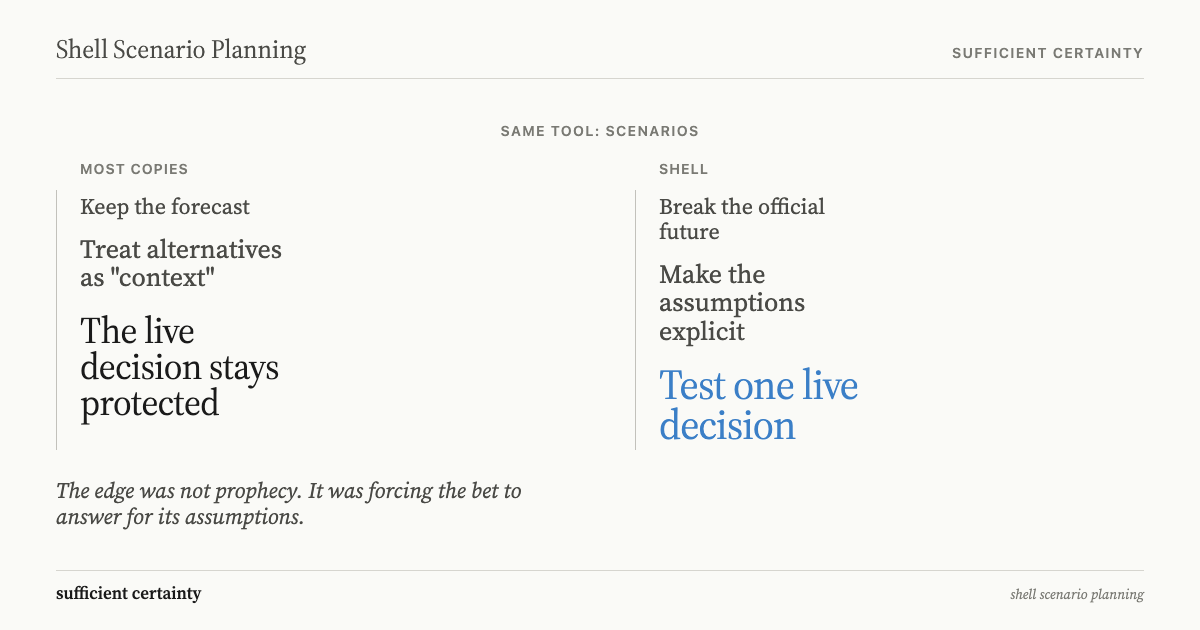
Once a forecast becomes the official future, budgets and careers cling to it. Challenging the number no longer looks like judgement. It looks like bad manners. The scenario team was up against the same politics I meet in every boardroom where the plan has been approved and nobody wants to reopen it.
What the copiers kept
What most companies copied was the safer half. They took the scenarios and kept the forecast, the evasion I trace in forecasting and scenario planning. The official plan still sat in the middle like a crowned head. Alternative futures were invited in as guests, then seated at the children's table. Nobody said the investment case might be wrong. They said the scenarios were "useful context," which is a tidy way of keeping the old number in charge.
Jenny Andersson shows how management literature turned the Rapids story into a foresight fable. Thomas Chermack and Laura Coons supply the corrective: Wack was trying to disturb how senior people thought the market worked, not entertain them with elegant alternatives. Once the myth became "Shell saw it coming," a small industry could sell foresight and workshop theatre to nervous executives. Useful work, if your aim is to invoice for ceremony.
I do not spend much time admiring scenario artefacts. The question is the same one running through the wider scenario planning argument on this site. Did the exercise force a live decision to confront its weakest premise, or did it merely give the organisation a more respectable story about its own diligence? The tool gets copied. The discipline gets left behind.
Break the forecast under your live decision and see which bet still matters when the future branches. Start the Walk →
Shell scenario planning on a real decision
Most scenario exercises stop here. The useful work begins past them. If a client brings me a plant expansion or a long supply contract, I do not start by naming scenarios. I start with the decision, the purpose it serves, and the span of time over which the consequences will be felt. Then I ask what the business case assumes about demand, cost, or supply. Roger Estall and I came back to that question repeatedly in Deciding: what are we assuming here? It does more work than a shelf of polished scenarios because it drags the real bet into daylight.
From there the work is concrete. Test the decision against a few materially different futures. Not dozens. A handful that differ where the decision is most exposed. Find the assumption doing the heavy lifting. If demand growth is the one thing the expansion cannot survive without, attack it. If it holds under pressure, you can commit. If it breaks, you have three choices: get the missing fact, change the decision, or say no. I argue the same discipline in decision-making under deep uncertainty. Uncertainty is normal. Pretending a forecast removes it is the problem.
Then, before money moves, name what you will monitor. Not everything. Just the assumption that can break the decision. If the plant needs demand to grow above 4% for the project to pay back, watch that indicator and agree in advance what number triggers a review. That specificity is what separates a monitoring plan from a dashboard nobody reads. The indicator matters only if you already know what decision it can change, the principle at the core of making decisions with uncertainty.
The test is simple. Did the exercise change a decision, change an assumption, or change what you monitor? If it did none of those, it was decoration. I am not against forecasting. A number can be useful. What I object to is the fraud by which a forecast becomes "the base case" and everyone stops treating dissent as normal. The method starts with the decision, not the future. Shell got that right fifty years ago. Most of the people selling scenario planning since then have not.
What Shell's scenario practice teaches about acting on uncertainty
Most teams I have worked with finish a scenario exercise with four quadrants on the wall and no idea what to do next. The scenarios are vivid. The decision is untouched. That gap is where almost all the value leaks out, and it is the gap Shell's original team understood better than any of the consultancies that came after them.
The lesson is not about generating futures. It is about what you do when the futures are sitting in front of you and you still have to commit money, people, or reputation to one course of action. You cannot wait for the uncertainty to resolve. If you could, you would not need scenarios in the first place.
I once worked with a mining company deciding whether to build a processing plant in a jurisdiction where the fiscal regime was under active review. The team had run a proper scenario exercise and produced three futures that diverged on commodity prices, export policy, and the speed of regulatory change. Good work. But the room then did what most rooms do: it tried to decide which scenario was most likely. I stopped that conversation. Probability ranking is the old forecasting habit wearing new clothes. The useful question is not which future will arrive. It is which assumptions beneath the investment case break first if the future turns against you.
So I asked the team to set the scenarios aside and name the assumptions the business case could not survive without. They found four, but two were carrying the project: a royalty rate that had been flagged for review but not yet changed, and an export corridor that depended on infrastructure the government had promised but not funded. Those are the critical uncertainties that earn the label. Not the uncertainties the scenario matrix happens to feature, but the ones the live decision cannot tolerate being wrong about.
The next step is the one most scenario practitioners never reach. For each load-bearing assumption, I asked the team: do we have sufficient certainty to commit? Not certainty. Sufficient certainty. The royalty rate was a political signal with no legislative draft behind it. The export corridor depended on a budget allocation two fiscal years away. Neither fact was hidden. Both had been sitting inside the scenario narratives without anyone noticing they were also sitting inside the investment case. The scenarios had generated the raw material. Nobody had used it.
The team decided the royalty exposure was tolerable because the project economics survived a rate increase to a specified ceiling. The export corridor was harder. No contract term could hedge a road that did not exist. So we wrote that assumption into the decision record, named the signal that would trigger a formal review, and agreed on who watched it. The investment went ahead with a smaller first commitment and a stage gate tied to the infrastructure timeline.
That is the practical connection between scenario work and the method. Scenarios generate possible futures. The method asks what those futures do to the decision you have to make now. Once you have surfaced the assumptions, judged whether you have enough certainty to act, and named what you will monitor, the scenario exercise has earned its keep. Without that second discipline, the workshop produces a handsome document and leaves the decision exactly where it was.
Shell's team understood this in the early 1970s. The scenarios were not the product. The changed decision was the product. Every team that copies the quadrant and skips the commitment is repeating the mistake the imitators made fifty years ago, and paying presentably for the privilege.
You could keep the five-year forecast and never test the bet underneath it.
Work through your decisionNo sign-up. Just pick your decision and start.
Grant Purdy is the co-author, with Roger Estall, of Deciding (2020), and the architect of the Universal Decision-Making Method.