
Sunk cost and decision making collide whenever past expenditure starts voting on future choices. HS2 had spent GBP46.8 billion by March 2026. The question was no longer whether to build it but whether anyone could face the political cost of stopping. Dead money had acquired a voice in the room.
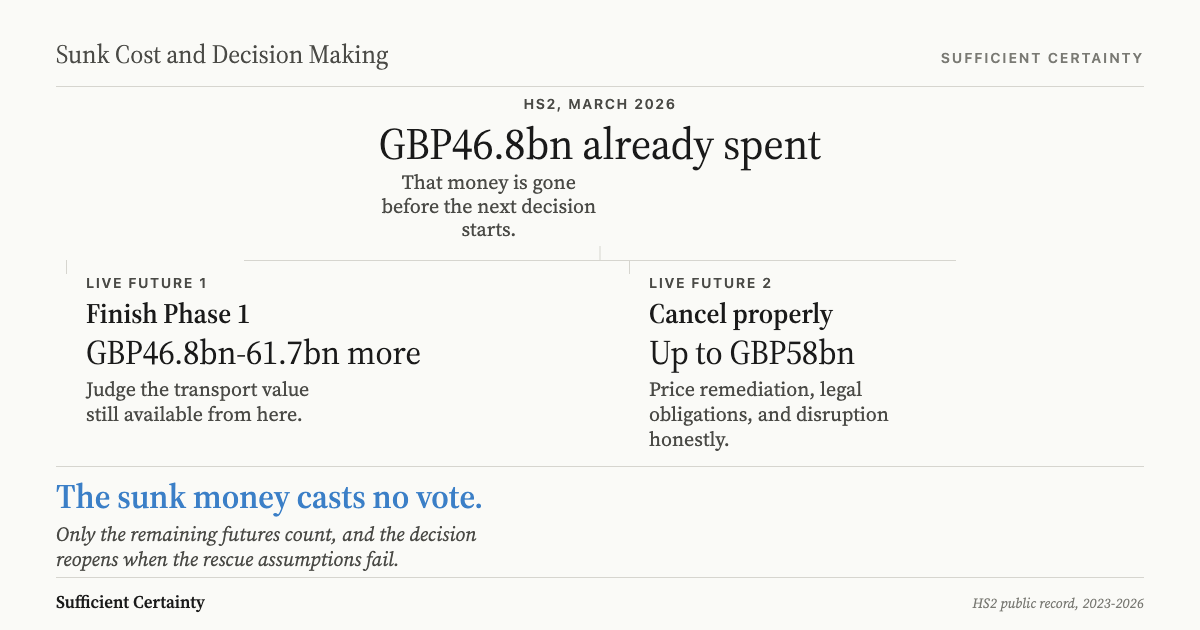
HS2 is what sunk cost and decision making looks like once the bill is too large to hide in committee papers. By March 2026, GBP46.8 billion had already gone, Phase 2 had been cut away, and officials were still choosing between another GBP46.8 billion to GBP61.7 billion to finish Phase 1 or as much as GBP58 billion to cancel it properly.
Treasury has this part right. In the Green Book, sunk costs stay out of appraisal, and the work is to compare the costs and benefits still ahead, including opportunity cost. The trick is stopping officials from sneaking dead money back in dressed as prudence.
Sunk cost and decision making collide whenever past spending is treated as evidence for continuing, and the fix is to compare only the paths still open on their own merits.
Why sunk cost and decision making get muddled
Yesterday's approval has a nasty habit of turning up as today's evidence. A board paper opens with spend to date, then a progress story, then a request for the next decision. By the time the room reaches the choice, history is already sitting at the table. That habit is the broader sunk cost fallacy, and it survives because most organisations never make the live decision stand on its own feet.
The psychology behind sunk cost bias is real, but the institutional version is uglier. Ministers want to avoid owning a public write-off, and contractors want continuation revenue. Officials prefer not to admit that yesterday's approval now looks silly. In my experience, once those interests are in the room, everybody discovers a noble reason for more spending, especially the people paid by it.
This is why so many elaborate decision-making frameworks disappoint me. They improve the formatting of a paper already rigged by spend-to-date. If the question arrives bent, cleaner headings do not straighten it.
What sunk cost and decision making should look like
Start by framing the live choice in forward terms. For HS2, the serious question was which remaining option still bought enough transport value from here to justify the next spend.
Next, Develop options. In its October 2023 accounting officer assessment, the Department for Transport compared continuing Phase 1 with stopping immediately, included cancellation and remediation in the stop option, and excluded sunk costs. That is the right structure. A stop option that pretends unfinished works can be abandoned without legal consequences and local disruption is propaganda, not analysis.
Mark Wild's May 2026 cancellation cost advice made the choice plainer. Real cancellation and remediation could cost GBP33 billion to GBP58 billion in 2025 prices, while finishing the agreed scheme was estimated to require GBP46.8 billion to GBP61.7 billion more. A Decider has to price both futures honestly, because the cost of stopping is real and the old spend still proves nothing. That is exactly what the Universal Decision-Making Method forces a room to do.
I have sat in rooms where somebody recites the money already spent as though the number itself were a strategy. It never is. It is only an attempt to make withdrawal feel disreputable before anyone has compared the live options properly. Occasionally that comparison reveals a genuine forward cost, a switching penalty or a capability the team would lose, and then the sunk cost fallacy is not a fallacy. But reciting the number is never how you get there.
Carry the next funding decision through the five steps and judge it without letting yesterday's spend cast the vote. Start the Walk →
Recognise assumptions hiding inside "we have come this far"
In sunk cost and decision making, the sentence "we have come too far to stop" is not a reason. It is an assumption wearing the costume of a reason. It assumes the benefits still justify the extra spend, and it assumes the people now running the scheme can deliver more reliably than they have so far. Often the mispricing predates the crisis entirely: the hidden cost fallacy approved a number that was never the whole cost to begin with.
Once those assumptions are written down, the magic goes out of them. Roger Estall and I built Deciding around this move because good decision analysis under uncertainty begins with testable claims, not with embarrassment about the money already gone.
The National Audit Office's 2026 High Speed Two reset report matters for a nastier reason. By March 2026, GBP46.8 billion had been spent, the cost range had climbed to GBP87.7 billion to GBP102.7 billion, and the decision system had become so complex that it slowed progress without preventing poor outcomes. Once a program grows that kind of protective shell, every fresh review starts to look suspiciously like paid time.
Sufficient certainty judges the next decision
The most embarrassing figure in the 2026 continuation assessment is also the most clarifying. The Department for Transport said that if today's costs had been known at Notice to Proceed in 2020, the equivalent benefit-cost ratio would have been only 0.3 to 0.4. The original approval would have died on its own paperwork. Old spending does not revive it.
Today's decision was still different. In the May 2026 decision to continue delivery, the department again excluded sunk costs, compared continuation with cancellation and remediation, and said the continuation case likely had a benefit-cost ratio above 1.5. Distrust that if you like. The current decision still had to live or die on the futures that remained.
If someone wants to write "difficult" next to my name in the margin, fine. I would rather be difficult than let yesterday's money cast another vote. Roger Estall and I wrote Deciding to separate the old approval from the live one, and to make the cost of stopping part of the future that must be priced honestly.
Design monitoring before you release the next pound
Sunk cost and decision making fail again when nobody writes down what would force a continuation decision back open. A rescue plan becomes the next sunk-cost trap if costs drift or dates slide and nobody agreed in advance what happens when promised capacity starts thinning out.
We already knew the assumptions carrying the rescue case. Monitoring should say exactly what happens when one of them breaks. Without that discipline, monitoring becomes ceremony and the rescue plan becomes one more shrine built to yesterday's spend.
Boards earn their keep by deciding whether the next pound buys anything worth having, and by reopening the decision when that answer changes. HS2 is only a public version of a very common private habit: once enough people are paid or protected by continuation, the organisation starts calling self-preservation good governance.
You could defend yesterday's spend and walk into the next funding meeting already trapped.
Work through your decisionNo sign-up. Just pick your decision and start.
Grant Purdy is the co-author, with Roger Estall, of Deciding (2020), and the architect of the Universal Decision-Making Method.