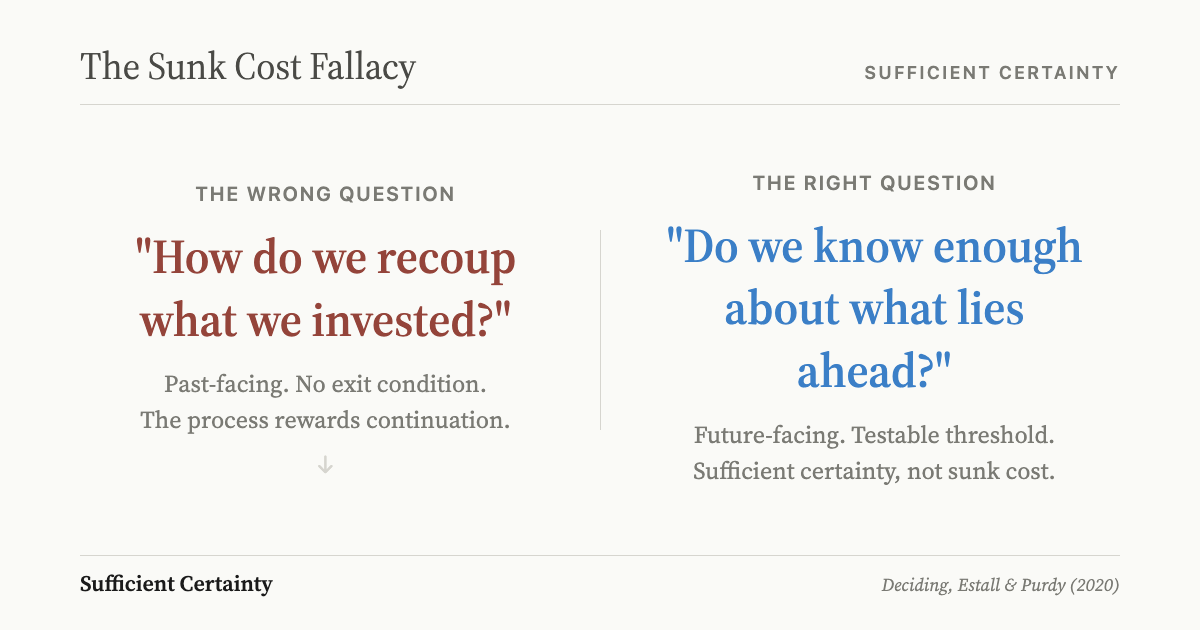
The sunk cost fallacy persists not because people are irrational but because most decision processes have no mechanism to separate past expenditure from future uncertainty. Every MBA graduate knows the name. Every organisation still falls for it. The fix is structural, not educational.
A sunk cost is money, time, or effort already spent that cannot be recovered. The sunk cost fallacy is the pattern of continuing a course of action because of what has already been invested, rather than what lies ahead. It persists not because people are irrational but because most decision processes have no mechanism to separate past expenditure from future uncertainty.
The standard explanation is correct but useless. Every MBA graduate knows the sunk cost fallacy by name. Every organisation still falls for it. Knowing the name of the trap has not reduced its frequency, because the trap is not in the thinking. It is in the process.
I have spent fifty years advising organisations on consequential decisions. The sunk cost pattern repeats across every sector I have worked in. And in every case, the people were not the problem. The apparatus they were operating within was the problem. The Universal Decision-Making Method that Roger Estall and I developed provides the structural fix: a process that forces past expenditure out of the frame and replaces it with a forward-looking test of sufficient certainty.
Sunk cost fallacy is the habit of letting what you have already put into something steer a decision about what to do next.
What the sunk cost fallacy is
The sunk cost fallacy is not confusion about arithmetic. It is the habit of turning yesterday's expenditure into today's reason to continue. Once prior spend is treated as evidence, the decision stops being forward-looking and starts being defensive. Instead of asking what future outcome is most likely, the room asks how to justify not walking away. That is a different question with reliably worse answers. That is why the problem shows up in boardrooms, ministries, and programme offices rather than only in textbooks. The numbers change. The reflex does not. People start protecting the embarrassment of admitting the past is gone.
Psychologists are right to point to loss aversion, but that is only the first layer. In organisations the loss is embedded in budgets, contracts, job descriptions, reputations, and speeches already made to investors or ministers. That is where sunk cost bias stops being a tidy label and becomes a governance problem. Old spend acquires moral weight. A project no longer has to justify its future. It merely has to remind the room how awkward cancellation would feel. Nobody says this plainly, of course. They say they must protect value, preserve momentum, or honour commitments already made. Same reflex, better tailoring.
The Anglo-French Concorde is the canonical example. By the early 1970s, everyone with a calculator could see the aircraft would never be commercially viable. Funding continued anyway, because stopping would have made the loss visible.
The details vary from sector to sector, but the mechanism does not. Once the question becomes "how do we rescue what we started?", the decision is already compromised. I do not need to drag Kodak, Boeing, and half the public sector in here to make the point; if you want the gallery, I put five more examples on sunk cost fallacy examples. The hub should explain the trap. The spokes can supply the wreckage. A hub page should tell you why sensible people keep making the same mistake, not rehearse every crash site in detail.
Why knowing about sunk costs does not prevent them
Every popular guide ends the same way: recognise the bias, ignore the past, judge the future on its merits. That advice is correct in the way "sleep more" is correct. It is not wrong. It is simply too weak to survive contact with an organisation. People do not persist because they have never heard the phrase "sunk cost fallacy." They persist because the process in front of them still rewards continuation and treats reversal as failure. That is why the same executives who can explain sunk costs perfectly over dinner will still defend them at nine the next morning in a steering committee.
Once a project is approved, the organisation starts manufacturing memory in its favour. Minutes record the approval, budgets allocate funds and teams are hired. Procurement contracts are signed. Performance targets assume delivery. By the time someone asks whether the original rationale still holds, the organisation has wrapped the project in enough ceremony to make stopping feel like insubordination. Awareness does not dissolve that structure. It merely gives the participants a nicer label for what they are doing. Training helps individuals. It does not redesign agendas, approval gates, or reporting lines.
Consider a logistics company that spends $150,000 on a fleet study. Three months later fuel prices move, emissions rules tighten, and the study is already stale. Yet the steering committee keeps quoting it as if it were scripture. The sunk cost is no longer the study or the fleet. It is the reluctance to admit the analysis has been overtaken by reality.
That is why awareness campaigns fail. The risk register carries the old spend. The business case cites prior expenditure as justification. The committee gets to feel diligent while never asking the only useful question: does the decision still deserve to exist? That is how you get analysis paralysis: endless motion, no decision, and a growing pile of paper proving how seriously everyone took the mistake. The organisation appears active, responsible, and analytical right up to the moment it writes off another quarter.
Separate what you have already spent from what the next phase actually requires and test the forward case. Start the Walk →
The decision process that lets sunk costs persist
The real defect is architectural. Standard organisational decision-making asks how to manage the risks of what is already underway. It rarely asks whether the thing should still be underway at all. That gap is where sunk costs hide. If the process begins from the assumption of continuation, every subsequent analysis is merely decoration on top of the original commitment. A process can be impeccably followed and still answer the wrong question from beginning to end.
Most decision-making frameworks are built for documentation, not judgment. They prove that someone looked at the risks, wrote the minutes, and used the right template. Useful, no doubt, if your goal is to satisfy an auditor. Useless, if your goal is to find out whether the program should live or die. Due diligence is not the same thing as a decision. Organisations confuse the two with impressive consistency. Auditors love the template. Markets, passengers, patients, and taxpayers are less sentimental.
Notice what is missing from those frameworks: a deliberate step that strips past expenditure out of the frame and forces the room to test whether the original assumptions still hold. Without that step, new information is treated as a nuisance to be managed, not a reason to reconsider. The apparatus can generate options analyses forever and still never produce an honest option called "stop." If stopping cannot appear as a respectable option, continuation is not being chosen. It is being smuggled in, and that is not prudence but the appearance of it.
A board will often respond to a red risk report by asking for another mitigation plan, which does nothing about the decision that created the exposure. Nobody is irrational in the room. They are responding rationally to a structure that rewards continuation, penalises abandonment, and treats cancellation as bad manners. The sunk cost fallacy in organisations is less a thinking error than an incentive structure masquerading as rigour. The process calls this discipline. Reality calls it delay.
How to strip past investment from a decision
The cleanest way to remove sunk cost from a decision is to stop asking about the money already spent and start asking what the organisation exists to do. That sounds simple, as most useful disciplines do. If the question is framed properly, prior expenditure loses its glamour very quickly. Most teams never do this because sunk money makes the current path look inevitable, which is nonsense dressed as maturity.
Purpose, as I use the term, is not a mission statement laminated in reception. It is the outcome the organisation is for. Once you use that frame, the past loses its leverage. A bad spend is still a bad spend, and the people involved may still need uncomfortable conversations, but the spend no longer gets to vote on the future. The future is decided by whether the next step serves the purpose better than the alternatives do. This is why purpose works: it shifts the argument from recovery to service, from embarrassment to consequence.
HS2 is the obvious British example. Once you strip out the political theatre and the cash already burned, you are left with a simple question: does the remaining project still serve the purpose it was supposed to serve? If the answer is no, then the fact that billions have already gone is not a reason to continue. It is a reason to stop pretending.
That is the test I walk through in sunk cost and decision making. The practical discipline is brutal in the best way: treat the remaining decision as if it were being proposed fresh today, with today's information, today's alternatives, and today's consequences. If you would not start it now, your past investment has supplied nostalgia, not evidence. That question is rude, which is one reason it works.
From hidden assumptions to sufficient certainty
"We should continue because we have invested $2 million" is not a fact. It is an assumption wearing a cash receipt. The real issue is usually hidden before the first cheque is written: somebody has already decided that past spend predicts future return, and nobody has bothered to say so aloud. That is the habit I call the hidden cost fallacy: the price gets approved, the assumptions do not. By the time the spending becomes sunk, the reasoning that justified it has usually disappeared into the wallpaper. Nobody budgets for assumption failure until the bill arrives.
The useful question is still the one I keep repeating, because most people still do not ask it: what are we assuming here? Once you force the assumptions into the open, you can test their significance. Some assumptions barely matter. Others decide the whole outcome. If the answer is "we do not know," then you have three honest choices: learn more, change the decision so it depends less on that assumption, or make a different decision. Sufficient certainty is not a mood. It is the point at which the critical assumptions are explicit enough, and tested enough, to act without pretending uncertainty has disappeared. That is the bridge to the sunk cost fallacy is not a fallacy, because sometimes the past does create a genuine future switching cost. Usually it does not. Sometimes it does. Test before you sermonise.
California's high-speed rail is the polite version of the problem: cost overruns, timeline slippage, and yet the original assumptions keep being treated as if they were still alive. NASA's Starliner decision in 2024 was the opposite: when thruster anomalies left too much uncertainty, the agency chose a different vehicle and brought the crew home without pretending sunk cost was a strategy. Same general problem, different response. One kept refinancing hope. The other tested the assumption and refused to board it.
That is also why sunk cost fallacy investing matters: in markets, the buy price gets promoted to exit plan, and people confuse their entry history with the asset's future. Sunk cost theory usefully names the trap, but theory is not a rescue service. The final discipline is monitoring. Decide in advance what will count as your assumptions breaking, and what you will do when they do. In every domain, the remedy is the same: define the trigger, define the response, and do it before hope acquires a budget line. Otherwise you do not have sufficient certainty. You have a hope budget.
You could keep funding the plan because stopping would make the loss real.
Work through your decisionNo sign-up. Just pick your decision and start.
Grant Purdy is the co-author, with Roger Estall, of Deciding (2020), and the architect of the Universal Decision-Making Method.