
Sunk cost bias turns past losses into fake evidence for continuing. Once dead money acquires a moral voice, boards defend work nobody believes in because abandoning it feels like admitting the original approval was wrong. The bias is not irrational. It is a rational response to a process that punishes reversal.
A board I once watched had a failing program on the table, three years old, in its second steering committee, carrying several million dollars of spend and a supplier contract nobody wanted to unwind. The paper before them did not ask whether the program still served its Purpose. It asked whether the next tranche of funding should be released. By then old money had acquired a moral voice. Stopping felt wasteful. Continuing sounded responsible. That is sunk cost bias.
The psychology behind the sunk cost fallacy is real. Kahneman and Tversky's prospect theory explains why a loss registers more strongly than a gain of the same size. The pain is genuine. Treating the pain as evidence is the fraud.
Sunk cost bias is the tendency to treat money already spent as a reason to keep spending, even when the forward case no longer holds on its own evidence.
Why sunk cost bias feels rational
While the project continues, the loss can still be dressed up as investment or strategic patience. Program sponsors like those labels, and suppliers rarely object. Once a Decider stops the work, the language clears and the money is simply gone.
Arkes and Blumer showed the same pull in The Psychology of Sunk Cost: people who paid more for theatre tickets kept turning up more often, even though the money could not come back. A theatre ticket is harmless. In a brokerage account the same impulse pins the exit to the buy price. In an organisation it arrives wearing a capital budget and an assurance review.
I have watched senior people defend programs they no longer believed in because stopping would make their earlier approval look foolish. The loss had ceased to be only money. It was now the sponsor's reputation and a chain of formal commitments, with consultants and suppliers still attached to continuation and middle managers reluctant to surrender the turf it created. Once that happens, the room does not need another spreadsheet. It needs the old spend removed from the question.
The sunk cost effect becomes dangerous when reputation joins the money
Barry Staw's 1976 paper, Knee-Deep in the Big Muddy, matters because it shows what happens after bad news arrives. When people are personally tied to the first approval, they are more likely to commit further resources. Anyone who has sat through a rescue meeting already knows the type.
From there the machinery takes over. Once the supplier wants another tranche and the sponsor wants not to look foolish, the middle manager who acquired headcount from the program quickly discovers the virtues of patience. Consultants then arrive to review the review, which is a splendid trade when cancellation can always wait one more quarter. By then the organisation has become the excuse rather than the beneficiary. The organisational sunk cost fallacy examples from Concorde through Enron show the machinery at full speed.
That is why telling a board that sunk costs are irrelevant is schoolroom advice. They know the phrase. Sunk cost theory gives them the vocabulary, but what they usually lack is a process that makes yesterday's approval inadmissible unless it tells us something true about tomorrow. Roger Estall and I built Deciding for exactly that reason.
Run your live project decision through the five steps and strip reputation, pride, and dead money out of the case. Start the Walk →
Sunk cost bias is a process failure, not just psychology
The escalation literature supports the same complaint. Sleesman and colleagues, in Cleaning Up the Big Muddy, show that escalation thrives when bad news meets social pressure and nobody has prepared a credible alternative. In plain English, the room is arranged to keep going.
That arrangement is the part I care about. Many decision-making frameworks tidy the apparatus without clearing the question. If the board paper opens with total spend to date and ends by asking for the next tranche, the past has already won. Everyone who benefits from continuation can now pretend they are merely defending due process.
A better frame starts where the sunk cost fallacy ought to be challenged, at Purpose and at the assumption carrying continuation. What are we trying to achieve now? What would have to be true for more money to help? Those questions are almost embarrassingly plain, which is why so many expensive governance systems avoid them.
How I strip past cost out of a live decision
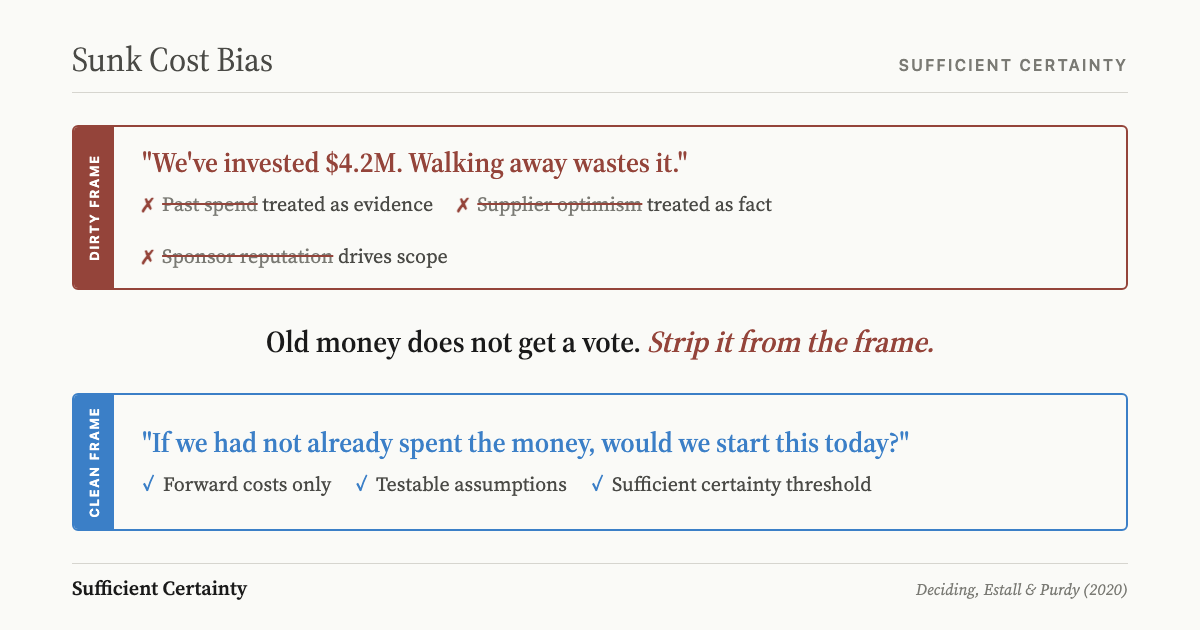
When I sit in a room with this problem, I do not begin by diagnosing bias. Calling it bias too early gives everyone a grievance and nobody a decision. I ask the room to restate the live decision without mentioning what has already been spent. If they cannot do it, the frame is dirty. If they can, and what surfaces is a genuine future cost created by the old spend, that claim deserves testing — because sometimes the sunk cost fallacy is not a fallacy.
Then I turn the defence into an assumption. "We have spent too much to stop" becomes "continuing from here will create more value than stopping now." That sentence can be tested, which is what good decision analysis under uncertainty is for. The original complaint cannot be tested. It is only a demand that yesterday's money be allowed to vote again. That is where the bias stops being a private feeling and becomes a governance habit. The habit usually starts upstream, where the hidden cost fallacy gets the spend approved with its real costs left unpriced.
If my name is attached to this method at all, it is because I keep objecting to that fraud. The Universal Decision-Making Method forces the decision back onto today's Purpose and makes continuation earn its place from this point forward. Old spend does not count as evidence, and supplier optimism does not become fact because it arrived on branded slides. If Sufficient certainty is not there now, the method does not permit a sentimental extension.
What happens when nobody strips the frame
Shoreham is the institutional warning. Ross and Staw's study of organisational escalation and exit at Shoreham followed a project trapped in regulatory conflict and political commitments, with the sunk spend making exit harder each year. Sponsors kept defending it until cancellation became formally inevitable long after the commercial case was dead. That is what happens when too many people find continuation more tolerable than confession, and the wider record of cognitive bias examples in public life is thick with the pattern.
Sunk cost bias survives because continuation rarely arrives under its own name. It arrives as respectable paperwork from suppliers and consultants, and as "stewardship" from the sponsors who approved it. Committees nod along because stopping leaves a body on the floor. I prefer one rude question: if we had not already spent the money, would we decide this today?
You could call stopping wasteful and sign the next tranche against your own evidence.
Work through your decisionNo sign-up. Just pick your decision and start.
Grant Purdy is the co-author, with Roger Estall, of Deciding (2020), and the architect of the Universal Decision-Making Method.