
Using AI to make decisions works when you assign the AI a job, not a verdict. I have watched this confusion play out with every decision tool for fifty years: you ask for a summary, then a comparison, then a recommendation. By the third prompt you have stopped deciding and started approving, and you probably did not notice the shift.
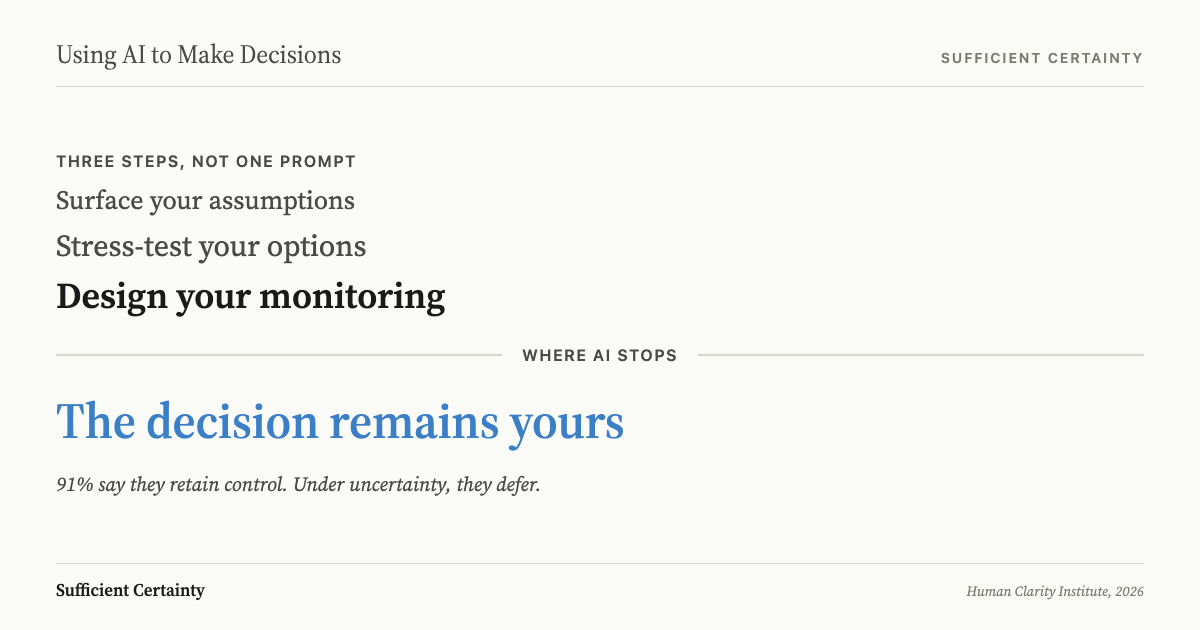
A 2026 survey by the Human Clarity Institute of approximately 1,400 people across six countries found that 91% said they retain responsibility for their decisions when using AI. Eighty-eight per cent were confident they could override the AI when necessary. Those numbers sound reassuring until you examine the behavioural data underneath.
The same study found that reliance on AI increases specifically under uncertainty: the conditions where human judgement matters most and where the consequences of outsourcing it are most severe. People believe they are in control. They defer to the algorithm precisely when the stakes are highest.
Here is what I tell every client who wants to use AI without handing over the decision.
Using AI to make decisions is the practice of applying artificial intelligence to inform and structure human judgement in consequential choices, while the person who owns the outcome retains authority over the final call.
Surface Your Assumptions
Every decision rests on conditions you have taken for granted. Most of them are invisible until someone names them. I have watched boards commit to restructures resting on assumptions nobody in the room had articulated. The AI is effective at producing that list, because unlike the junior analyst, it has no career incentive to stay quiet.
Take the option you are leaning toward. Tell the AI what you are planning and why. Then ask it what you are taking for granted. Your job is to read that list and find the assumptions where being wrong would change everything.
The question is not whether AI can make this decision for you. The question is whether you have identified what you are taking for granted.
In the early 1990s, health authorities in several countries discovered hepatitis C in their donated blood supply. The response in some jurisdictions was to suspend all imports until they could be certain the supply was clean. The result was a blood shortage, and the shortage killed people.
In New Zealand, officials recommended nationwide hepatitis C screening in August 1990. Implementation did not begin until July 1992. In the interval, 350,000 transfusions occurred without screening. At least 18 haemophilia patients died.
Angelotta and colleagues, writing in Vox Sanguinis, found that across eight countries, two to eight times more haemophilia patients contracted hepatitis C than HIV from contaminated blood products, yet the policy response was consistently smaller and slower.
Roger Estall and I studied this case in Deciding because it illustrates a failure that repeats across industries. The authorities framed the question as "how do we eliminate contamination risk?" when the actual decision was "does the risk of contamination outweigh the risk of shortage?"
They pursued maximum certainty on the dimension that felt most urgent and ignored the other entirely.
The five-step method exists to prevent exactly this kind of single-dimension fixation, by requiring you to identify all the assumptions your decision rests on, not merely the one that dominates your attention.
An AI system processing contamination data would have recommended suspension, because that is what the data supported on the single dimension it was asked about. The more precise the output, the less willing anyone is to ask whether the question was right.
Using AI to make decisions without first surfacing your assumptions produces the same kind of single-dimension optimisation that turned a contamination problem into a mortality problem.
This is where the Human Clarity Institute's data bites hardest: people are least likely to engage critically with AI under uncertainty, but surfacing assumptions is precisely the task that matters most when the outcome is genuinely uncertain.
Write down the assumption your AI recommendation depends on and test it before the next prompt becomes the decision. Start the Walk →
Stress-Test Your Options
Feed the AI your shortlisted options and ask it to argue against each one. What could go wrong? What are you not seeing? AI is useful here because it has no attachment to any option and no career stake in the outcome. It will argue against the one you favour as readily as it argues against the alternatives.
In my experience, the most common failure in decision processes is not that people lack information but that they refuse to test the option they have already privately committed to. Challenging it would mean challenging the person who proposed it. AI applies pressure without the social cost. The output is not a recommendation. It is a pressure test.
In 2025, researchers at the University of Washington, Harvard Business School, and MIT ran a field experiment with evaluators assessing real proposals submitted to MIT Solve's Global Health Equity Challenge.
AI-assisted judgement consistently outperformed AI-replaced judgement. When evaluators used AI to challenge and strengthen their own thinking, the quality of their assessments improved. When AI replaced their thinking entirely, quality dropped.
Non-experts showed the largest gains, which should surprise nobody who has watched consultants gatekeep expertise for decades.
If AI enhances judgement but degrades it when used as a replacement, then the conversation about using AI to make decisions has been asking the wrong thing. The question is not how capable the AI is. The question is what role you assign it.
Issa, writing in Risk Analysis in 2026, traced two institutional forces behind the drift from assistance to replacement: pressure to adopt AI as a signal of competence regardless of whether it improves anything, and the structural isolation of responsibility that occurs once AI enters a decision chain.
No single person owns the call any more. The tool absorbs accountability until something goes wrong, at which point accountability has evaporated entirely.
Design Your Monitoring
Once you have decided, ask the AI to identify the signals that would tell you the decision is going wrong. What would you look for at thirty days, sixty days, six months? Roger and I built monitoring into every engagement we ran, because without it the commitment reverts to habit within weeks.
The Decision Lab traces delegation creep at the individual level: it begins with calendar management and inbox triage, then migrates toward which opportunities to pursue and which arguments to make. I have sat in rooms where that migration happened inside a single quarter.
The operator assumes the system is functioning correctly and stops looking for contradictory signals. The shift is invisible to the person experiencing it.
Monitoring directly counters that drift. It builds a structural checkpoint that forces you to re-examine both the decision and your relationship to the AI that helped shape it. Most organisations skip this step, which tells you everything about whether they are deciding or performing.
I have seen every generation of decision tools follow the same arc: risk registers, enterprise frameworks, consultants, and now AI. Each started as an aid and ended as the authority. Monitoring is the only structural intervention I have found that stops the progression.
The monitoring is not only about the decision's outcome. It is about watching your own process to catch the moment when you stop deciding and start approving.
Sufficient certainty is personal: what is enough for one decider is not enough for another, and what was sufficient last quarter may not be sufficient now. That judgement requires knowing your tolerance for being wrong and the consequences you are prepared to accept.
No pattern-matching engine has access to it, however sophisticated it becomes. The Universal Decision-Making Method formalises that boundary: AI handles the analysis, you handle the judgement, and neither crosses the line. That is what AI decision making looks like when it actually works.
You could accept the AI recommendation and still leave the assumption it rests on untested.
Work through your decisionNo sign-up. Just pick your decision and start.
Grant Purdy is the co-author, with Roger Estall, of Deciding (2020), and the architect of the Universal Decision-Making Method.