
Waiting makes every option worse when nobody in the room has calculated how fast each option is losing value. The options on the table rest on assumptions about cost, regulation and competitor behaviour, and those assumptions are decaying while the committee schedules the next review.
In a finely balanced match, a player can take the winning stroke now or wait. The stroke does not change; its significance does, because the match moves underneath it. I have watched the same thing happen in boardrooms for forty years: a capital investment, a product launch, a restructure sits on the agenda while the assumptions underneath it quietly rot.
Waiting makes every option worse when the assumptions supporting each option change faster than the decision-making process can keep pace, raising cost and narrowing the window for success.
Every Option Has a Half-Life
The phrase "cost of delay" has entered product management vocabulary, but in my experience most organisations still treat it as a motivational slogan rather than a number. Don Reinertsen, who formalised the framework in The Principles of Product Development Flow, reported that eighty-five per cent of product managers cannot quantify what a one-month delay costs their organisation. Among those who do try, individual estimates within the same team differ by a factor of fifty to one.
That variance is not a calibration problem. It is evidence that the team has never identified the assumptions their cost estimate rests on. One person assumes the market will wait; another assumes a competitor is six months behind; a third assumes the regulatory window stays open through the next quarter. Each assumption produces a different cost of delay, and none has been tested.
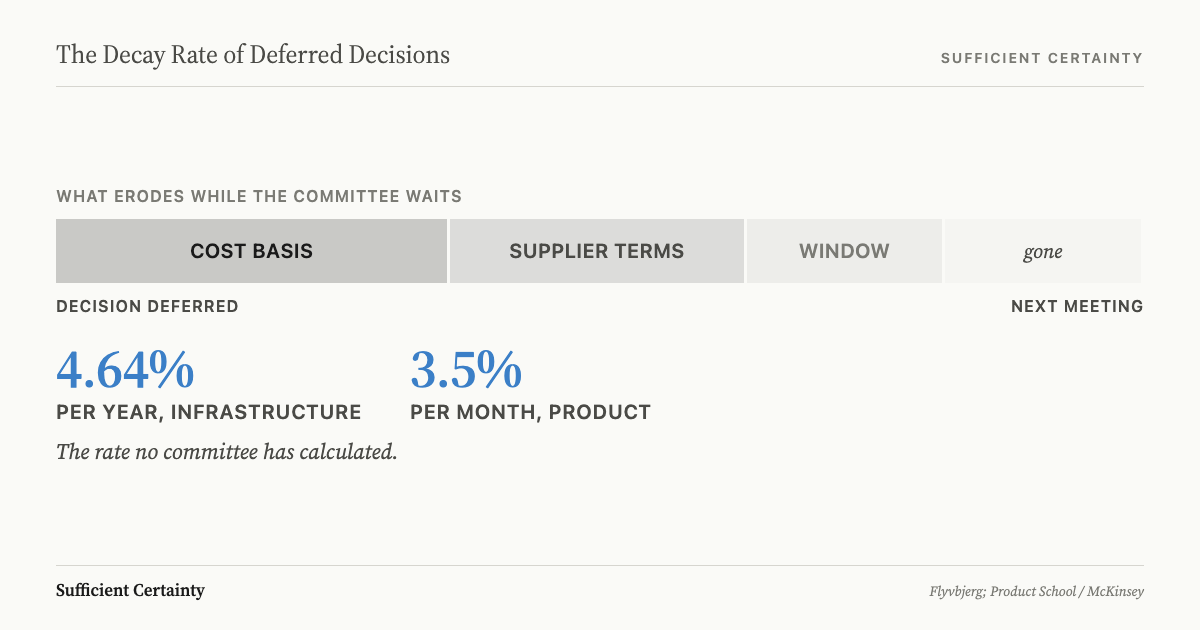
Bent Flyvbjerg's research on infrastructure projects puts hard numbers to the pattern. A six-year delay on a major infrastructure project doubles its cost, with escalation running at 4.64 percentage points per year on average. For a project the size of the Channel Tunnel, that figure translates to approximately one million dollars per day in expected cost growth, excluding financing. The assumptions behind the original budget did not survive contact with six years of material cost inflation, regulatory change and labour market movement.
In product development, the decay curve is steeper: research synthesised by Product School shows that a ten-month delay in market delivery reduces financial return by approximately thirty-three per cent, compounding at roughly 3.5 per cent per month, and later months destroy the business case entirely as competitors move, customer needs shift and the team that was ready to build it gets reassigned.
| Domain | Decay rate | What a one-year delay costs |
|---|---|---|
| Infrastructure (Flyvbjerg) | 4.64% per year | ~$1M/day on Channel Tunnel scale |
| Product development (Product School) | 3.5% per month | 33% of return destroyed in 10 months |
Who Benefits When the Committee Waits
Committees defer because they believe more information will arrive before the next meeting. Sometimes it does. I have rarely heard a committee ask whether the value of that information exceeds the decay cost of waiting for it. The person who proposes waiting rarely carries the cost of the wait; the cost lands on the project, the team or the customer, while the proposer's reward is another quarter with their reputation intact.
I have sat in rooms where a manufacturer was committing resources to a new product line. The decision rested on assumptions about raw material prices, consumer demand and competitive positioning, and each week those assumptions shifted. The committee waited three months for a consultant's market study, and by the time it arrived, the market the study described was no longer the market the product would enter.
Roger Estall and I wrote in Deciding that a ranked option is only as durable as the assumptions about the context in which its outcomes will be experienced. The product line did not get better with age; the assumptions underneath it got worse, while the committee congratulated itself on thoroughness.
The legitimate version of "wait" is what software engineers call the last responsible moment: defer commitment until deferring further would eliminate an option or raise its cost materially. That principle is sound, but it requires knowing when the moment arrives. Most committees I have observed do not set a trigger; they set another meeting date. A trigger names the assumption being monitored: "if the vendor's price hold expires before 15 March, we lose the 12 per cent discount." A meeting date monitors the calendar.
The consultant who recommends "wait for more data" has an incentive to keep the trade-off conversation going; the committee member who agrees has an incentive to avoid a career-staking call. Neither of them is paying the decay cost.
| Who proposes waiting | What they gain | Who pays the decay cost |
|---|---|---|
| Committee member | Avoids a career-staking call | The project team and customer |
| External consultant | Another month of billable engagement | The organisation's cost basis |
| Sponsoring executive | Preserves optionality on paper | The team allocated but idle |
A government changing tax policy to stimulate business investment faces the same dynamic at national scale. The policy rests on assumptions about current economic conditions and the lag between announcement and behavioural response. If the legislative process adds eighteen months, the economic conditions the policy was designed to address may have shifted so far that the stimulus lands in the wrong part of the cycle. That gap, from sound decision to obsolete effect, is the decay rate at national scale, and it operates in exactly the same way inside a corporate capital-expenditure committee that meets quarterly.
Name the assumptions behind the option your committee deferred and calculate how fast each one is decaying before the next meeting. Start the Walk →
How Waiting Makes Each Option Worse
The Universal Decision-Making Method provides the diagnostic that the standard cost-of-delay conversation misses. Reinertsen tells you to quantify delay cost. The method tells you where the cost comes from: the assumptions behind each option, their volatility, and how fast the context around each assumption is changing.
The method starts with the option the committee has deferred and identifies the assumptions that make it viable: a supplier price hold, a regulatory deadline and a customer commitment. When I run this exercise with a leadership team, the first assumption usually surfaces in under a minute; the second takes longer because it has been living as an unspoken belief rather than a named condition. For each assumption, two questions matter: how much influence does this assumption have on the desired outcome, and how confident is the team that it will still hold at the next decision point?
The assumptions with high influence and declining confidence are the ones generating the decay rate. A supplier who has quoted a price valid for sixty days creates a hard boundary: after day sixty, the option's cost basis changes. A regulatory window closing in Q1 creates a cliff, where every week of delay brings the option closer to extinction. I have priced this decay in procurement committees and in infrastructure boards, and the number always surprises the room. These are not risks to put on a register; they are the decay mechanism itself, and they can be expressed as a dollar figure per week.
In a procurement exercise I facilitated last year, the committee had deferred a vendor selection for two months. We listed the assumptions holding the preferred option together and priced each one:
| Assumption at risk | Exposure | Cost per week |
|---|---|---|
| Supplier price hold, expires day 45 | 12% discount on $7M contract | $16,100 |
| Regulatory window, closes end of Q1 | $130,000 compliance rework | $10,000 |
| Customer LOI, competitor courting buyer | $2.1M first-year revenue, 5%/wk erosion | $105,000 |
| Decay rate of this decision | $131,100/week | |
That figure ended the deferral at the next meeting. The committee had assumed waiting was the safe choice; $131,100 per week proved it was the most expensive one.
A prioritisation matrix that does not include a time dimension will rank options as though they are sitting in a vacuum. The option that scores highest today may not score highest next month, because the assumptions behind its score are changing at a rate nobody measured. When the matrix includes a column for what changes if the committee waits ninety days, the stable options reveal themselves and so do the ones that are actively losing value.
When Waiting Makes the Last Option Worse
I return to the 737 MAX because the timeline is blunt. After the Lion Air crash in October 2018, Boeing had options: ground the fleet, mandate simulator training, redesign the MCAS software with redundant sensor inputs. Each option had a cost, and each had a decay rate, because every week of continued operation compounded the reputational and legal exposure. Five months later, Ethiopian Airlines Flight 302 fell from the sky. The subsequent twenty-one-month grounding, the longest in US aviation history, cost Boeing upward of twenty billion dollars in concessions, production costs and rework, plus a 2.5 billion dollar criminal settlement.
The options that existed in October 2018 were gone by March 2019. Waiting did not preserve them; it destroyed them.
The mechanism is identical in every boardroom where a committee has pushed a vendor selection, a restructure or a product launch to the next quarter. The vendor's team moves to another project. The restructure's key champion takes a job elsewhere. The product launch window narrows as a competitor ships first. In every WSJF calculation where delay has a dollar figure, the cost compounds the same way: the longer the item sits unshipped, the more revenue it fails to generate, and none of that accumulating loss appears on the agenda of the meeting that deferred it.
What Waiting Costs Before the Next Meeting
If your committee has deferred a decision and your leadership team believes waiting is the conservative choice, it is not. Waiting is a choice with a cost that compounds, and the conservative move is to price that cost before the next meeting.
Every time I have put a decay figure in front of a steering committee, the reaction has been surprise. Leaders who assumed delay was free discover it has been running at tens or hundreds of thousands per month, spent to preserve optionality the organisation is not using.
If Flyvbjerg's infrastructure data is any guide, the escalation runs at nearly five percentage points per year before anyone notices; in product development, it may be running at 3.5 per cent per month. Expressed as a weekly cost, that figure makes the argument for acting now.
The five steps of the Universal Decision-Making Method make this visible because they force the team to name assumptions before acting, then design monitoring so the assumptions do not silently expire. A committee facing competing priorities that has not priced the decay of each option is not deliberating; it is drifting, and the options are getting worse while it drifts.
You could defer the decision and never calculate what each option loses while it waits.
Work through your decisionNo sign-up. Just pick your decision and start.
Grant Purdy is the co-author, with Roger Estall, of Deciding (2020), and the architect of the Universal Decision-Making Method.