
After a management review, write the owner's name beside one action in the minutes. Jemison Metals recorded full-year 2022 on-time delivery of 76.6% at its February 2023 review. That result needed a management response with follow-up evidence. For the action you select, agree what result the owner will check and what finding would require another decision.
A management review is top management's evaluation of whether its management system remains suitable, adequate and effective, and what changes it needs.
Assign decisions from the completed management review
Start with the conclusions already recorded. Identify the change management has approved, the person responsible for carrying it out, and any resource decision still outstanding. Keep these beside the evidence discussed. A request to improve delivery needs a connection to the affected operation and customer commitment.
The ASQ overview of ISO 9001 places management review within performance evaluation. It also describes leadership and resource requirements. The follow-up therefore concerns how the system operates, including whether managers have provided what the work needs.
Distinguish an approved change from a request for investigation. Management may have agreed that delivery performance needs attention while leaving the choice of response open. Record who will bring back the missing evidence and who can approve a change. Do not present an unresolved resource request as an authorised commitment.
Assign someone who can return the action to management when the evidence challenges the agreed response. The person gathering data may differ from the manager who can change staffing or spending. Both responsibilities need to be clear before implementation starts.
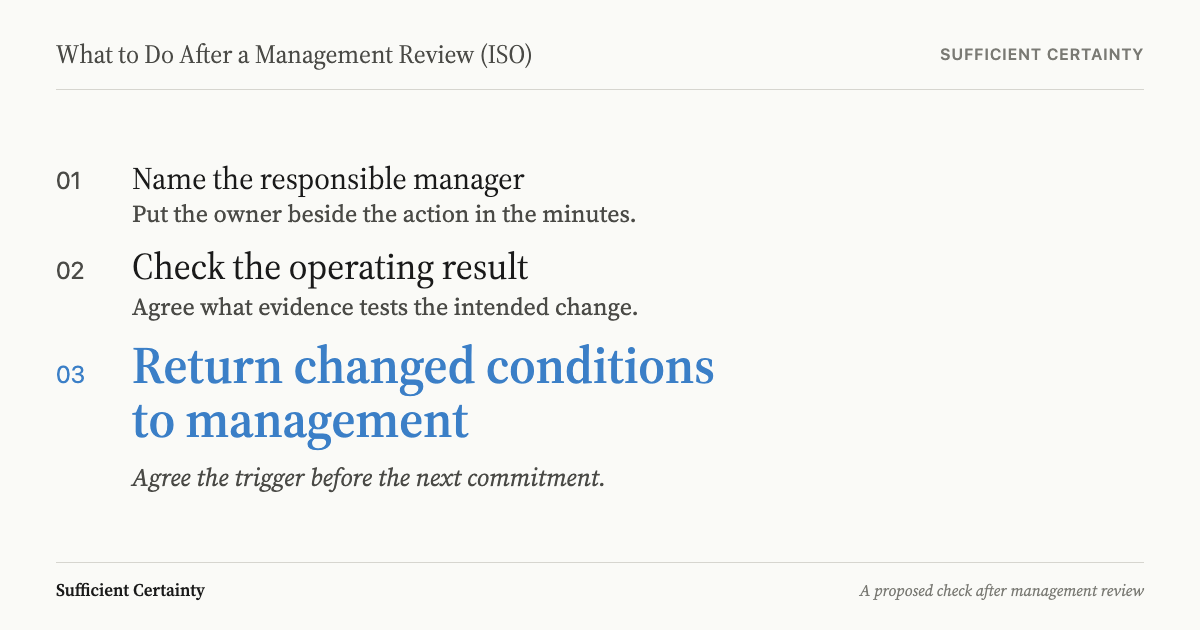
The sequence below is a proposed follow-up check, not an ISO-prescribed sequence.
The completed review should connect customer results, unresolved system findings and available resources. If the proposed change depends on staff who are already committed elsewhere, record that constraint. A decision about resource allocation remains unresolved until the responsible manager accepts the trade-off.
Set the first follow-up at the point when management can still change the commitment. That may be before another shift receives the revised process or before a purchase becomes binding. A due date tracks delivery of the task. The follow-up point protects the decision that depends on it.
Which operating result would make management change the action agreed in your review? Start the Walk →
Recorded actions make system weaknesses visible
A management review brings evidence from different parts of the business into the same discussion. Delivery results can be considered alongside customer feedback and staffing needs. This allows managers to examine whether an apparent local problem requires a wider change.
As ASQ explains in its description of a quality management system, management reviews consider the overall effectiveness of the improvement process. A recorded action preserves the connection between the evidence and the change management selected.
Preserve the result management expected to change so later reports can test the same decision. If the minutes only say that a procedure will be updated, the follow-up can establish completion without showing whether the problem has changed. State the customer or operating result the update is intended to support.
These records also help different managers interpret the same action. The quality manager may be arranging evidence for the next review. The operations manager needs to know what work will change. Senior management must know whether the approved resources remain sufficient. Each needs access to the reason for the action.
The examples below show proposed uses of the action record.
Use the action record to identify which new evidence needs a management response. An organisational governance framework helps when it makes that authority clear. Reporting a changed condition achieves little if nobody knows who can revise the commitment.
A review can also conclude that an existing arrangement remains adequate. Keep the reason for that conclusion. Record which customer requirements and operating conditions support it. If those conditions change, management needs a way to reconsider its earlier judgement without waiting for the next scheduled review.
Jemison Metals documented its review conclusions
The Jemison Metals management-review minutes of 23 February 2023 provide a direct example. The document records review inputs, discussion and action assignments. Its attached slides identify ISO 9001 management-review requirements, including system changes and resource needs.
For delivery, the minutes report total-company full-year 2022 performance of 76.6%, with results separated by plant. The company retained fabrication tracking calls and continued implementation of its BEST software. R. Rowland was assigned continued weekly and monthly reporting, with operating facilities and functions reported separately in 2023.
The first page also carries an 88.30% total-company figure within the account of the previous management review. That figure belongs to a different reporting period. It should not be treated as the baseline for calculating a change to the full-year 2022 result. The relevant evidence here is the recorded follow-up arrangement.
Keep the reporting period and operating unit attached to the result being checked. Otherwise, a company total can be compared with a different period or used to draw a conclusion about an individual plant. Before deciding that a response works, confirm that the reports describe comparable work and conditions.
The pricing-error discussion exposed a separate evidence gap. A manager asked whether errors per line item had changed. The minutes say that information was not believed to be available. Named managers were handling the errors, and Rick was assigned to obtain a first-quarter update on what had been learned. A further update was conditional on those findings.
An update should test what management needs to learn before it approves the next response. The proposed reader check is to ask whether the pricing-error evidence supports continuing the current action or changing it. This is an application of the case, rather than a claim about a later Jemison decision.
The minutes establish assignments and planned follow-up. They do not establish subsequent delivery improvement or successful action closure. Their value for this question is concrete: the review identifies an evidence gap, names people and specifies when learning should return to management.
Check the action at its next decision point
Take the action selected from your review and add the result that would support continuing it. Use evidence available from the operation. Confirm who will collect it, who will interpret it and when it will reach the responsible manager. Avoid creating a report whose only purpose is to keep the action list updated.
Write the condition that requires another decision before approving the next commitment. For a proposed process change, that condition could be evidence that the same customer problem persists during normal work. For a resource decision, it could be the withdrawal of the capacity on which implementation depends. These are proposed checks, not reported Jemison outcomes.
Agree the response when that condition appears. Specify who receives the evidence and which commitment needs reconsideration. The general approach to monitoring decisions connects changed conditions to action.
Keep this management-system decision distinct from closing an individual finding. Follow-up after a quality audit tests the response to specific evidence against requirements. Management review considers whether the system and its resources remain adequate across the business. An unresolved finding may inform that judgement without determining the whole response.
The Universal Decision-Making Method makes implementation and monitoring part of deciding.
Report whether the intended result is supported by evidence before recommending that management regard the action as effective. ISO's quality-assurance guidance connects performance monitoring with review and adjustment. A completed task and a demonstrated effect need separate entries in the follow-up.
If the first report cannot answer the agreed question, record what is missing and how it affects the commitment. Management can request a different measure, limit the next stage or revise the response. Keep that choice explicit. Repeating an inconclusive report does not resolve the uncertainty that prompted the action.
Keep the minutes and action record together. For wider organisational governance, this gives the next manager a usable explanation of the commitment. The immediate task is small: name the owner, then agree what evidence that owner must bring back before management commits further.
Your review minutes record an agreed action. What finding would bring that decision back to management?
Work through your decisionNo sign-up. Just pick your decision and start.
Grant Purdy is the co-author, with Roger Estall, of Deciding (2020), and the architect of the Universal Decision-Making Method.