
Accountability vs responsibility is not a vocabulary lesson. It is the difference between assigning work and owning the call. A RACI chart can fill every box and the room still cannot say who decides when the demand forecast turns out wrong. That gap is where accountability collapses.
A board chair once slid a RACI chart across the table, beside a 60-page business case and a delivery plan already carrying dates. Every box had an initial in it. The room still could not answer a plain question: who was deciding to proceed if the demand forecast and cost assumptions were wrong? That is why, when people ask me about accountability vs responsibility, I do not treat it as a vocabulary lesson. It is the difference between assigning work and owning the call.
That table had plenty of roles and not a single person carrying the bet. The vocabulary debate between the two terms arrives late, usually after the decision has already drifted into committee.
Accountability vs responsibility is the distinction between owning a decision and the assumptions behind it, and carrying out the work that follows from that decision.
Accountability vs responsibility is a timing problem
Most page-one explanations handle the subject as though the debate starts after something has gone wrong. That is already too late. By then the argument is usually about cover. One person says they were only responsible for delivery. Another says they were accountable, but the team owned the execution. The split sounds sophisticated. In practice it is often an alibi built after the event. By the time people are arguing over roles, the decision has already escaped.
A RACI matrix can tell you who does the work and who gets a say. It cannot tell you whether anyone owned the call before the chart was drawn. McKinsey’s piece on the limits of RACI says 80% of organisations struggle with decision making. Of course they do. The chart is often drawn after the hardest part has already been dodged. No cell asks who owns the demand forecast or when the decision must be reopened. If the decision rights were never settled early enough, the A in the box is just paperwork with a letter in it.
A matrix can assign responsibility and still leave the decision homeless
For once, the UK Government’s GovS 002 project-delivery standard says the obvious thing. It names a single senior responsible owner for the business case and the governance of the project, while the project manager is responsible to that person for day-to-day delivery. That is what sane role design looks like. Many people can carry responsibilities. One person still owns the call. That is not heroic leadership. It is basic governance.
The valuable part is not the title. It is the insistence that plans carry their assumptions. That is the adult version of accountability. When the business case shifts, everybody should know whose judgement is on the line. Do not tell me only who is running the workstream. Tell me who is staking their name on the demand case or the timetable. This is close to what I mean by a Decider, and Roger Estall and I made the same point in Deciding: many people can do the work, but the live bet still belongs to one person.
Anchor one team decision to a single owner before you spread the work across the matrix. Start the Walk →
Accountability vs responsibility breaks down when nobody owns the assumptions
The ugly cases are always described afterwards as coordination failures or communication failures. Those labels are too polite. They hide the prior failure, which is that nobody owned the assumptions that made the decision look safe.
The FAA’s joint technical review of the 737 MAX said the agency had inadequate awareness of MCAS and had not evaluated it as a complete and integrated function. Read that again and the pattern is obvious. Plenty of people had responsibilities. Nobody was clearly carrying the whole decision about how the system would behave, or the assumption about how pilots would respond when it misbehaved. When a system cuts across teams and regulators, somebody has to hold the whole judgement or the gaps become the design.
The marine collision report on the Florence Spirit and Alanis found that diffused responsibility between the master and the piloting master precluded coordination and communication on the bridge. One officer effectively dropped into bystander status while conditions worsened. Again, the paperwork would have shown roles. The live decision had no hard centre.
The same defect appears far from aircraft and ships. The National Audit Office review of UK mega-projects looked at 227 projects with a whole-life cost of GBP834 billion and warned that governments keep committing to budgets and timetables before they understand feasibility and uncertainty. Public commitment hardens the timetable before the evidence is ready, which leaves everyone managing pieces and nobody owning the bet. Commitment was being made before anyone had properly owned the assumptions.
Start with the decision, then spread responsibility
My rule is plain: name the decision and the person with authority to make it, then say what has to be true for it to work. If the forecast or timetable starts to wobble, that same person should be pulled back into the room. Only after that do I assign tasks. Otherwise the workstream becomes a place to hide from the decision instead of a way to carry it out. The worst version is accountability in management without authority: a manager owns the target but never owned the decision behind it. That is the only version of accountability vs responsibility that interests me, because it turns a semantic argument into an operating rule.
The Universal Decision-Making Method starts there and ends with monitoring, which means the person who made the call does not get to vanish behind the implementation plan. The deeper pattern behind accountability in leadership is that most organisations never get even this far: responsibility can be delegated and parcelled out, but accountability cannot be collectivised.
Shared accountability does not clarify hard calls. It gives everyone enough cover to say they were involved and nobody enough obligation to say the decision was theirs. I have seen it protect timid ones.
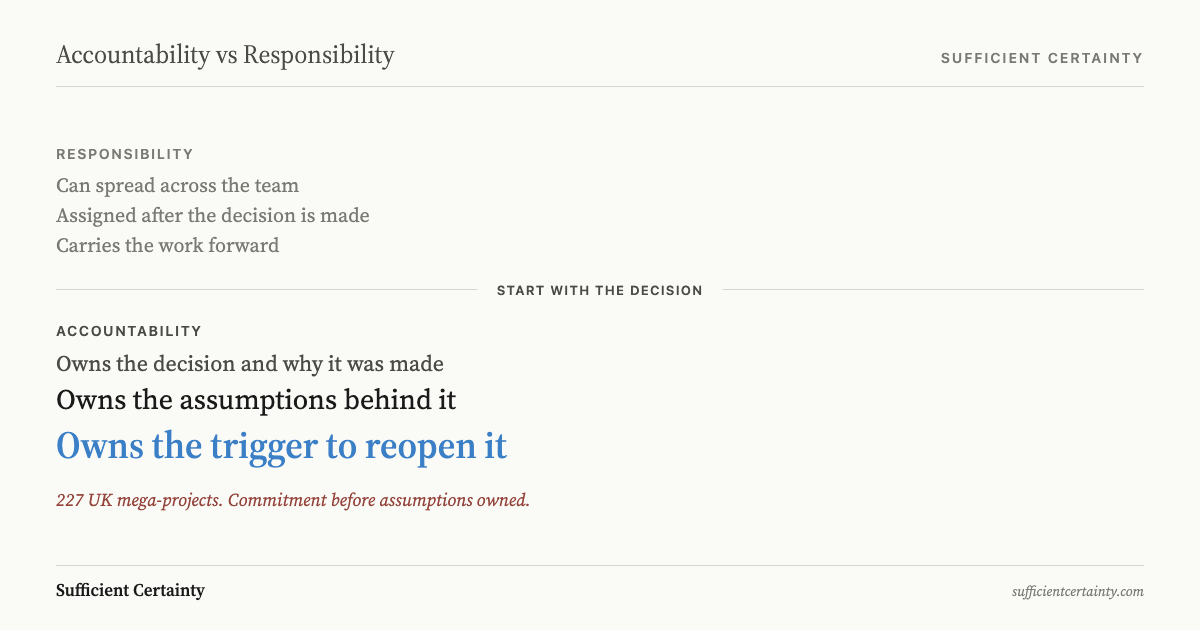
Apology-driven accountability programs miss the point because they go looking for blame after the work is underway. Most accountability frameworks fail for the same reason: they assign roles without recording the reasoning. The real distinction is earlier and cleaner. Responsibility can spread across the team. Accountability stays with the person who made the decision and owns the trigger to reopen it.
You could fill another RACI chart and still leave the real decision homeless.
Work through your decisionNo sign-up. Just pick your decision and start.
Grant Purdy is the co-author, with Roger Estall, of Deciding (2020), and the architect of the Universal Decision-Making Method.