
After an underwriting assessment, compare the quoted locations, exclusions and limits with the exposure records used in the assessment. A suitable price cannot make mismatched coverage acceptable. Before anyone binds the policy, resolve differences between the business assessed and the liability the insurer is about to accept.
An underwriting assessment examines an applicant's exposure to loss to determine whether insurance can be offered and on what terms.
Check the terms before accepting the exposure
Put the assessment, current exposure schedule and proposed quotation together. Use the same version date for the comparison. Start with the item that would most change acceptance if it were wrong. This may be a covered location, the use of a building or a limit applying to several locations. Find the supporting record rather than relying on the summary label.
The NAIC glossary describes underwriting as examining and classifying exposure, deciding whether to accept it and determining the appropriate rate. The resulting assessment supports a particular set of insurance terms. It is not an approval of any later wording that happens to carry the same applicant name.
The acceptance decision concerns the proposed policy as it will be bound. Check that its insured parties and activities match those assessed. Read endorsements alongside the base wording. Where a quotation depends on an inspection or protective measure, identify whether that requirement has been satisfied and who can accept any remaining qualification.
| What underwriting recorded | What must match | Check before binding |
|---|---|---|
| Covered locations | The schedule is current | Match the dated exposure record |
| Quoted exclusions | Coverage matches the assessed wording | Compare the endorsement versions |
| Policy limits | The proposed limit remains authorized | Check the accepted amount and conditions |
Ask the underwriter to explain any mismatch in plain language. Does the quotation include an additional location? Has an exclusion been removed during negotiation? Does a sublimit apply as assumed? Keep the answer with the revised quotation. A correction in the assessment alone does not change the document that the intermediary or binding team will use.
Distinguish a fact awaiting confirmation from a term deliberately accepted by an authorized person. An unresolved construction detail is not equivalent to an agreed exception. Where an exception is permitted, record the evidence considered and the authority used. That keeps the next person from mistaking an unanswered question for a completed acceptance check.
The same distinction matters in recording assumptions in a decision. State what has to be true about this exposure for the proposed terms to remain acceptable. Avoid a general statement that all information is accurate. Identify the disputed or consequential fact and the record that supports it.
Do not let the expiry of a quotation become a reason to skip a material check. Tell the intermediary what remains unresolved and obtain the required decision within the available time. Where that cannot be done, use the insurer’s established process for amending or withdrawing the offer. Record the action taken so the binding team sees the current position.
Check whether the quoted policy still matches the exposure your underwriter assessed. Start the Walk →
What does the assessment support?
The assessment gives a reasoned basis for comparing an insurance proposal with the insurer's acceptance rules. It can identify missing information and make the reasoning behind conditions visible. It also allows a later reviewer to see why the business was accepted, declined or referred. These are useful functions even when the final choice remains uncertain.
A completed assessment supports only the exposure and terms it actually examined. Treat a material negotiation change as a reason to return to that boundary. Do not infer that a revised premium has resolved a changed coverage question. A price adjustment and a change in what the insurer must pay are different parts of the acceptance decision.
Property information and policy wording interact. The NAIC explanation of catastrophe models identifies location information and insured values as exposure inputs. It also identifies deductibles and limits among the terms used to calculate insured loss. The practical implication is specific: the quotation must preserve the terms used in the analysis, or the effect of the change needs review.
Keep that review focused on the policy being offered. The task here is not to rebuild the insurer's entire catastrophe analysis. Ask whether the additional location or revised limit changes the loss the insurer is accepting. If specialist analysis is required, pass the actual revised terms to the specialist rather than a verbal account of the change.
Within data-driven decision making, this is a question of matching evidence to the commitment. The most detailed assessment can become irrelevant when a later document describes a different exposure. Clear version control protects the meaning of the analysis as it passes into a binding instruction.
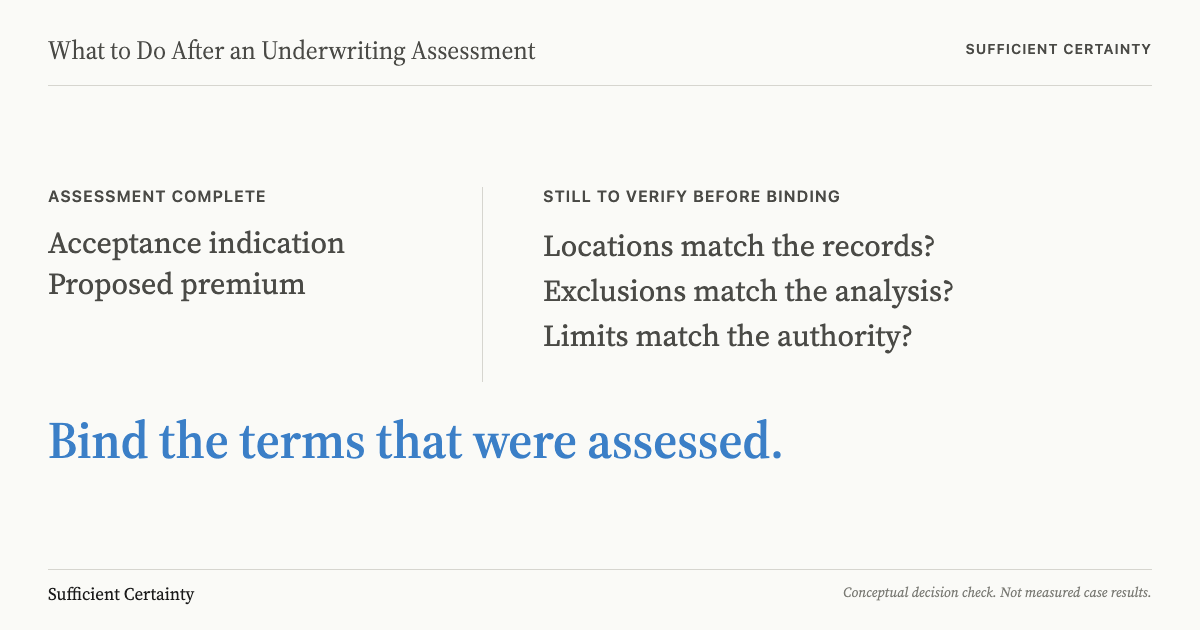
When a comparison finds no material difference, say so and identify the versions checked. That record is more useful than asking staff to repeat the whole assessment. The purpose is to resolve a consequential gap, not create another routine approval layer.
A sound individual quote can still add shared exposure
Merced Property & Casualty illustrates why the location on a quotation also matters beyond that single policy. On November 30, 2018, the California Department of Insurance announced action to take control of Merced. It reported that Camp Fire claims had overwhelmed the small insurer to the point of insolvency.
The department also announced additional reviews of California-domiciled property insurers' exposure management. Its statement establishes the insolvency and the regulator's response. It does not identify a particular underwriting file, missing exclusion or negligent acceptance decision. Nothing here asserts that Merced failed the proposed document check.
The illustrative lesson is to check what the new policy adds to a shared event exposure. A correct location matters because other covered locations may face the same event. The acceptance reviewer needs to know whether the new commitment remains within the authority and conditions used for the quotation.
For this check, ask the responsible exposure team whether the quoted location and limit have been included in the relevant accumulation record. Use the current record, including business already bound. A new quote should not receive an answer based on a schedule that omits recently accepted policies. Refer material uncertainty to the person authorized to decide it.
Reinsurance should be checked against its operative terms before it supports acceptance. The NAIC explains that a reinsurer's obligation depends on the applicable agreement. A broad statement that the business is reinsured does not establish how a particular location or coverage change is treated.
That is a limited acceptance question, not a substitute for reviewing an aggregate exposure result. The reviewer checks whether this proposed policy was included on the basis assumed. A separate team may own the wider analysis. Record its relevant confirmation and preserve the boundaries of what it confirmed.
Match the quoted coverage to the exposure before binding
Create a short acceptance note that identifies the exact quotation version. List the consequential exposure facts and any changes made after the assessment. Record whether the proposed terms remain supported. Where the answer is no, specify the amendment or evidence needed before a binding instruction is released.
An unanswered coverage question must reach someone who can change the quotation. Give that person the source document and the proposed wording. A referral that says only that the account is unusual forces another reviewer to reconstruct the problem. State which fact could change acceptance and what decision is required.
Does the final quotation cover the same exposure on the terms that were assessed?
Use evidence that can change the decision to keep the referral proportionate. Confirming a material location may be necessary. Rechecking unrelated information may add delay without changing the proposed liability. Explain why the remaining uncertainty is acceptable or why the terms must change.
The Universal Decision-Making Method, set out by Roger Estall and Grant Purdy in Deciding, connects that judgment with the purpose and consequences of the commitment. Applied here, it keeps the focus on the insurance actually offered and the evidence supporting its acceptance.
Send the binding team the approved terms and the conditions that remain operative. Check that any required action is visible in its workflow. Preserve the comparison with the acceptance note. If a location or endorsement changes before binding, the team should know which change requires another underwriting review.
After binding, keep material changes connected to the same record. Use monitoring tied to the decision when an accepted condition changes. This does not alter a policy automatically. It gives the responsible team a clear reason to review the exposure and determine what action the contract and applicable requirements permit.
Which change in the quotation would require another acceptance decision?
Work through your decisionNo sign-up. Just pick your decision and start.
Grant Purdy is the co-author, with Roger Estall, of Deciding (2020), and the architect of the Universal Decision-Making Method.