
Evidence based decision making turns on one discipline: setting a threshold before you look at the evidence. Without a stopping rule, the evidence pile grows, the meeting loops, and the decision defaults to whoever gets tired last. A written threshold tells the room when it knows enough to act.
A policy manager I worked with left a steering meeting with a 12-page proposal and six months of staff survey data. Legal had sent a note. The deadline was Friday. Her paper came back with one line in the margin: what is this based on? She did not need more paperwork. She needed a way to show why the evidence on the table was enough to decide, which is what evidence based decision making is supposed to do.
The phrase is usually sold as a virtuous research ritual. Gather the studies, pool them in a systematic review, add some local data, and wait for wisdom to descend on the room. In my experience that ritual mainly helps committee chairs who want the paper to keep moving, and advisers who make a living from another round of refinement. Research never signs the approval line. The decision still belongs to a person whose name will be remembered if it goes wrong.
I have never found the phrase useful on its own. It tells a room to respect evidence, which is hardly radical, but it says nothing about when to stop or what claim the evidence has to carry. That gap is not accidental. A great deal of organisational machinery lives happily inside it. If nobody states the threshold, everyone can look diligent and nobody has to say, plainly, this is enough. If you want the wider case for where evidence fits, read the full guide to data-driven decision making.
Evidence based decision making means using the best available evidence to judge whether a decision is sound enough to make now, then recording what would make you reopen it.
The Evidence Runs Out at the Moment of Commitment
Denise Rousseau makes the honest point in her paper on organisational decisions: uncertainty does not disappear and decisions still get made under pressure, with bias still in the room Rousseau, 2018. That is much closer to working life than the cheerful diagrams that imply a better evidence pipeline will save us from judgement. In my experience, those diagrams mostly protect process owners from having to say whose judgement counts and what uncertainty is still tolerable.
I have sat with boards and executive teams that had thick packs and no basis for commitment. The trouble was simple: nobody had said, in plain English, what claim the paper needed to prove. Was the real hurdle a two-year payback, or a tolerable level of regulatory exposure? Until that is named, the evidence is just a pile. People can admire it and hide behind it, which is catnip for any bureaucracy that prefers motion to commitment.
A 2024 review by HakemZadeh and Rousseau examined more than 5,000 articles and concluded that this work is a social endeavour, not an automatic pipeline from research to answer HakemZadeh and Rousseau, 2024. I agree. I want challenge from the room, then ownership from one Decider. The Universal Decision-Making Method forces that ownership into the open, which is why I trust it more than the pious phrase on its own.
Set the evidence threshold for your live decision and name the point where another round stops changing the call. Start the Walk →
Evidence Based Decision Making Needs a Stop Rule
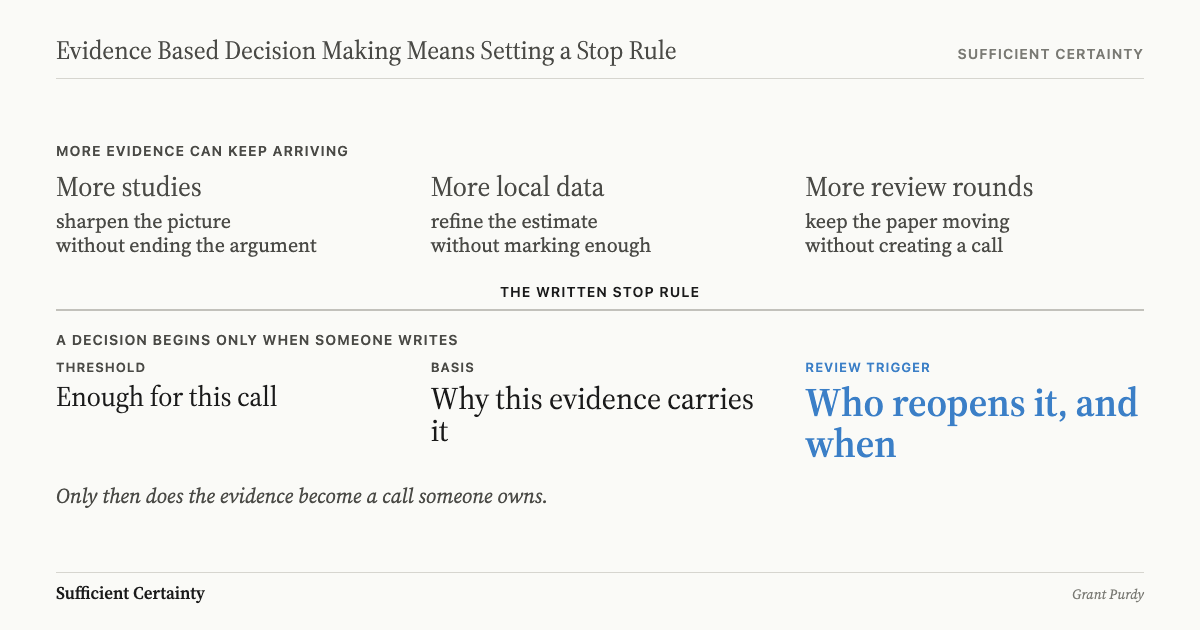
Every serious decision reaches the same awkward moment. Another week of evidence might sharpen the picture, but the window to act is closing. How far the evidence can carry you before that point is the question behind should data decide or just inform. If nobody has set a stopping point, delay gets to dress up as caution and nobody looks irresponsible for asking the paper to come back again. That is why so many organisations can produce thick evidence packs and still look startled when asked whether the case is actually ready.
Intel learned this in 1994. Its engineers could show that the Pentium floating-point flaw was extraordinarily rare, about once in every nine billion random divides. That evidence was technically sound and commercially beside the point once customers started wondering whether the company would leave even a tiny doubt sitting inside every chip. By December 20 Intel had offered a lifetime replacement policy to any owner who wanted one, and by January 17 it disclosed a pretax charge of $475 million Intel, 1994 replacement announcement, Intel, 1995 charge disclosure. The live question had shifted from arithmetic to trust.
That is the stop rule as I use it. You stop when the evidence has reduced the decisive uncertainty far enough for the call in front of you, inside the window you actually have. Stakes matter, and so does whether you can undo it.
If it has not, you either get better information or change the decision so the weak assumption matters less. If neither move is available in time, you are looking at the wrong course. I wrote elsewhere about enough information to make a decision; the point is not perfect proof. The point is to know which gap is still capable of doing damage.
Good Evidence Can Answer the Wrong Question
Some of the worst failures happen when the evidence is real but the question has quietly expired. JPMorgan, Wells Fargo, and Norfolk Southern all had accurate dashboards and still got the call wrong for exactly this reason. The Columbia Accident Investigation Board recorded that foam struck the shuttle's left wing 81.9 seconds after launch, and that engineers made repeated requests for military imaging CAIB Report, Volume I. Managers kept treating more evidence as optional because a nastier assumption had already settled over the discussion: even if the imagery showed serious damage, there was little they could do during the mission. Once that belief takes hold, the request for evidence starts looking like administrative theatre.
I see the same move in ordinary organisations. A team says it wants proof, but what it really wants is permission to leave the frame untouched. That arrangement suits program sponsors who have already sold the plan, and it suits governance staff whose lives get harder the moment the frame has to be reopened in public. Evidence then becomes a costume for avoidance, which is generous language for what is really going on.
The Boeing 737 MAX review reached the same conclusion in colder language. The Joint Authorities Technical Review found fragmented visibility across Boeing and FAA teams, and said MCAS assumptions were not adequately reviewed, updated or communicated as the design changed FAA Joint Authorities Technical Review. Boeing had analysis and certification artefacts. The trouble was that the analysis kept serving a design brief that had already expired. If you deal with forecasts and models, this is the same trap I raise in predictive analytics decision making. A model output can be precise and still be loyal to the wrong assumption.
Write a Record That Survives a Bad Outcome
A sound process does not buy you a sound outcome. Markets move and conditions change, and luck remains irritatingly available to the opposition. If you score every decision by what happened afterwards, you train managers to chase impossible certainty and to bury any assumption they cannot fully defend.
In Deciding, Roger Estall and I treat the record as part of the decision, not paperwork after it. I want a record that says what claim carried the day and what evidence mattered most. Then I want the reopen signal and the owner named.
Months later, when the outcome sours, the strongest voice in the room should not get to rewrite history because the paper never pinned anyone to the live assumption. Without that discipline, approval papers mainly protect executives and advisers from being tied to their reasoning later. That is why so many of them look polished and empty at the same time. If you want the wider case, read about judging decision quality separately from outcome quality.
If someone asks next week whether the proposal is evidence based, do not answer by waving a bibliography around like a priest with incense. Say what decision you are justifying and which uncertainty the evidence has actually reduced. Then state what would make you reopen the call. That answer gives the room something to test. The recital of sources only tells them you know how to decorate a delay.
You could gather another round of evidence and still be asked what the paper rests on.
Work through your decisionNo sign-up. Just pick your decision and start.
Grant Purdy is the co-author, with Roger Estall, of Deciding (2020), and the architect of the Universal Decision-Making Method.