
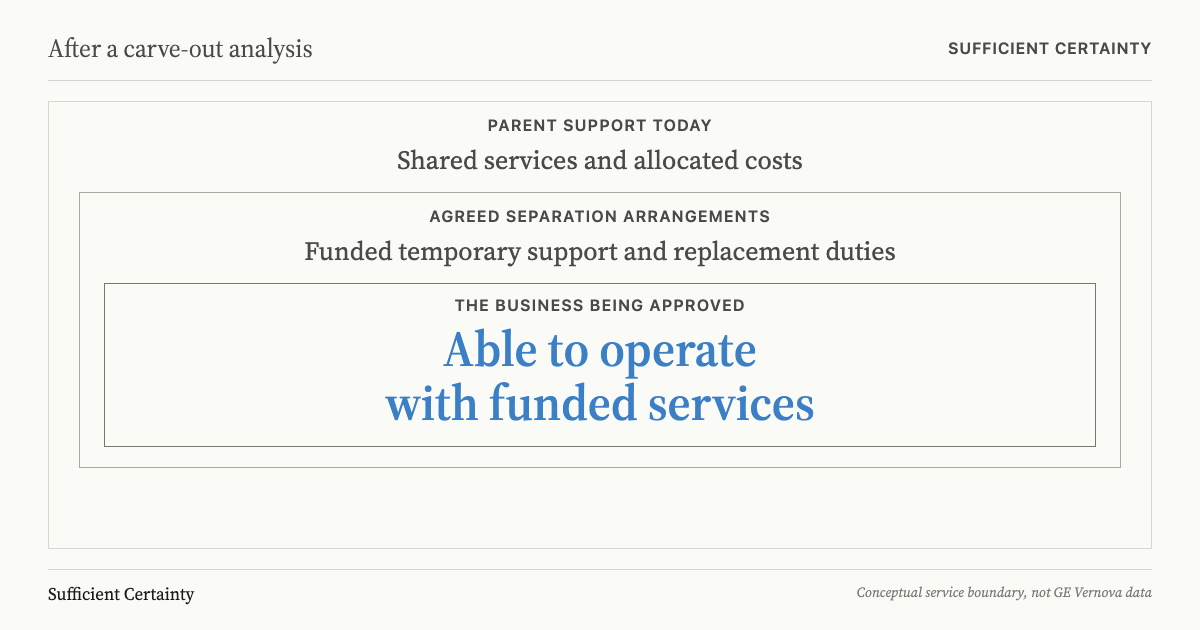
After a carve-out analysis, ask each shared-service owner to name the funded replacement for the separated business. A separation schedule can show a clear transfer date while payroll still depends on the parent. Before signing the commitment, connect every essential parent service to an agreed continuation or a replacement that can operate.
A carve-out analysis examines the operations and finances of a business being separated from a larger company.
Map the business that must operate alone
Start with the completed analysis and the proposed separation terms. Mark which services come from the parent today. For each service, identify what the new business needs to keep doing after separation. Use the actual operating requirement, rather than copying the parent's department names. A treasury allocation, for instance, does not specify who will arrange a bank guarantee after the transfer.
The normal next work includes agreeing separation responsibilities and preparing transition arrangements. A transition service agreement, or TSA, defines temporary support after the transaction. Deloitte's TSA guidance stresses service scope and duration, with time for the buyer to establish its own services. Those terms need to match the business that the sponsor intends to create.
Build a service-cost schedule from records already available. Give each essential service a current provider, a receiving owner and a proposed end arrangement. Record the evidence behind its price. A supplier quotation and an allocation from the parent answer different questions. Show both when both affect the separation, but label them clearly.
The business being separated includes the support it needs to operate, even when that support sits outside its accounts. This is a question of organizational governance: who can commit resources, and who remains responsible until a service has a viable home?
Keep temporary support visible as a dependency. The service has not become independent because a contract permits its continued use. Give the proposed exit its own owner and funding. This differs from choosing a portfolio exit route. The question here concerns the capability of the business that continues.
Connect the proposed separation boundary to the services the business must fund. Start the Walk →
What does a separation model establish?
A well-prepared model helps define what is being transferred and what resources it currently uses. That is necessary work. Without a consistent boundary, managers can price different businesses while believing they are discussing the same transaction. Agreeing the boundary allows the finance and operating teams to compare their work.
Deloitte's carve-out reporting guidance explains that the activities being separated determine which assets, liabilities and operations enter the statements. It also identifies complications when resources are shared. Financial presentation therefore requires a defined business. It does not establish that every future service arrangement is ready.
Use that distinction when reviewing the cost schedule. Historical allocations can help explain reported results. Replacement costs help assess the proposed operating arrangement. Transition charges describe another period. Combining them without explaining their timing can hide the cost of reaching the intended business. Keep one-time setup work separate from continuing expense.
An allocated expense is evidence of a historical accounting treatment, not a price at which the new business can buy the service. The next check asks the service owner what must be obtained, by whom and by when. That check may confirm the model or require a different operating scope.
Preserve the value of the original analysis by identifying exactly where new evidence changes it. A revised quote should change the relevant service line, then flow into the funding request. Avoid reopening unrelated work. The discipline used after financial due diligence helps separate an observed figure from the future claim made with it.
Agreement on the numbers becomes useful when everyone agrees which operating arrangement those numbers describe. Ask the sponsor to confirm whether the immediate purpose is legal separation with temporary support or independence from specified parent services. Each purpose creates a different commitment.
GE Vernova: a completed separation with continuing dependencies
GE Vernova became an independent public company in April 2024. Its 2024 annual report explains why its earlier combined financial information did not necessarily represent independent operations. GE had performed corporate functions and allocated expenses. Those allocations might differ from the costs of obtaining similar services independently.
The report also describes continuing work on GE credit support. GE Vernova was required to seek termination or replacement of support that remained outstanding at separation. Contractual restrictions applied while GE remained obligated. This is evidence of continuing separation duties, not evidence that the separation failed.
The disclosure does not establish that a particular carve-out framework was used. Its relevance is narrower: a completed corporate separation can leave parent support to replace, and historical costs need careful interpretation. The distinction matters before a sponsor signs terms that assume independent operation.
The relevant boundary is the service the business can obtain, not only the entity that owns the assets. Apply that reasoning to the proposed separation. If the plan assumes access to parent purchasing terms, identify the contract or replacement offer supporting that access. Do not extend a past arrangement into the future without evidence.
Consider a proposed payroll service exit. The receiving owner may have selected a system but still lack a funded implementation team. The cost schedule should show both the temporary payroll service and the work needed to replace it. This is an illustrative checkpoint, not an account of GE Vernova's payroll arrangements.
A document review can reveal a missing obligation, but the sponsor still has to decide what to do about it. The checkpoint after a due diligence review concerns the evidence behind findings. Here, the specific action is to reconcile the proposed service boundary with a funded means of operation.
Check the retained parent business as well. A service may remain necessary there after the separated business stops paying its allocation. Identify which party will carry the remaining expense under the proposed arrangement. The purpose is to make the agreed duties explicit, so the same resource is not assumed to be available to both businesses without funding.
The perimeter must match the intended business
Before signing, review the service-cost schedule with the people who will use it. Ask the sponsor to state what the separated business must deliver without the parent. Then ask each receiving owner to show how an essential service will continue. Record whether the answer is an agreed temporary service or a replacement with an achievable start date.
A separation commitment needs funded duties on both sides of every essential service exit. A planned supplier contract may require data transfer or consent from another party. Name that dependency and the person who can resolve it. If the evidence does not support the date, change the date or secure continuing support.
Use the Universal Decision-Making Method to frame that commitment before treating the model as a recommendation. The method in Deciding, by Roger Estall and Grant Purdy, connects the intended outcome with the conditions required to achieve it. In this case, those conditions include service availability and the resources needed to establish it.
For each unresolved service, state the choice now available. The sponsor might fund the replacement, extend temporary support, or narrow the proposed separation. Include the effect on the operating model. Leaving a line marked pending does not communicate which commitment remains unsupported.
Ask the receiving owner to confirm the evidence date. A quote prepared for a different scope should not silently become the basis for approval. Record the volume or service level to which it applies. If the operating requirement changes before signing, return that line to the owner for confirmation and update the funding attached to it.
Finally, give each exit a review point before existing support ends. Link that review to evidence from the receiving owner. If the replacement loses its funding or its start date moves, bring the separation terms back for review. Monitoring the decision means checking the condition that justified the commitment.
Approve the separation against the business that can actually operate under its agreed service arrangements. Keep that service-cost schedule with the signed terms, so the people carrying out the separation can see the duties they must complete.
Which parent service still has no funded replacement when its support ends?
Work through your decisionNo sign-up. Just pick your decision and start.
Grant Purdy is the co-author, with Roger Estall, of Deciding (2020), and the architect of the Universal Decision-Making Method.