
On 31 December 2015, Westinghouse Electric took ownership of CB&I Stone & Webster, the contractor on four nuclear reactors in Georgia and South Carolina, for no cash at closing and a working capital target of $1.174 billion. Four months later, Westinghouse put closing working capital at negative $976.5 million and asked for the $2.15 billion difference. Delaware's Supreme Court ruled that the price mechanism could not carry the claim.
The historical accounts were audited and agreed. Much of the fight was over cost overruns on the reactors, which is to say over estimates of what they would still cost to finish. After financial due diligence, that is the step to take: decide how much certainty the price actually requires, and on which forward assumptions, before the price mechanism is agreed.
Financial due diligence is a buyer's examination of a target's historical earnings, debt, working capital and cash flow, used to set and adjust the price.
Financial due diligence fixes the past to a locked date
A financial due diligence report produces four core outputs. The quality of earnings analysis starts from reported EBITDA and strips out one-off costs, owner expenses, accounting changes and income that will not repeat, leaving a normalised EBITDA the buyer can defend in front of an investment committee. It is usually the single most important number in the report.
Net debt comes next. The report counts cash and borrowings, then hunts for debt-like items: unpaid tax, deferred capital spending, customer deposits, provisions that will become cash calls. Each one found is a dollar that comes off the equity price rather than out of the buyer's pocket later.
The net working capital analysis sets the peg. Monthly balances of receivables, inventory and payables are averaged over a trailing period, adjusted for seasonality, and agreed as the level the business needs to run. If the business is delivered with less, the price falls. Historical cash conversion, the share of EBITDA that actually arrived as operating cash, tests whether the earnings were real.
Together these outputs are a situation analysis of the target's finances, and they matter. Wangerin (2019), studying the time acquirers spent on diligence, found that less of it was associated with lower post-acquisition profitability and a higher probability of goodwill impairment. The work is not a formality.
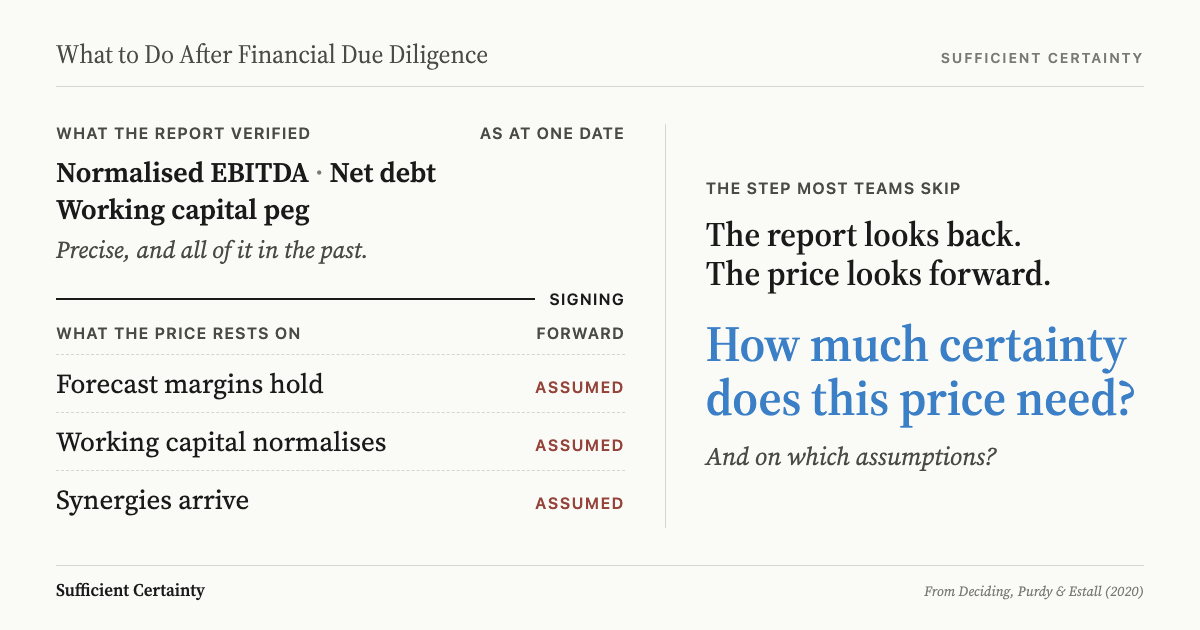
What the report delivers is a precise account of the past, adjusted to a locked date. It is the financial workstream of the wider review covered in what to do after a due diligence review, and it is the most rigorous part of it. Every figure in it describes a business that has already happened.
Pick the forecast figure your price leans on hardest and decide how sure you need to be of it before the price mechanism is agreed. Start the Walk →
The price pays for forecast years the quality of earnings report never tested
The valuation model does not run on normalised EBITDA. It runs on forecast EBITDA: next year's margin, the run-rate of cost savings not yet made, synergies, growth in the order book. Between the quality of earnings figure and the number the multiple is applied to sits a bridge of pro forma adjustments, and that bridge is where most of the price is decided.
The diligence team usually has no mandate to test it. Their scope ends at the historical figures. The deal team builds the forecast, and the assumptions in it are rarely written down as assumptions, the same gap that sits behind an NPV result. S&P Global Ratings has run an annual study of EBITDA addbacks in leveraged deals, and its fifth edition found management continues to regularly miss its projections. Precision about the past does not transfer to the forecast.
None of this makes the diligence wrong. It makes it partial. The report answers whether the historical numbers are reliable. The price asks a different question: whether the business will keep producing them, at the forecast margin and with the forecast working capital, for as long as the multiple assumes.
| What financial due diligence produced | What the price assumes | Gap to test |
|---|---|---|
| Normalised EBITDA | The forecast margin starts from this base and the removed costs stay removed | Each line of the bridge from quality of earnings EBITDA to the model's year-one EBITDA |
| Net working capital peg | The trailing average is what the business will need after closing | Contracts whose cost-to-complete estimate has moved since the peg period |
| Net debt and debt-like items | Nothing outside the balance sheet becomes a cash call | Loss-making contracts and deferred spending not yet provided for |
| Historical cash conversion | Cash keeps arriving at the same share of EBITDA | Forecast years where conversion drops, and the reason |
The working capital row deserves the most attention in any business that earns revenue over long contracts. There, working capital is built from estimates of the cost to complete each contract. If those estimates are wrong, the peg is wrong, the net debt is understated, and the error surfaces after closing. The peg is only as good as the estimates inside it.
Westinghouse and the $2.15 billion Stone & Webster true-up
Westinghouse and Stone & Webster were the construction consortium on two AP1000 reactors at Vogtle in Georgia and two at V.C. Summer in South Carolina, under contracts awarded in 2008. Both projects ran over budget and behind schedule, and Vogtle's owners sued the consortium and CB&I, Stone & Webster's parent. In October 2015, Westinghouse agreed to buy Stone & Webster outright and take on the projects, settling the disputes.
The price at closing was $0, subject to a true-up against a net working capital target of $1.174 billion. No representations survived closing, and CB&I carried no post-closing liability absent fraud. The deal closed on 31 December 2015, and CB&I recorded a pre-tax charge of about $1.5 billion on the sale, according to its 2016 annual report.
On 28 April 2016, Westinghouse delivered a closing statement putting working capital at negative $976.5 million, $2.15 billion below target. CB&I's own calculation came to $1.6 billion, about $428 million above it. Westinghouse's position was that Stone & Webster's historical statements had not properly applied generally accepted accounting principles.
The Court of Chancery sent the dispute to the independent auditor. In June 2017, the Delaware Supreme Court reversed, holding that the true-up was limited to changes in the business between signing and closing. It was not a route to challenge the accounts Westinghouse had agreed to buy on.
By then the consequences had arrived. In December 2016, Toshiba, Westinghouse's parent, warned of a possible loss of several billion US dollars tied to the acquisition. On 29 March 2017, Westinghouse filed for Chapter 11 protection, disclosed that day by V.C. Summer's owner, SCANA. The price mechanism tested the wrong interval. The exposure sat in what the reactors would cost to finish, and the agreement left no route to reprice it after closing.
Set the certainty threshold before the price mechanism is agreed
The step between the diligence report and the signed agreement is a question the report does not ask: how much certainty does this price require, and on which assumptions? Take the bridge from quality of earnings EBITDA to the model's forecast EBITDA, and the cost-to-complete estimates behind the working capital schedule, and treat each line as an assumption with a size attached.
Then work through the five steps of the Universal Decision-Making Method:
- Frame the decision as the price and its terms, not the acquisition in principle.
- Treat the valuation model as a set of tentative elements, open to change.
- List the assumptions each forecast year depends on, and rank them by how much of the price rests on each.
- Decide what level of sufficient certainty each one needs, given what it costs if wrong.
- For those that cannot reach it before signing, implement and monitor: move them into the agreement through a wider true-up, a specific indemnity, an earn-out or a price reduction, and name who watches them after closing.
The trigger is before the sale and purchase agreement's price mechanism is agreed, not after the closing statement arrives. That is the practical answer to how much due diligence is enough: enough to reach the certainty the price requires, on the assumptions that carry it, and no more on the rest. The analysis then needs to stay useful after approval, because the monitored assumptions are what the integration team inherits.
The accounts Westinghouse bought on described Stone & Webster's past. The price depended on its future, and nobody had set a threshold for it.
How confident are you that the forecast your price rests on will hold once the quality of earnings adjustments stop doing the work?
Work through your decisionNo sign-up. Just pick your decision and start.
Grant Purdy is the co-author, with Roger Estall, of Deciding (2020), and the architect of the Universal Decision-Making Method.