
After portfolio rationalization, ask the responsible manager to list the customer commitments attached to one proposed closure. In April 2017, Unilever announced a process to sell or demerge Spreads despite reporting lower costs and stronger cash generation in its separate unit. An exit recommendation still needs an executable route.
Portfolio rationalization reviews a business's activities or offerings to decide which to retain, change or remove in support of its objectives.
Turn the proposed removals into executable decisions
The completed review gives the executive a shortlist. Each proposed removal should have a stated reason and an expected effect on the remaining business. The next decision concerns which discontinuations can proceed, under what conditions, and with whose authority. Keep those decisions separate when their dependencies differ.
Start with one shortlisted service or product. Ask its owner to identify every customer commitment that survives the proposed end date. Use the actual contract or order record. A promise to support an installed product may remain after new sales stop. Record who will fulfil that promise and what resources they need.
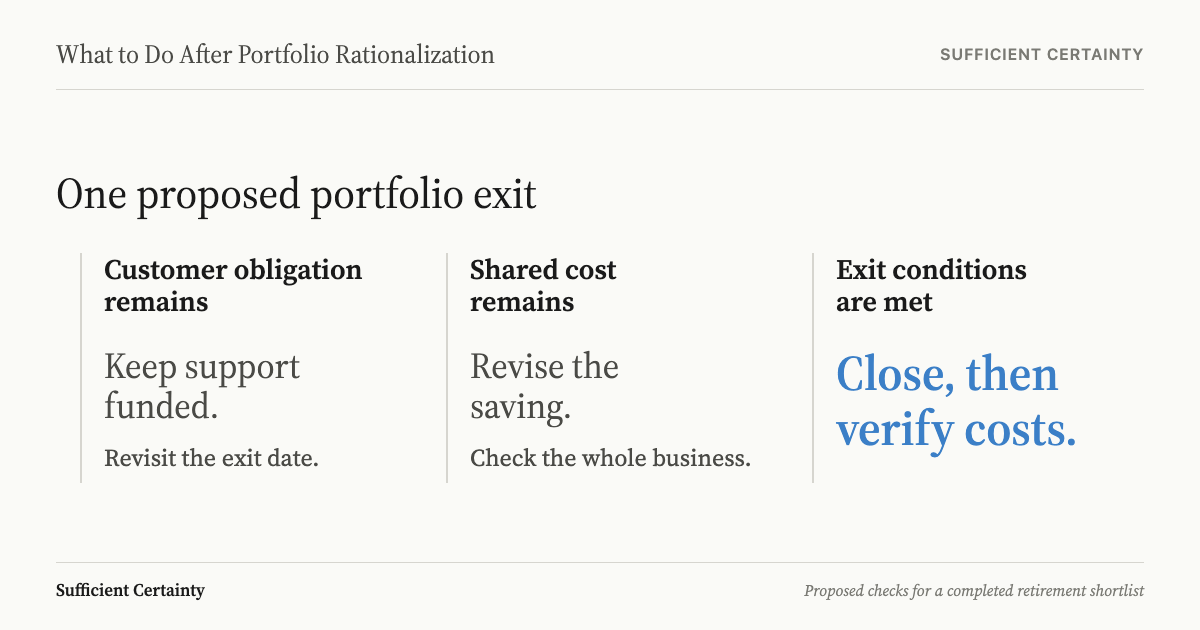
Approve an exit only when the work that must continue has an owner and a funded route. Trace any shared component into the offerings that will remain. A retiring product may use a testing facility or supplier agreement that other products still need. Ask the receiving owner to confirm the proposed arrangement. The check described after value-chain analysis helps expose work passed into another team's budget.
Next, ask finance which costs will actually stop. Separate expenses that disappear from expenses that move to the remaining portfolio. Record the action required to end each expense, such as terminating a lease or reducing a supplier commitment. An accounting allocation alone does not establish a saving.
The monitoring record should follow the dependency that determines whether the exit can happen. Put the evidence beside the planned release date. If customer migration must finish before support closes, name the acceptance condition and the person who can confirm it. This gives the executive a specific reason to defer or revise the discontinuation.
This proposed timeline places the dependency check before closure approval.
Use the commitment list to distinguish a condition for approval from a task that can follow approval. If an unresolved contract term could prevent the exit, obtain an answer before authorising closure. If a document update cannot change the decision, assign it within delivery. This keeps attention on the evidence that matters.
Which customer obligation could keep a proposed portfolio exit from releasing its expected savings? Start the Walk →
A smaller portfolio can reduce avoidable work
A rationalization review can make overlapping obligations visible. It gives managers a shared record of what the business offers and why each activity remains. That supports strategic thinking by connecting an activity's continuing purpose with the resources it uses.
The Association for Project Management describes portfolio management in terms of strategic objectives and capacity to deliver. Its portfolio-plan definition also includes major dependencies. Those connections matter when a completed shortlist becomes a sequence of removals.
Fewer offerings create savings only where the business can stop spending or use released capacity elsewhere. Removing an offering can reduce the work needed to maintain its documentation and handle its orders. The proposed benefit needs evidence that this work will end. If the same staff must support legacy customers, the capacity remains committed.
Use a forward-looking comparison. HM Treasury's Green Book guidance on sunk costs excludes expenditure already incurred from the next choice. It also recognises that resources already paid for can have another use. Apply that distinction carefully when comparing continued operation with an exit.
Compare the cost of continuing with the full cost of leaving, including the transition. Include the obligations the business keeps. Check the timing of cash outflows, rather than subtracting an allocated annual cost from a forecast. The article on cost-benefit analysis explains why the forecast supporting a favourable result still needs scrutiny. For a separation rather than a closure, the follow-up to a carve-out analysis checks which essential services need funded replacements.
Unilever proposed selling or separating its spreads business
Unilever's April 2017 review announcement records the distinction between operating improvement and future portfolio fit. It had established a separate Baking, Cooking and Spreads unit in 2015. The unit reduced costs, increased cash generation and maintained market share. Unilever nevertheless described the underlying category as challenged in developed markets.
The announcement said Unilever would launch a process to sell or demerge Spreads. It also reported that evaluating the alternatives exposed complexity in its dual-headed legal structure. A review of that structure would seek greater simplicity and strategic flexibility.
This was an announced process, not evidence of a completed sale or achieved disposal savings. The document does not establish that Unilever used a particular portfolio-rationalization framework. It provides a limited example of a portfolio choice whose execution involved conditions beyond the operating performance of the selected business.
Improved current results do not settle whether an activity belongs in the future portfolio. For the reader's shortlisted removal, keep the strategic reason visible while checking the exit route. Temporary improvement may justify changing the timing or terms. It does not, by itself, resolve the reason for leaving.
The proposed monitoring task follows from that distinction. Write down what must remain true for the selected route to serve the business's purpose. A receiving team must be able to support transferred customers. A shared contract must be separable on acceptable terms. Choose the dependency that could change the approval, and collect evidence about it before the commitment becomes difficult to reverse.
A delayed exit changes the savings forecast even when the strategic reason for leaving remains sound. Keep the cost of continued support in the comparison. Give the executive a revised choice when the dependency slips. Continuing unchanged until the next routine review can leave the old forecast attached to a different situation.
In this proposed example, a discontinued service still needs its shared support contract. The expected saving remains unavailable.
In the same proposed example, the executive defers contract cancellation until the receiving team accepts support. The continuing cost stays in the exit forecast.
Monitor the dependency that could delay exit
Prepare a short exit record for each proposed discontinuation. State the purpose of removing it and the obligation that could prevent closure. Name the evidence needed before approval. Identify who will report a change, and who can authorise a revised course. Use existing contract and finance records where possible.
The Universal Decision-Making Method provides a sequence for this decision:
- Frame. State what the remaining portfolio must deliver after the exit.
- Tentative Elements. Describe the proposed exit and the practical alternative if it cannot proceed.
- Assumptions. Identify the customer release or shared-resource change on which closure depends.
- Sufficient Certainty. Agree what evidence justifies committing to the discontinuation.
- Implement+Monitor. Assign the dependency check and the condition that requires another decision.
Check dependencies at the point when their evidence becomes available. A customer acceptance record can support a migration decision; a signed cancellation can support the forecast end of a supplier charge. Ask finance to confirm the expense has actually ended after the cancellation takes effect. Use the same evidence standard across the shortlist, while allowing different exit routes.
Make the trigger usable. In a proposed example, an executive might require confirmed acceptance by the receiving support team before cancelling the old service contract. If acceptance fails, the owner must bring back the exit date and continuing cost for review. This is a proposed control, not a description of Unilever's process.
Keep the saving open for verification after the activity has closed. The APM account of benefits management distinguishes delivery from benefits that emerge after transition. The same distinction matters here: ending sales is observable, but a promised expense reduction needs its own evidence. The benefits record used after a business case can carry that check.
Give unresolved items a named decision owner. A report that says only “migration delayed” leaves the executive without a clear choice. State whether the delay requires more support funding or a changed closure date. Update the expected saving when either changes.
Compare the remaining expense with the approved exit record. Investigate differences before counting the saving as delivered. If another team has absorbed the expense, update the whole-business result. Follow active decision monitoring by linking the observed change to the choice it could alter. The review is complete when the next commitment has enough evidence to proceed, and the conditions requiring reconsideration remain visible.
How confident are you that the costs assigned to a proposed removal will actually end after transition?
Work through your decisionNo sign-up. Just pick your decision and start.
Grant Purdy is the co-author, with Roger Estall, of Deciding (2020), and the architect of the Universal Decision-Making Method.