
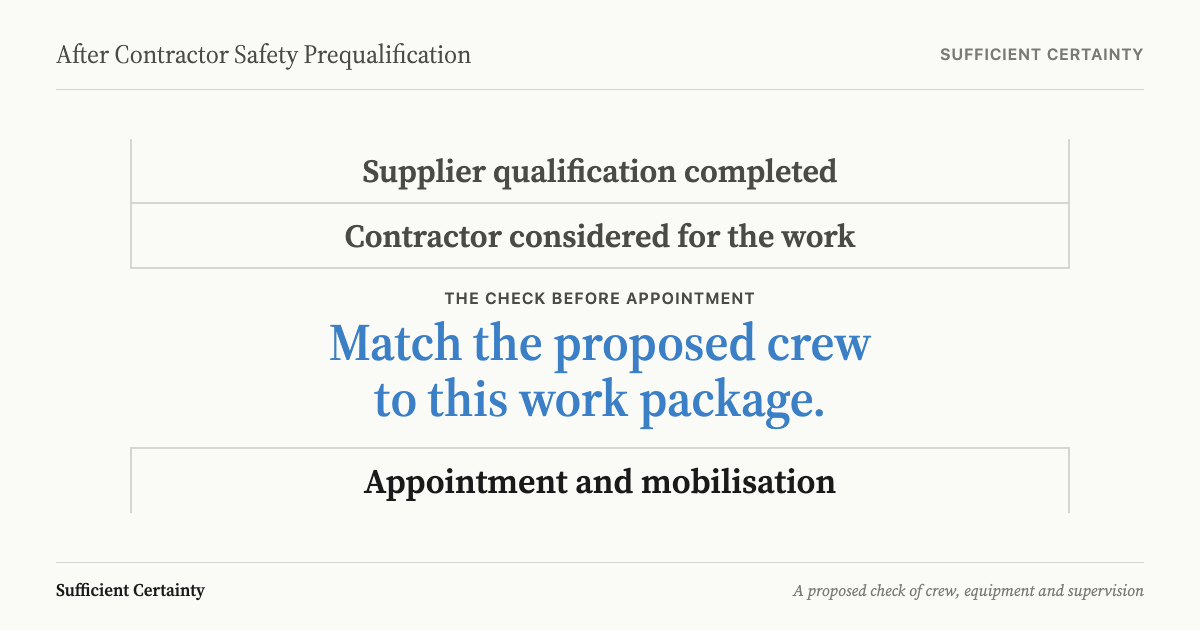
After contractor safety prequalification, ask the contractor to name the crew, equipment and supervisor proposed for your work package. The approval email may identify a company while the mobilisation plan still leaves those details open. Put the names beside the evidence used to qualify that company. Before appointment, check whether the people and resources offered can perform the work you intend to buy. A supplier can satisfy preliminary requirements while its proposed arrangements for your site remain untested.
Contractor safety prequalification is a preliminary assessment of a contractor's health and safety capability against stated requirements before selection for work.
Carry prequalification evidence into mobilisation
Start with the assessment record and the current scope of work. Mark which activities the review covered. Record any exclusions or conditions attached to its result. A qualification for routine maintenance should not silently become approval for an unfamiliar task because the same supplier has offered it.
The next check must connect the assessed company with the work it will actually perform. Ask the contractor to identify its proposed supervisor and who will perform each task that requires particular competence. Request the equipment needed for the work, including anything the client must supply. Include subcontractors in that account.
Keep this proportionate. Do not repeat the whole questionnaire when the answer is already supported. Check the part that could change your appointment decision. A client manager can use the risk assessment guidance to connect that enquiry with the outcome and people affected.
The checklist below is a hypothetical record, not a finding about any actual contractor. It assumes that a reviewer has checked the preliminary assessment's scope. The remaining items describe evidence still needed for the proposed work.
Send the unanswered items to the person who can resolve them. An email to the supplier's account manager may start the enquiry. Confirmation should come from someone who knows the proposed work and has authority over the resources offered.
Make the handoff usable for the site manager. State which evidence was accepted during qualification and which questions remain open for this work package. Give each open question an owner. This prevents a complete assessment file from hiding an incomplete appointment review when procurement passes the contract to operations.
A supplier-level review supports a bounded shortlist
Prequalification can provide useful evidence of an organisation's arrangements. It gives the buyer a basis for comparing potential contractors before investing in detailed job planning. Its value depends on knowing what the assessment covered and what evidence supported its conclusions.
The Health and Safety Executive explains that third-party assessment is one way to demonstrate health and safety competence. For construction work, it also says scheme assessment does not prove that an organisation can manage the risks on a particular site. Buyers must check project-specific requirements.
Keep the qualification result within the scope of the evidence behind it. A favourable assessment supports consideration of the supplier. Your appointment still needs a reasoned judgement about the proposed job. This differs from verifying remedies after a supplier audit, where the question concerns what affected workers actually received. Here the commitment is ahead: who should be appointed, on what terms, to perform defined work?
Which assumption connects the qualified supplier with the crew proposed for your work? Start the Walk →
Does the proposed crew match the assessed capability?
A company's record does not identify the people it will send. An experienced team described in a tender may be committed elsewhere. An available substitute may need different supervision. These are possibilities to check with the contractor, not reasons to assume that its submission is misleading.
Evidence about the organisation must be matched to the crew proposed for this job. HSE defines competence in terms of capability applied to a task. A training record is relevant evidence. Ask how the person will apply that learning to the work and conditions they will encounter.
Use a proposed task to make the discussion specific. Ask the supervisor to describe the work sequence and the points where client action is needed. If the plan depends on an isolation, establish who will provide it and how the crew will know it is in place. If equipment is hired, establish who checks that the actual equipment meets the plan.
An unresolved dependency belongs in the appointment decision before it becomes a problem at the site entrance. Record the dependency and the evidence needed to resolve it. The handoff after a CDM risk assessment addresses another part of this problem: information must reach the people who will use it. Contractor selection adds the question of whether those people can perform the proposed work.
Ask the contractor to confirm how substitutions will be agreed. The replacement may be fully capable, but the earlier evidence may no longer describe the resources offered. Compare the change with the original task requirements before accepting it. Keep that comparison with the appointment record.
Mozal linked contractor selection to site requirements
The BHP Billiton 2006 sustainability report describes a contractor health, safety and environment framework at the Mozal aluminium operation in Mozambique. Prequalification was part of a wider process. The framework also covered tender and award selection, access and activation, execution and control, and performance management.
The company account says each component had objectives, methods and measures. It describes a contractor forum for communication with Mozal. It also reports medical fitness decisions by an onsite practitioner and mentoring for contractor leaders. These were arrangements extending beyond a supplier's preliminary application.
Mozal's reported process treated selection and work on site as connected responsibilities. The useful feature is the separation of stages, with arrangements for the people entering the operation. It gives a client manager a concrete example of the work that can follow qualification.
This is a historical company account, not independent proof that any proposed crew was safe. It does not establish present legal compliance. Nor does it establish that prequalification alone caused any safety result. The proposed check in this article is a reader application, not a claim that Mozal used the Universal Decision-Making Method.
For your own appointment, keep evidence at the same level of detail as the decision. A supplier policy may support a question about company arrangements. Confirmation from the proposed supervisor may support a question about tomorrow's work. The check after a workplace risk assessment can inform the site controls, while this review establishes who can put those controls into practice.
Check the actual work package before appointment
Use the Universal Decision-Making Method to organise the appointment decision. Keep the prequalification evidence attached to the work package so the reason for selection remains available to the person managing mobilisation.
- Frame. State the work to be completed and the conditions needed to protect people affected by it.
- Tentative Elements. Name the contractor and proposed resources, with the scope and terms being considered.
- Assumptions. Record what must be true about the crew's capability and the client's site arrangements.
- Sufficient Certainty. Decide what evidence is needed before appointment, given the consequences of being wrong.
- Implement+Monitor. Assign responsibility for checking the arriving resources and responding to changes before work starts.
Write each important assumption as a condition someone can check. “The nominated supervisor will be present for this work” can be confirmed or challenged. “The contractor is approved” leaves the condition unclear. HSE's guidance on method statements explains how a work sequence brings the required controls together. Compare that sequence with the resources actually offered.
The following split shows the proposed distinction to preserve in your appointment record.
- Assessed company arrangements
- Evidence within the review scope
- Actual crew assigned to the work
- Supervisor available when needed
- Equipment suited to the planned task
- Client controls ready before work starts
Resolve a gap that affects safe performance before authorising the work that depends on it. Ask for a revised arrangement or change the work package. If a suitable crew is unavailable, reconsider the appointment or timing. Do not turn an unresolved condition into an unexplained note for the site manager.
After appointment, check changes against the agreed basis. A replacement supervisor or different machine may require another review. As with checking the operation behind an assessment, follow the work beyond the document's label. The authority to start should rest on the arrangements that will exist when the crew arrives.
A qualification result leaves one appointment question open: can the proposed crew do this work under the actual site conditions?
Work through your decisionNo sign-up. Just pick your decision and start.
Grant Purdy is the co-author, with Roger Estall, of Deciding (2020), and the architect of the Universal Decision-Making Method.