
After a supplier audit, the step before closing a finding is to ask for proof that affected workers received the remedy. Apple reported closing 95.9 percent of supplier findings in 2023 through its corrective action and verification processes. That figure describes reported closure. The decision on the desk concerns a particular finding and the workers affected by it.
A supplier audit checks a supplier's activities against specified requirements and records findings that require a response.
Audit findings become supplier corrective actions
Open the audit report at the finding awaiting closure. Read what happened to the workers before reading the supplier's response. A finding about recruitment fees concerns money taken from people seeking work. A revised hiring procedure may prevent another charge. It does not show whether an earlier charge has been returned.
The next working document is a corrective action plan. The supplier describes the change and names the person responsible. The buyer sets a deadline and agrees what evidence to review. Keep the original finding beside that plan so the response remains tied to the problem that prompted it.
Separate the work needed to prevent another breach from the remedy for people already affected. Assign a date to each. Where someone faces immediate danger, address that danger before the ordinary closure review. An administrative deadline should never hold up urgent protection.
The UN Guiding Principles on Business and Human Rights distinguish actual harm from potential impacts. Principle 22 calls for businesses to provide or cooperate in remedy when they caused or contributed to harm. A buyer's role depends on its involvement. Finding a problem at a supplier does not automatically establish that the buyer caused it.
For the closure review proposed here, make the affected workers visible in the record. Use protected references where names would expose them. State the remedy owed to each person. Keep unresolved cases open rather than hiding them inside a completed site-level action.
A repayment plan is signed and the finding is closed. Workers still cannot confirm that the money reached them.
The finding stays open until repayment is checked with affected workers. The reviewer records any unpaid amounts for follow-up.
The remedy needs its own evidence. The procurement file can contain a sound plan while the worker's loss remains unresolved. This is a specific governance and compliance distinction: accepting the paperwork is a decision about whether the finding can safely be closed.
What does a corrective action plan establish?
A useful plan makes a difficult response manageable. It gives the supplier a defined task and lets the buyer follow progress against an agreed date. When the response is disputed, both parties can return to the original requirement instead of negotiating what completion means after the event.
For example, suppose an audit finds that a recruitment agency charged workers prohibited fees. This is a proposed reader scenario. A plan could require repayment and a change to the agency arrangement. The repayment addresses the loss. The change to the arrangement addresses the prospect of another charge.
Apple's supplier standards effective November 2023 require repayment when workers have paid prohibited recruitment fees. That requirement gives a concrete result to check. A ban written into the new policy cannot by itself demonstrate that result.
A promised payment is still a promise. Record what will count as proof before the supplier submits it. Otherwise, a reviewer may accept the first available document because it looks official or arrives just before the deadline. The closure standard then follows the supplier's submission rather than the harm described in the finding.
A plan also helps locate responsibility. The supplier may need to recover money from an agency, but the worker should not disappear from the review while those parties settle their accounts. Ask who is responsible for delivering the remedy if that commercial dispute continues.
This is where setting an evidence threshold becomes practical. Write the claim that closure would make: the agreed remedy reached the affected people. Then identify the unresolved question that could make that claim false.
The deadline measures progress, not remedy. A missed date calls for action. A met date still needs supporting evidence. The organisational governance task is to make the person approving closure answerable for that distinction.
A supplier action plan leaves a decision: what evidence is enough to confirm that affected workers received the remedy? Start the Walk →
Apple describes verification after supplier assessments
Apple's 2024 supply chain progress report describes a Corrective Action Plan after a finding. Page 43 specifies a check-in after 30 days. It describes further checks after 60 and 90 days. Apple says it then verifies completed actions through its Corrective Action Verification process. The company reports that these processes closed 95.9 percent of findings in 2023.
Page 20 makes the worker remedy more concrete. Apple says it requires suppliers to repay prohibited recruitment fees promptly. It reports using an independent third-party auditor to verify full and timely repayment. Apple reports that suppliers repaid $263,870 to 53 workers in 2023. These are Apple's own reported practices and results. They are not independent proof of conditions across every supplier workplace.
The useful distinction is between a supplier completing an action and a worker receiving a remedy. A new policy can support the first claim. Evidence of repayment supports the second. Each document should be judged against the claim it can actually establish.
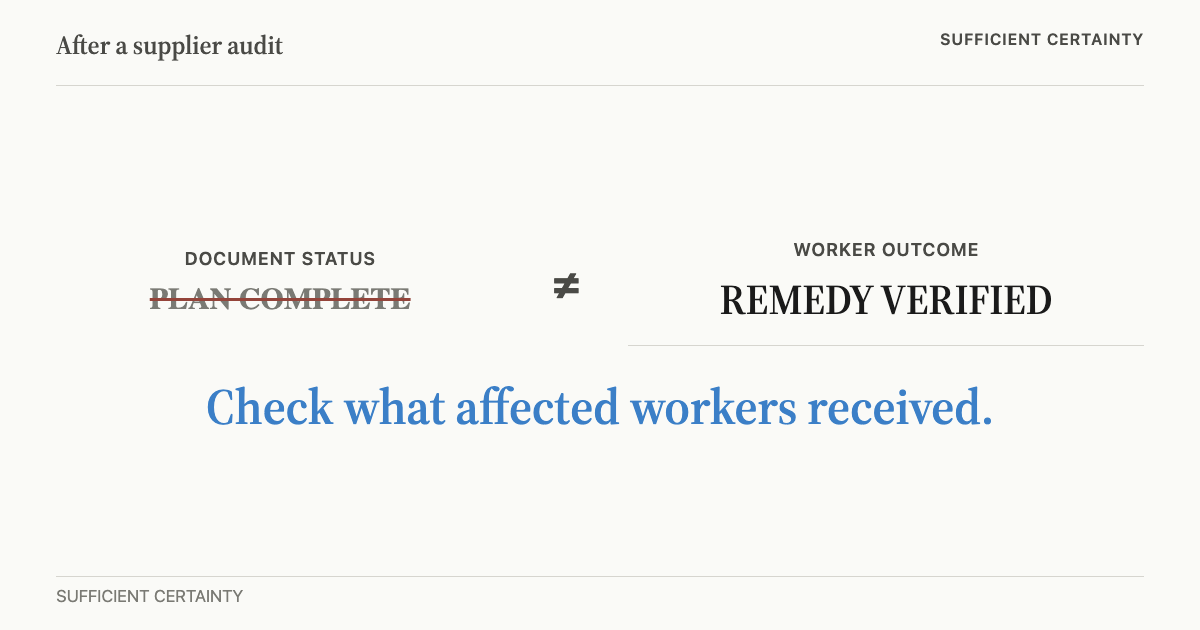
Closure counts do not resolve individual cases. An overall percentage cannot tell a reviewer whether one worker remains unpaid. It also cannot establish that a payment was free from pressure to return the money. Those are questions for the evidence in that worker's case.
The following checks are proposed for the reader, rather than presented as Apple's procedure. Compare the remedy record with payment evidence. Seek confirmation from affected workers through a safe channel. Investigate a difference in the amount or a report that the worker had to surrender the payment afterwards.
Silence is weak evidence when speaking is unsafe. The US Department of Labor's forced labor remediation guide stresses safety from retaliation and participation by workers or credible representatives. That guidance concerns forced labor. Its worker-engagement principles inform this proposed approach to checking recruitment-fee remedies; they do not make every fee finding a proven forced-labor case.
Confirm the remedy before closing the supplier finding
Before signing closure, put the supplier's evidence against the specific result required. Use the following table as a review aid. Each row shows a proposed check, rather than a claim about Apple's review documents.
| What the supplier submitted | What it assumed | Gap to test |
|---|---|---|
| Revised recruitment policy | The earlier fee charges have been repaid. | Confirm receipt with affected workers. |
| Payment transfer record | Each affected worker received the amount owed. | Match the recipient and amount to the remedy record. |
| Completed training record | The fee-charging practice has stopped. | Check a later recruitment round for fresh charges. |
Next, write a short closure note explaining why the evidence is sufficient for this finding. Include any workers whose remedy remains incomplete. If the supplier has finished preventive work but repayment remains disputed, record those statuses separately. The improvement deserves recognition without erasing the outstanding loss.
A worker may have left the supplier before the review. Decide how that person can safely confirm receipt without depending on the former employer. Where direct contact is unsafe, seek suitable independent support. Do not treat difficulty reaching someone as proof that the remedy is complete.
Sufficient certainty depends on the harm. A corrected document reference may need a simple record check. A repayment finding needs evidence that reaches the affected people. Serious harm or conflicting accounts justify a deeper review by a person with relevant expertise. The supplier's willingness to cooperate does not replace that review.
Use the assumptions behind the decision to choose the next check. If the uncertainty concerns who was charged, resolve the affected-worker record. If it concerns receipt, check the payment. Buying another general audit will not necessarily answer either question.
Set a later check against the practice that caused the finding. For recruitment fees, consider reviewing the next hiring round. Decide what evidence of another charge would reopen the finding and name the person who will respond. This is part of the Universal Decision-Making Method: decide what certainty is sufficient for the commitment and what will require another decision.
Close the finding only as far as the evidence permits. State any limit plainly in the decision record. The closure note should let another reviewer see why the worker remedy was accepted. If it cannot do that, the task after the supplier audit remains unfinished.
How confident are you that closing the supplier finding means the affected workers received the remedy?
Work through your decisionNo sign-up. Just pick your decision and start.
Grant Purdy is the co-author, with Roger Estall, of Deciding (2020), and the architect of the Universal Decision-Making Method.