
After a customs audit, compare one assessed shipment with its supporting product and transaction records before approving the audit response. In March 2024, Ford agreed to pay $365 million to settle United States customs allegations concerning Transit Connect vehicles. The decision after an audit is whether the evidence supports the proposed classification, origin or value for the entries being addressed.
Keep the response deadline visible while checking that evidence. A deadline determines when action is needed. It does not establish that a proposed declaration change or duty calculation is correct.
A customs audit examines import or export records and transactions to assess whether declarations and related duties comply with applicable customs requirements.
Ford settled allegations about the imported vehicles
The United States Department of Justice announcement described allegations of misclassification and undervaluation. The government alleged that imported cargo vans had temporary rear seats and features intended to secure passenger-vehicle treatment. It alleged that the seats were removed after clearance. The announcement contrasted the applicable passenger and cargo duty rates: 2.5% and 25%.
The settlement resolved allegations, with no determination of liability. It does not establish that Ford had just completed a customs audit. The case is relevant because it makes a shipment's physical features and declared treatment concrete. It does not prove that a particular audit process failed.
For an import manager reading an audit finding, the practical issue is the connection between the description in the entry and the goods it describes. A product label in a database is a starting point for that examination. The evidence must address the actual product characteristics relevant to the proposed classification.
The same discipline applies to a proposed value adjustment. Identify which transactions and supporting records the calculation covers. Ask whether the proposed treatment relies on facts that have been established for those transactions. Avoid accepting a total merely because it can be reconciled to a spreadsheet.
Consider a hypothetical audit response that replaces one commodity code across a product family. Before approving it, the import manager should ask what establishes that every affected model shares the relevant characteristics. One specification may cover one model well while leaving another model unresolved. The proposed correction should show where that distinction matters.
That question is about the evidence required to commit. It does not require every uncertainty to disappear. It requires the responsible reviewer to identify which uncertainty could change the response, the affected entries or the proposed amount. The review can then focus on that uncertainty before approval.
Separate the audit finding, the company's factual response and any legal interpretation. Record whether the disagreement concerns what was imported, how the rules apply or how the amount was calculated. Those are different questions and may require different expertise. Combining them in one response paragraph makes it harder to see which question remains open.
Use the same distinction when briefing finance. A proposed duty amount may depend on a classification conclusion that is still under review. Show that dependency before requesting approval. Finance should be able to see which part of the amount is established and which part depends on an unresolved finding.
This sits within organisational governance: the person approving the commitment needs to understand its basis. A general account of governance and compliance does not replace the shipment evidence. It helps identify who must judge whether that evidence is sufficient.
The proposed check below follows the reader's audit finding through to approval. It is a decision sequence, rather than an account of the Ford settlement.
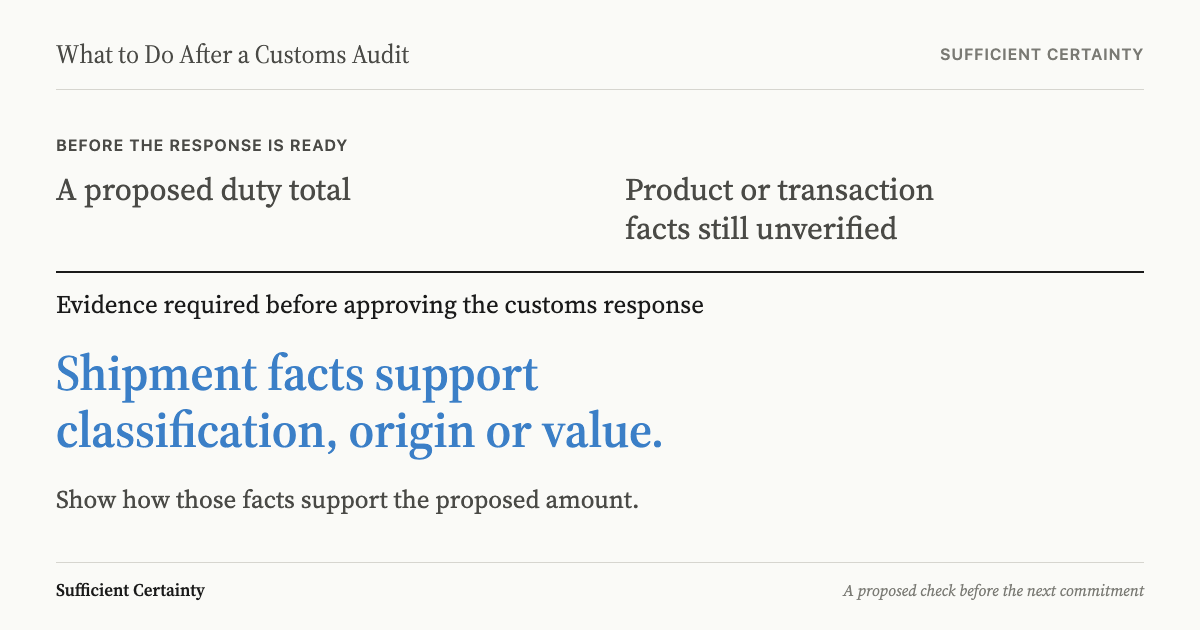
What does the audit establish about each entry?
A completed audit gives the importer findings to address. Depending on its scope, it may identify missing records, inconsistent declarations or a disputed treatment. The response should preserve the audit's stated population, period and method. Do not extend a sampled finding to other entries without establishing why the extension is justified.
The audit also creates a useful basis for prioritising work. Some findings may be resolved by retrieving an existing record. Others may require product expertise, supplier evidence or specialist customs advice. Make those differences visible so that a readily available document does not distract attention from an unresolved material issue.
CBP's tariff classification publication explains the importer's responsibility to use reasonable care in entering, classifying and valuing merchandise. A broker's involvement can support that work. It should also be clear which product facts the importer has supplied and which conclusions need specialist confirmation.
A classification review needs the product characteristics that matter to the proposed heading. An origin review needs evidence relevant to the claimed origin treatment. A value review needs the transaction facts behind the amount. These questions can overlap, but answering one does not automatically settle the others.
The WTO customs valuation overview describes a system intended to reflect commercial realities rather than arbitrary values. For a manager preparing a response, the practical consequence is to make the source of the proposed value visible and identify any facts needed to support it.
Different reviewers may read the same audit total differently. This proposed example shows why the response needs its supporting conditions.
A compliance risk assessment can establish which activities deserve attention. The customs audit response must go further into the affected transactions. A high priority does not select the correct classification or establish the value.
Keep a separate workstream for correcting ongoing controls. The response to a regulatory inspection may need evidence that a correction remains effective. The decision here comes earlier: whether the shipment-specific response and proposed duty treatment have an adequate basis.
Identify the shipment fact that could change the proposed customs response before approving it. Start the Walk →
Set the evidence required before approving the response
Choose a material finding and identify the commitment it creates. That may be approving a factual response, authorising a declaration correction or paying an assessed amount. Keep those commitments separate where their evidence or approval requirements differ. Confirm applicable deadlines and procedures with the responsible customs specialist.
For each commitment, write what must be established. Specify the affected entries, the proposed treatment and the evidence that would support it. Ask the reviewer which missing fact could change the result. This gives the team a clear question to resolve before gathering more records.
The timeline below locates that question before approval. The flagged point is where an unresolved assumption should be examined, rather than carried into the response.
Set the required confidence according to the consequence of being wrong and the ability to correct the commitment. A material uncertainty affecting many entries warrants more attention than a missing reference that does not change their treatment. The responsible specialists must determine the appropriate customs response. The manager must ensure that the approval paper states what their conclusion depends on.
Use the Universal Decision-Making Method to connect that evidence to the pending decision. Name the intended outcome, the proposed action and the conditions it requires. Seek enough evidence to decide responsibly, while keeping the deadline and available response options in view.
Record the result for the full affected population. If a checked shipment represents a wider group, explain the basis for that grouping. If product versions, suppliers or transaction terms differ, identify where further checks are needed. One verified entry is useful evidence; its relevance to another entry must be established.
Keep a concise list of unresolved items with a named owner and a due date. Use gap analysis follow-through to distinguish a missing document from an unresolved conclusion. State what each item could change in the proposed response.
Before signing, read the response beside the shipment records and calculation. Confirm that every material assertion has support, every estimate is identified and every open issue has an agreed route. Approve the commitment only when its stated basis matches the evidence available for the affected entries.
Before sending the final response, check that its attachments are the versions reviewed by the responsible specialist. Match each attachment to the relevant finding and entry group. Keep superseded calculations clearly identified. This prevents an approved conclusion from being paired with an earlier calculation or a product specification covering a different shipment.
An audit finding identifies a customs issue. How much evidence supports the treatment you are about to approve?
Work through your decisionNo sign-up. Just pick your decision and start.
Grant Purdy is the co-author, with Roger Estall, of Deciding (2020), and the architect of the Universal Decision-Making Method.