
After a compliance risk assessment, compare one assessed activity with the record of how it is actually done. A carefully ranked assessment can still miss the person who approves that activity. The categories may be accurate. The proposed work can still leave that person outside its scope.
Keep the assessment open beside the transaction records. Use that comparison to decide whether the proposed priorities cover the activity that needs control.
A compliance risk assessment examines exposure to breaches of applicable obligations and evaluates the controls used to prevent or detect them.
Compliance ratings sort exposures within a chosen scope
The assessment gives the compliance team a basis for proposing work. Its entries connect an obligation with an activity and describe the existing controls. Ratings help compare the entries. The next management discussion concerns priorities, responsible people and the resources available to carry out the proposed work.
Keep those uses. A compliance function cannot examine every activity with equal effort. A documented assessment lets people explain why some areas receive closer attention. It also makes disagreements visible. A purchasing manager can challenge the description of an approval process before it becomes the basis for a training program.
The DOJ and SEC's 2020 FCPA Resource Guide describes risk assessment as fundamental to a strong compliance program. Its discussion includes the markets and business relationships involved. It warns that attention to low-risk areas can divert resources from more serious exposure. That historical guidance supports selective scrutiny, rather than identical checks everywhere.
The scope determines what gets compared. A list organized by country answers a different question from a list organized by payment route. A list organized by legal obligation can identify relevant duties without showing how a manager could bypass an approval. Those views can complement each other. Their headings do not make them interchangeable. For a transaction awaiting release, the follow-up to sanctions screening checks whether the named parties in the result match the transaction record.
The issue resembles the problem with a completed risk matrix. A rating becomes useful when its underlying judgment remains available. Keep the assessment's explanations beside the proposed priorities so the approver can see what each rating includes.
Consider this illustrative compliance assessment output. Its summary and payment-control entry describe the same proposed coverage. These statements are invented to expose a scope conflict. They are not quotations from ABB or a reconstruction of its assessment.
What does the assessment give the control owner?
A control owner needs a usable account of the exposure. The assessment can show why a check exists, where it applies and which records support it. That helps the owner distinguish a required action from a general request to be more careful.
Keep the obligation attached to the activity. An entry called third-party bribery needs more detail before it can support a work plan. State which business activity it concerns. Then identify the action that could create the exposure. The team can examine the relevant documents instead of asking every department to repeat the same broad review.
This preserves the value of the risk assessment. The assessment provides a shared starting point and a record of the choices made about coverage. Managers can use it to explain the proposed allocation of effort. They can also identify where a rating depends on missing information.
A named owner needs matching authority. Someone responsible for supplier screening may have no power to stop a payment. Someone responsible for payment approval may never see the screening findings. The assessment should let the approver see that separation before assigning more work to either person.
Take an assessed exposure to the people who operate the process. Ask them to locate the relevant approval in the current records. Check whether the proposed owner can obtain those records and act on a concern. Treat a missing answer as information about the proposed scope, rather than a reason to complete the ownership column anyway.
This is where resource allocation becomes a concrete decision. Additional reviewers will not help the selected control if their work ends before the payment decision. The proposed priority needs to say what those people will examine and who can act on the result.
Does this compliance assessment cover the person who can authorize the payment? Start the Walk →
ABB used subcontractors in the Kusile bribery scheme
ABB's South African business provides a documented reason to examine the transaction route. In its December 2022 criminal resolution announcement, the DOJ described bribes benefiting a senior Eskom official. ABB used subcontractors associated with the official in work connected with the Kusile power station. It recorded payments as legitimate business expenses even though part of the money was intended as bribes.
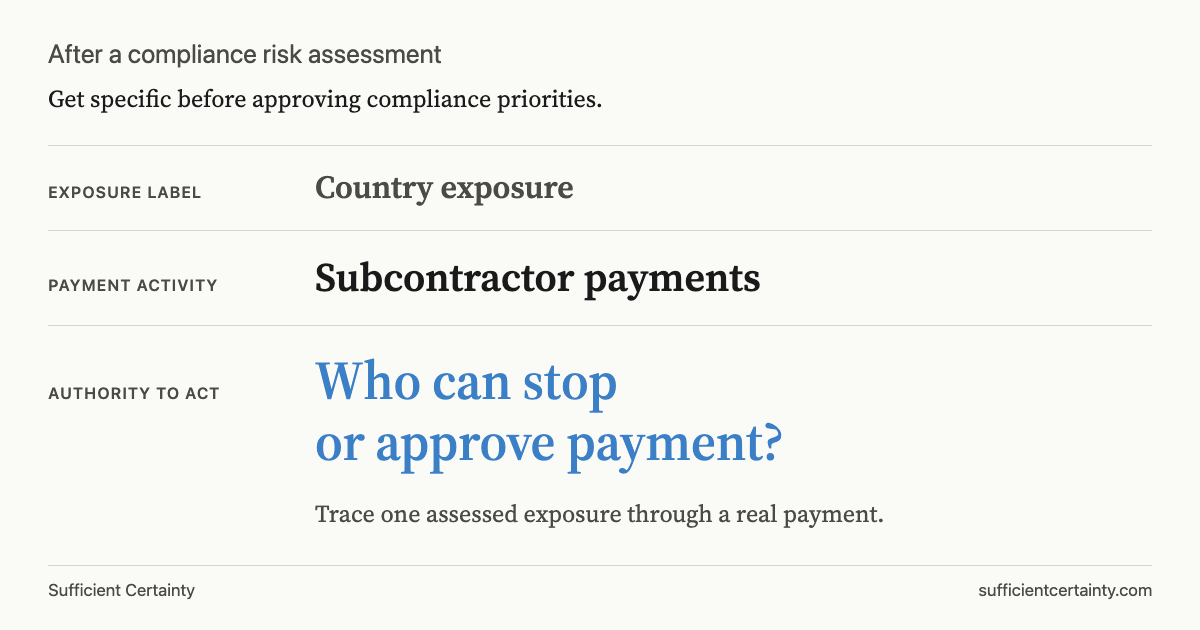
The payment route crossed the category boundaries. Geography identified where the scheme occurred. The state-owned customer identified an important relationship. Subcontractor payments described how money could reach the official. A proposed assessment needs enough detail to connect those views before managers choose the controls to fund.
The ABB South Africa plea agreement's statement of facts gives a more specific account. It describes an advance to a subcontractor that an ABB manager knew was intended partly as a bribe. The payment was recorded as an advance for services. It also describes the use of variation orders involving another subcontractor. These were mechanisms inside the commercial work, not simply a country-level description of corruption.
The reader application is a proposed comparison of assessment scope with those mechanisms. It does not establish that ABB used a particular compliance risk assessment or that a different assessment would have stopped deliberate wrongdoing. The case establishes the payment conduct. It makes the missing transaction detail consequential when evaluating a proposed compliance priority.
ABB's 2022 deferred prosecution agreement also addresses assessment context. Attachment C requires periodic risk assessment reflecting the company's circumstances, including government interactions and its geographical organization. It requires responsibility for compliance oversight at senior level, with appropriate authority and resources. These provisions describe undertakings under that agreement.
For the reader, a proposed priority called government-customer training is therefore incomplete until its coverage is clear. Ask whether it reaches staff who approve subcontractor work and variations. Ask what information those staff receive before they authorize a payment. Those are proposed assessment questions drawn from the reported mechanisms. They are not claims about a training program ABB actually selected.
The comparison can also reveal that the proposed priority already covers the route. Record that finding with the documents examined. The purpose is to establish the relevant coverage before assigning resources, rather than to assume every category-based assessment has failed.
A future duty is not a completed result. The agreement does not show that every later assessment captured the payment routes or that every assigned person could intervene. Those conclusions need later evidence. Here the decision comes earlier: whether the assessment gives managers a sound basis for approving compliance priorities.
Check the transaction route before setting compliance priorities
Choose an exposure whose proposed priority will affect the next work plan. Pull the underlying transaction records and compare them with its assessment entry. Start with the commercial activity described in the entry. Follow the payment request to the approval and record where someone can change or stop it.
Describe the act that needs control. Replace a broad entry such as overseas bribery exposure with a description of the relevant payment activity. Keep the country and customer information as context. Include any intermediary that changes who receives the benefit or what evidence reaches the approver.
Then locate the people with authority at those points. Separate the person who supplies information from the person who can require it. Separate a reviewer who advises from an approver who releases the payment. Check the current delegation and exception process before treating a job title as evidence of power.
Who can stop the payment described in this assessment?
Fund work at the relevant decision point. If the comparison reveals a gap, revise the proposed priority. That may require access to payment records or a different approval condition. It may require coordination between compliance and procurement. Give the responsible person a defined action within their authority.
This goes beyond repeating a third-party risk assessment. The issue is how the assessed business activity and its payment decisions fit together. A supplier review can support that work, but the compliance priority must cover the transaction in which the supplier participates.
Put the revised scope beside the existing risk register entry. Keep the reason for the change visible to the person approving the work plan. Otherwise, a later summary can restore the broad category and remove the detail needed to carry out the decision.
Approve a scope the owner can explain. Before signing off the priorities, ask the owner to show the transaction and intervention point. Keep any unresolved gap in the decision record. The Universal Decision-Making Method starts with framing the decision. Here that means deciding what activity the compliance work must cover before deciding how much effort each category receives.
Compliance priorities need a payment route and someone with authority to act on it.
Work through your decisionNo sign-up. Just pick your decision and start.
Grant Purdy is the co-author, with Roger Estall, of Deciding (2020), and the architect of the Universal Decision-Making Method.