
After a double materiality assessment, write one change beside each material finding that would make you review it. A completed assessment can need attention before the next reporting cycle. The useful question is which change would make its conclusions unreliable. Record that change while the evidence and reasoning remain available.
A double materiality assessment identifies significant impacts on people and the environment, and sustainability matters with significant financial effects on the organisation.
Material findings determine what needs reporting
The immediate task is to connect the findings to the information that will be reported. Under the ESRS adopted in 2023, which underpin the 2024 case below, a matter can be material from either perspective, or both. General disclosures also apply independently of the assessment result. A completed matrix therefore needs a documented route to disclosures.
For the reporting team, preserve the assessed impacts and their evidence. Keep the risks and opportunities with the reasons for the conclusions. Record the relevant locations and business relationships. Include the time horizons assessed. Separate the decision that a matter is material from the later choice of information needed to explain it. Keep the reasoning with the finding.
For management, identify the decisions that each finding affects. A water impact might affect a proposed production increase. A workforce finding might affect an outsourcing proposal. These are suggested applications, not facts about the company in the case. Name the actual decision before assigning another action plan.
A reporting deadline and an operating decision have different purposes. The report explains the assessment. The operating decision determines what the organisation will do. The distinction between governance and compliance matters here: completing the disclosures does not settle every decision that uses the findings.
Before closing the assessment project, ask its owner to identify where the supporting evidence will live. Set access arrangements for the people who will review changes. An exported slide with coloured dots is insufficient if its replacement team cannot recover the underlying judgement.
Why separate impact and financial materiality?
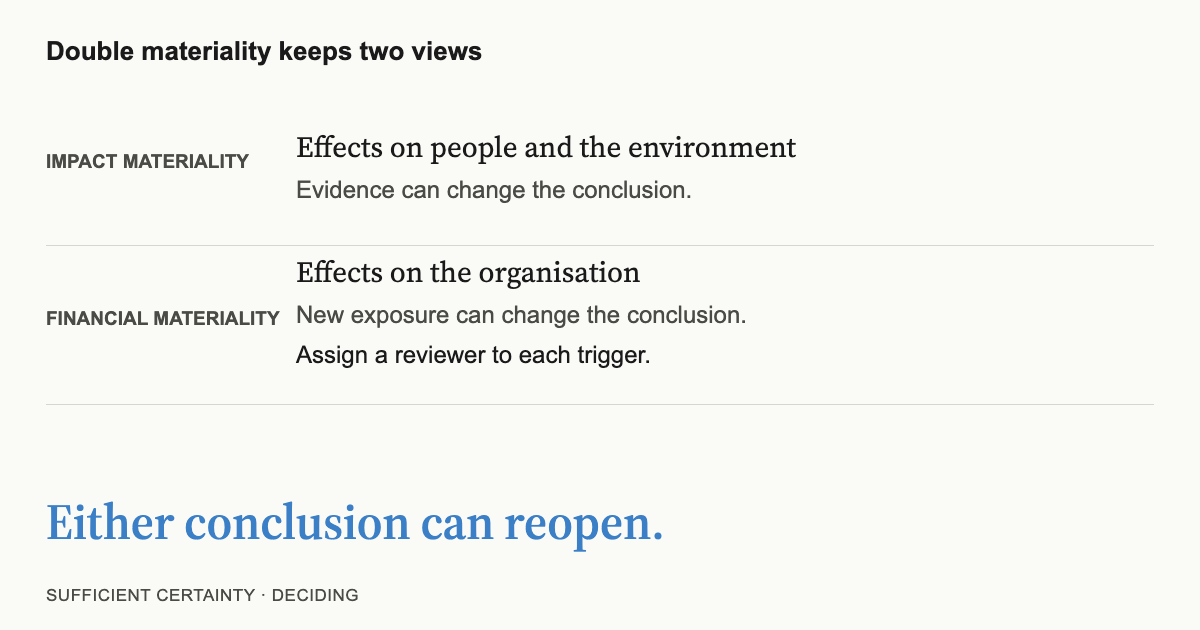
The two perspectives answer different questions. Impact materiality concerns effects on people and the environment. Financial materiality concerns effects on the organisation. The 2023 ESRS explicitly retain impacts whether or not they are financially material. Financial effects can also occur over different time horizons. An impact can remain material without immediate financial effects.
Keep two recorded conclusions rather than a single combined score. Otherwise, a financial estimate can displace the reason an impact mattered. A small expected expense is not evidence that an affected community experiences a small effect.
| Financial not material | Financial material | |
|---|---|---|
| Impact material | Report impact information | Report both perspectives |
| Impact not material | Retain evidence; monitor changes | Report financial informationCheck for changing impacts |
This is a simple illustration of the two perspectives, not a replacement scoring method. Its lower-left cell also needs attention. Evidence supporting a non-material conclusion can expire. Keep excluded findings reviewable. Preserve enough detail to explain what was considered and what could alter that conclusion.
Apply the same separation when choosing responses. An impact can justify attention without a demonstrated business return. The person responsible for a response still needs authority to act. Clarify accountability and ownership before giving that person a deadline or asking for progress.
Which change would make a materiality finding need review before the next reporting date? Start the Walk →
An annual review can miss a change between reports
An annual calendar creates a reliable date for review. It does not show when a supplier or location changes. Changes in activity also need attention. A conclusion can become less reliable while its reporting status remains unchanged. Monitor the conditions behind the conclusion.
EFRAG's May 2024 implementation guidance describes the assessment as a dynamic process. Its examples of changes include acquisitions, significant supplier changes, new markets and new scientific evidence. The guidance allows focused annual updates where appropriate. It also says updates need ongoing consideration. This is non-authoritative guidance for the 2023 standards, not a statement of every current reporting obligation.
The following monitoring approach is proposed for the reader. Start with one material finding and identify the evidence that most affects its conclusion. Ask who could observe a change in that evidence through existing work. Procurement might notice a different production location. A site team might receive revised information about local water availability.
The trigger should state the observable event and the review it starts. “Watch supplier sustainability” is too broad. “Review the affected finding before approving a change of production location” gives the person a defined task. A trigger starts a review. It does not automatically change the materiality conclusion.
Use existing change notices, complaints, operational records and expert updates where they provide relevant evidence. Do not create a new dashboard merely to count signals. Monitoring decisions requires someone to interpret a signal and respond. A mailbox without an assigned reviewer cannot provide that response.
For findings close to a threshold, record which evidence is uncertain. Choose a review interval that matches the likely pace of change. Fast-changing conditions can need checks between annual reviews. Stable conditions may need fewer checks, provided the responsible person can still detect a significant event.
BASF recorded an assessment across its value chain
BASF's 2024 double materiality assessment provides a documented example. It assessed matters at Group level across its value chain. It considered stakeholder interests through direct and indirect input. Experts reviewed the assessment, and the company informed its governing bodies about the process and results.
BASF reported that its first assessment in accordance with ESRS increased detail and documentation compared with earlier assessments. It planned annual updates. Its results recorded impacts with their time horizons and value-chain locations. The company then allocated relevant disclosure requirements and data points. This was an assessment and reporting process, not evidence of a failed response.
The separate 2024 water chapter shows why evidence updates matter. BASF used Aqueduct 4.0 to identify water-stress sites. Including those sites increased the number covered by its water-management target. The reported implementation status for 2023 was consequently adjusted downwards. The company said the sites relevant to the target were reevaluated each year.
Changed coverage can change reported progress. The documented change concerns a water target's coverage and comparison. It does not establish that BASF changed a materiality judgement or missed a warning. Keep that limit clear when using the case.
A proposed application follows: when updated environmental evidence adds a location to a concern, review the findings and decisions connected to that location. Check whether the assessment boundary or impact evidence needs revision. Review the response too. An environmental management review after an ISO 14001 audit can supply relevant evidence, but the materiality conclusion still needs its own reasoning.
For a reader applying this approach, retain the old boundary as well as the revised one. Explain which locations were added and why. Then check the decisions attached to those locations. This preserves a usable comparison instead of treating every change in reported progress as a change in performance.
Give each material finding a reason to reopen
Use a small review register beside the completed assessment. For each relevant finding, record its impact and financial conclusions, supporting evidence, review trigger, responsible person and next review date. Include important non-material conclusions where a foreseeable change could alter them. Reopen the affected finding first.
- Material impacts; related risks and opportunities
- Evidence and assessment conclusions
- Changes that reopen a finding
- People responsible for reviewing signals
- Decisions affected by changed evidence
- Responses agreed before the next report
Apply the Universal Decision-Making Method to a specific decision affected by the assessment:
- Frame: state the intended outcome and who is affected.
- Tentative Elements: identify a feasible response and alternatives.
- Assumptions: name the conditions supporting the response.
- Sufficient Certainty: decide what evidence is enough to act.
- Implement+Monitor: assign actions and conditions for reconsideration.
When a trigger occurs, record the new evidence and review both perspectives. Decide whether the conclusion or response needs changing. Check the disclosure separately. Record reasons when no change is needed. Preserve the impact perspective throughout. A response review must not turn into a financial-only assessment.
Before signing off the register, test one trigger with the assigned reviewer. Present a sample change notice and ask which finding it affects. Check that the reviewer can locate the evidence and reach the person authorised to act. If that route is unclear, correct it before closing the assessment. This exercise tests the review arrangements without pretending the underlying assessment has changed.
This makes the assessment useful within organisational governance. The organisation retains a reporting record and a practical way to revisit decisions when their conditions change.
How confident are you that both materiality perspectives will receive attention when the evidence changes?
Work through your decisionNo sign-up. Just pick your decision and start.
Grant Purdy is the co-author, with Roger Estall, of Deciding (2020), and the architect of the Universal Decision-Making Method.